Lecture 2 - Presentation of Financial Statements
 Call Kai
 Learn
Learn Practice Test
 Spaced Repetition
 Match
Match Flashcards
 Knowt Play
1/20

There's no tags or description
Looks like no tags are added yet.
Name | Mastery | Learn | Test | Matching | Spaced | Call with Kai | Chat |
|---|
No analytics yet
Send a link to your students to track their progress
21 Terms
When would you debit and credit an asset and liability?

What financial statements are assets, liabilities, capital, revenue and expenditure found on and when do you debit and credit each of them?

What is the acronym to remember what do debit and credit?


What do you debit and credit for each of these transactions?

How do you get from the transaction to preparing the financial statements (what are the steps)?

What is a ledger account?
A detailed record tracking all the transactions of a specific category, such as cash, inventory, accounts payables, etc.
Each item in IS & SOFP will have a ledger account
All accounts are collected in the ledger
Eg. Shareholders invest £6,000 into the company (share purchase at nominal value of shares). What are the ledger and journal entries for this transaction?

Eg. A company purchases goods on credit for £400. What are the journal and ledger entries for this transaction?

How do you go from the trial balance (TB) to the financial statements?
List all the balances on each of the accounts in the accounting system
Assets and expenses have debit balances, and liabilities and income have credit balances
Total debits = total credits
If the TB doesn’t balance, check for errors
Prepare the financial statements from the TB
Draw up the Pro-forma financial statements
Insert the balances from the TB
P&L
Calculate the year’s profit/loss and then close the accounts and transfer the result to retained earnings
SOFP
Balances not transferred out
Amounts carried forward to next financial year

Construct a trial balance from these balances

Why do we make year-end adjustments?
Are required to ensure financial statements give a true and fair view
Matching: Ensure all costs of generating revenue are matched to the revenue of the period
Depreciation - recognise cost of using asset
Accrual - record any goods or services used but not yet recorded/paid for
Prepayments - adjust for any payments made for goods or services not yet used
Recoverable amounts: Reduce assets to the maximum cash that will be recorded
Bad debts, obsolete or damaged inventory
What are the different financial statements?
Statement of financial position (aka balance sheet) - assets, liabilities and equity
Statement of profit or loss (aka income statement) - income and expenses, gains and losses
Statement of changes in equity - contributions in (equity) and distributions out (dividends)
Statement of cash flows
What is the layout of the income statement and balance sheet?
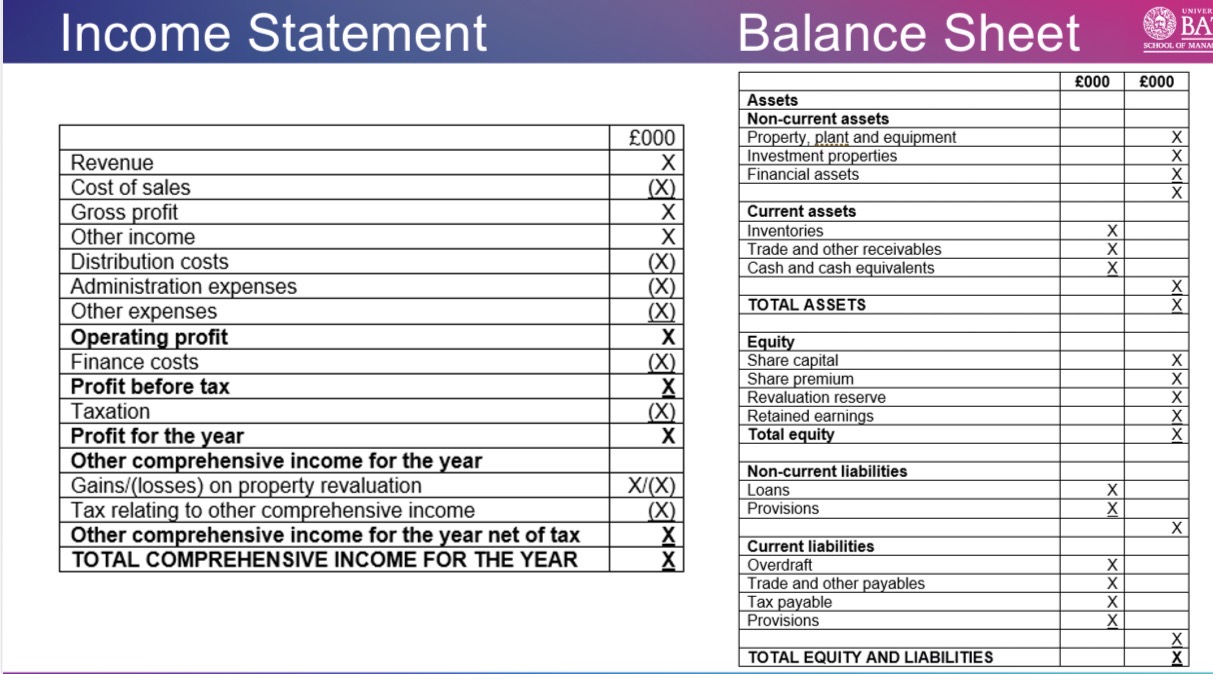
What does the statement of changes of equity show?
Shows how each component of equity has been changed in the year
Equity b/f +/- movements in year = Equity c/f
Components of equity:
Share capital - part of the capital of a company that comes from the issue of shares
Share premium
Retained earnings
Other reserves
Share capital is number of shares issued x nominal value
Share proceeds is number of shares issued x market value (this comes into the company as cash)
What do the SOFP and SOPL show?
SOFP (aka balance sheet): Shows what a business is worth at a specific point in time - uses ‘as at 31/12/20XX’
Income Statement (aka SOPL): Shows the business’ trading activities over a period of time - uses ‘for the year ended 31/12/20XX’


How do you know if an element appears on the financial statements?
An item must appear on the financial statements if and only if it:
Has a probable flow of economic benefit
Can be reliably measured
What are features and the importance of financial statements?
Prepared by managers
Approved by board of directors
Addressed to shareholders
Communicate information about the performance and position of the company to owners of the company
Enable shareholders to judge stewardship of managers (historic) but also to assess prospects (future)
What is the sequence of approval for financial statements?
Directors are responsible for:
Keeping appropriate accounting records
Selecting appropriate accounting policies
Making reasonable estimates
Independent external audit will provide an opinion on the truth and fairness of the financial statements prepared to provide assurance to investors
The financial statements are presented to shareholders at the annual general meeting (AGM)
The shareholders approve the financial statements
The financial statements are published
What are the general IAS 1 requirements for financial statements?
Financial statements must be clearly identified as such:
The name of the reporting entity
The period for which the information is provided
The presentation currency used
The level of rounding used (£000 or £m)
What are disclosure notes?
Disclosure requirements given in standards, law and stock exchange requirements
Additional information accompanying the financial statements that explains and provides more detail about the figures and transactions
Note 1 – Accounting policies: Explains the accounting methods and principles used to prepare the financial statements