Forensics Science olympiad: Fingerprinting
 Call Kai
 Learn
Learn Practice Test
 Spaced Repetition
 Match
Match Flashcards
 Knowt Play
1/20

There's no tags or description
Looks like no tags are added yet.
Name | Mastery | Learn | Test | Matching | Spaced | Call with Kai | Chat |
|---|
No analytics yet
Send a link to your students to track their progress
21 Terms
Plain Arch
ridges enter on one side and exit on the other side

Tented Arch
similar to the plain arch, but has a sharper edge in the center.

Ulnar Loop
A loop that opens toward the pinky (picture is of the right hand)

Radial Loop
A loop that opens toward the thumb (picture is of the right hand)

Plain Whorl
a ring shaped design resembling a swirl or circle, pattern is round and continuous and is the consequense of at least one ridge.

Central Pocket Whorl
Central ridges will curve multiple times to create a smaller intter whorl.

Double Loop Whorl
Consists of two separate loop formations with two separate and distinct sets of shoulders and two deltas
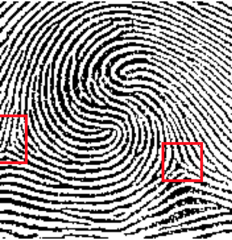
Accidental Whorl
A mix of different patterns. Cannot be classified as any other pattern.

Bifurcation
Where a ridge splits and becomes two separate ridges.

Ridges
The raised skin on fingers that creates the print

Island
A ridge that is not connected to all other ridges

Enclosure
A ridge that splits into two and then back into one, leaving a bubble like or eye shaped loop

Loop
a pattern where one or more ridges enter from one side, recurve, and exit on the same side from which they entered

Spur
A short ridge that branches off into a longer ridge, resembling a hook or spur
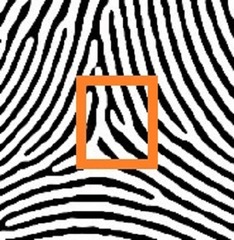
Trifurication
a point in a fingerprint where a single friction ridge divides into three separate ridges.

Delta
a triangular, three-pronged or funnel-shaped area where ridge lines diverge

Double Bifurcation
a fingerprint feature where a single ridge splits into two, and then one of those branches splits again
Fingerprint dusting
develop latent, or invisible, fingerprints on non-porous surfaces by gently brushing them with a fine powder. The powder adheres to the natural moisture and oils left by the finger, making the print visible for collection, often with clear tape
Iodine fuming
develop latent fingerprints by using iodine vapor to react with the oils and sweat left behind by a finger. The process is temporary and must be followed by immediate photography to preserve the print, as the brown color will fade over time. The developed prints can be made more permanent by applying a chemical fixer, such as a starch solution
Nynhydrin
a chemical method used by forensic investigators to visualize latent fingerprints on porous surfaces, primarily paper and cardboard. It works by reacting with the amino acids present in fingerprint residue to produce a distinct, high-contrast purple color called Ruhemann's purple
cyanocrylate fuming
to develop latent fingerprints on non-porous surfaces. It involves heating liquid cyanoacrylate (super glue) inside a sealed chamber to produce fumes, which then polymerize onto the sweat, oils, and amino acids in a fingerprint, forming a stable, whitish print. This technique is a non-destructive process that creates a stable, enhanced fingerprint, which can then be further improved with powders or dyes, or lifted for analysis