linguistic 1010 exam 3
 Call Kai
 Learn
 Practice Test
 Spaced Repetition
 Match
 Flashcards
 Knowt Play
1/163

There's no tags or description
Looks like no tags are added yet.
164 Terms
mind
is an abstract faculty that manifests itself in mental phenomena such as perception, thinking sensation, reasoning, memory, language, …
analyzable into component parts or functions
human brain
is a physical object, the central organ of the human nervous system
functional localization
There is converging evidence from several sources that the different functions of the mind can be localized in different parts of the brain
evidence for these different functional areas of the brain come from
• Brain lesions (from disease or injury) and their effects on cognition and behavior
• Different types of cells and layering in different brain regions
• Functional imaging of the brain in action
Before we had sophisticated tools for studying anatomy of the brain, our main evidence for the localization of functions in different parts of the brain came from studies of brain pathology and its effects on behavior.
• Studies of this kind really took off in the mid-19th century as psychologists began to use methods of science to hypothesize about how the brain gave rise to our thoughts and our selves.
• There was a sequence of famous patients that stimulated this debate, including Phineas Gage.
Phineas Gage
suffered a severe head injury in 1848 while working
in railroad construction.
• An accidental explosion shot a 13 lb iron rod in through his left cheek and out through the top of his skull.
• Remarkably, after the accident, he made an almost full recovery and lived a relatively normal life for another 12 years
Gage’s personality was reported to have changed from responsible and courteous to impetuous and blunt, even rude.
• Even so, Gage remained able to work and carry out complex tasks (coach driving).
• Working from his preserved skull, scientist believe the rod pierced Gage’s left frontal lobe.
• This suggested that this part of the brain governs impulse control (an idea supported by modern research.)
Henry Molaison
suffered a head injury in a bicycle accident as a small child, which caused increasingly severe seizures.
• To save his life from the effects of the seizures, doctors removed several parts of his brain in 1953, including the hippocampus (in blue at right).
• As a consequence of this surgery, suffered from anterograde amnesia. This means he could not form new long-term episodic memories. (In contrast to retrograde amnesia: forgetting one’s past).
was studied extensively from the time of his surgery. Until his death, he was known as HM in the medical literature for privacy reasons.
• Much of what we know about the biological basis of memory derives from the original study of HM.
• HM could form short-term memories (live for 15-20s) and acquire new skills, suggesting that different parts of the brain underlie these abilities.
conclusion of case studies
Brain trauma is an important source of information about the connection between cognition and brain anatomy.
• Injuries to different areas cause different kinds of impairments to memory, personality, etc. This suggests that the mind can be analyzed into different components associated with different regions of the brain.
• The brain has some ability to recover from injury within limits. It appears that one region suffers trauma, other areas can take over the functions of that region to some extent. This resilient feature of the brain is referred to as plasticity.
cerebellum
coordinations
control of voluntary movement
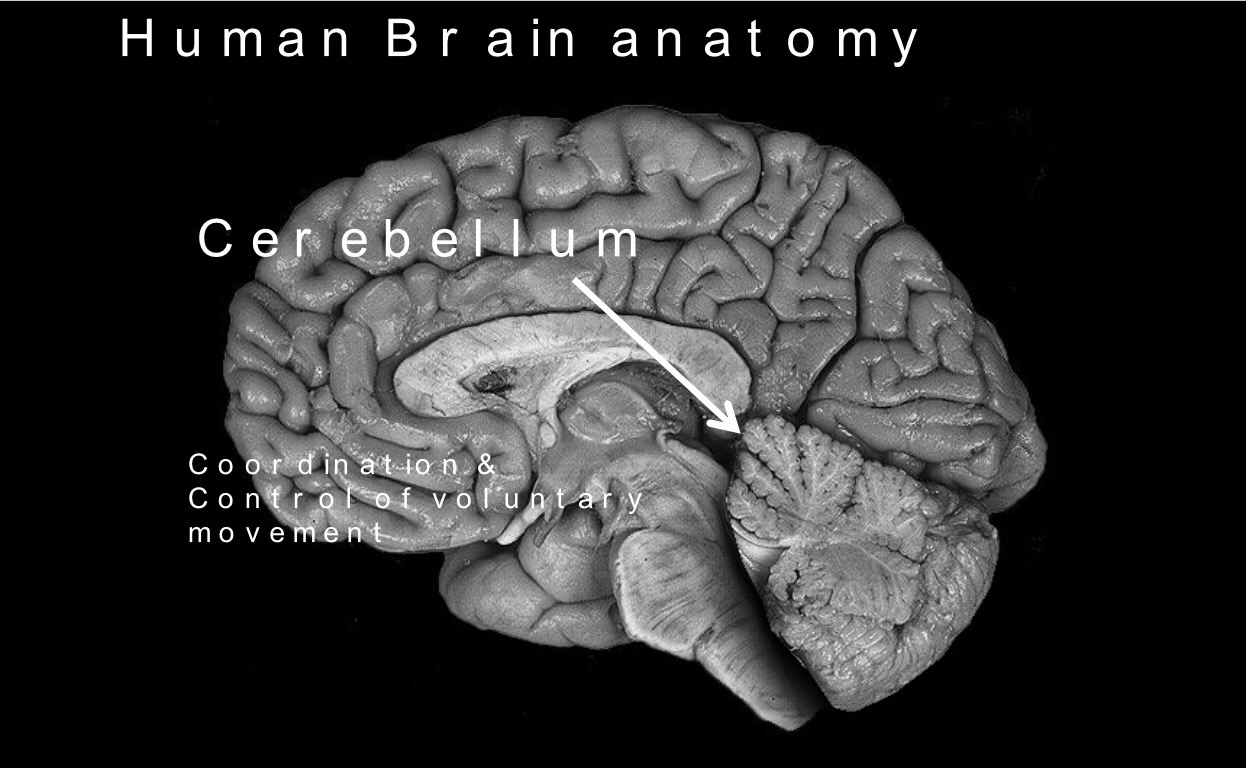
brain stem
breathing, heartbeat, blood pressure

thalamus
relay for sensory information

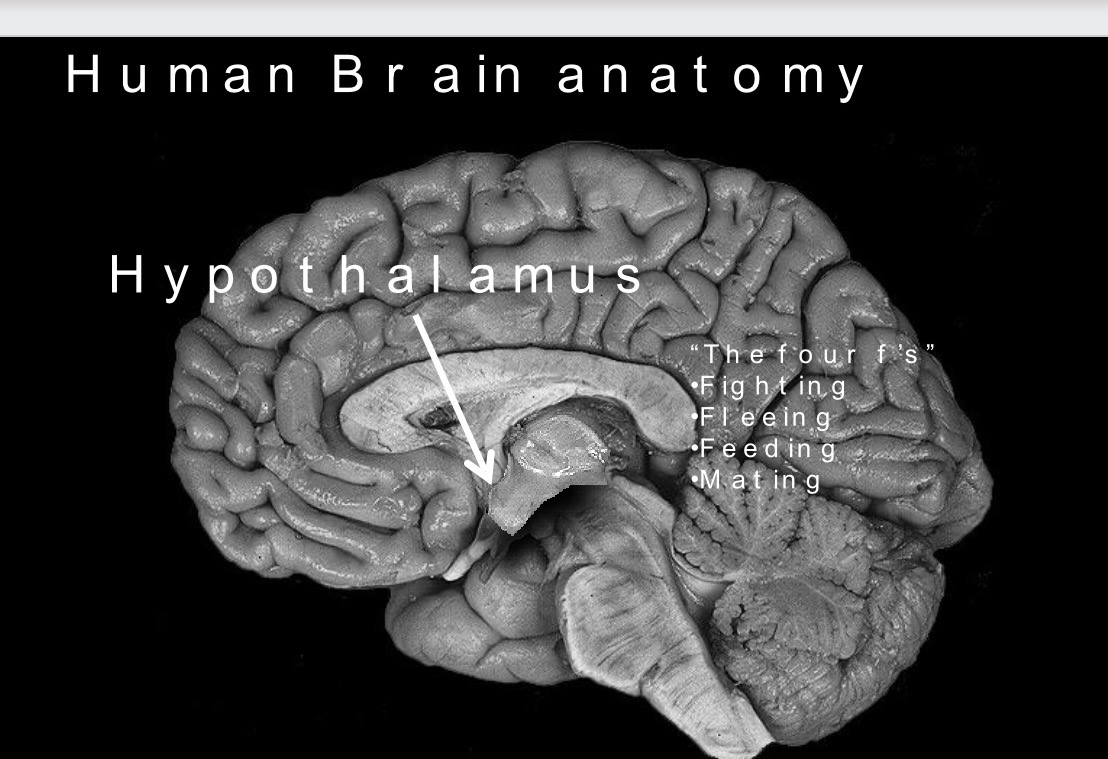
hypothalamus
the four Fs
fighting
feeding
fleeing
mating
picture of cerebrum

cerebral cortex
cortex is the surface of the brain, also known as gray matter
In latin "cortex" means tree bark
This is where information computation happens
summary of class on brain
Functional localization in the brain
• Case studies from brain lesions (early days)
• Cytoarchitecture (Brodmann areas)
• Parts of the brain:
cerebrum, cerebellum, brain stem, thalamus, hypothalamus
• Cerebral cortex (information processing) on the four parts of the cerebrum:
• Frontal lobe
• Parietal lobe
• Temporal lobe
• Occipital lobe
• Motor cortex and somatosensory cortex (somatotopic arrangement)
sulcus
a furrow (valley) of the cerebral cortex
Plural form is sulci, also called a fissure, especially for the major sulci
fissure
another name for sulcus

frontal lobe
emotions, decision making, planning
parietal lobe
bodily sensation, sensory integration, spatial orientation
occipital lobe
vision
temporal lobe
auditory perception, memory, and emotion
Converging evidence for differentiation of brain regions comes from the study of
cytoarchitecture.
• This refers to differences in composition, connection and layering of neurons in different areas of the brain.
Korbinian Brodmann (1868-1918) published a landmark study in 1909 identifying 52 distinct areas of the cerebral cortex on the basis of cytoarchitecture.
Those 52 areas are now referred to as Brodmann Areas.
• Subsequent research has associated many of these areas with distinct cognitive functions
The area of the brain that processes auditory information is referred to as the
primary auditory cortex.
is found in the superior portion of the temporal lobe and is identified as Brodmann Area 41 and 42.
• It is located interior to the Sylvian (lateral ) fissure on a structure called Heschl’s gyrus.
somatosensory cortex (areas 1,2 and 3)
the most anterior portion of the parietal lobe, and lies along the central sulcus
primary receptive area for tactile sensation in the body
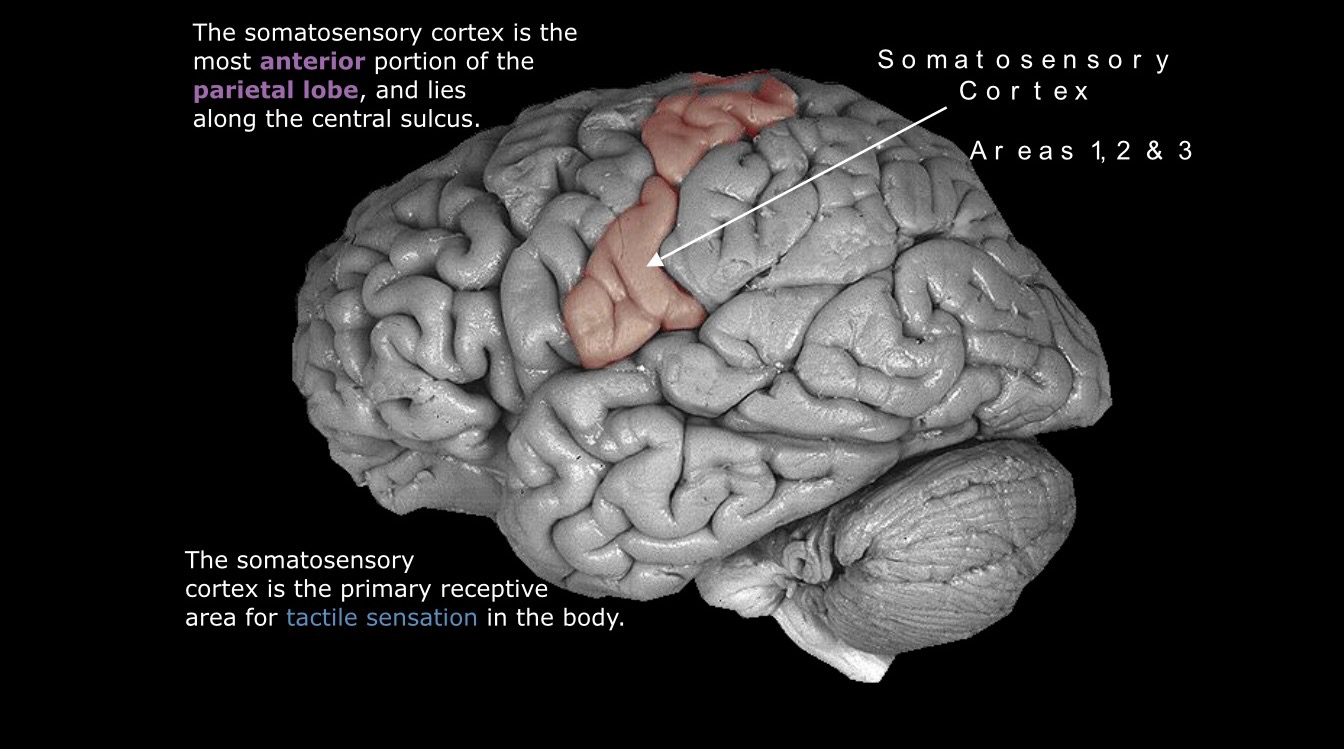
somatosensory cortex (area 4 frontal lobe)
motor cortex
as the name suggests, the (primary) motor cortex is an area that is directly responsible for body movement
the somatosensory cortex and the motor cortex are both arranged somatopically
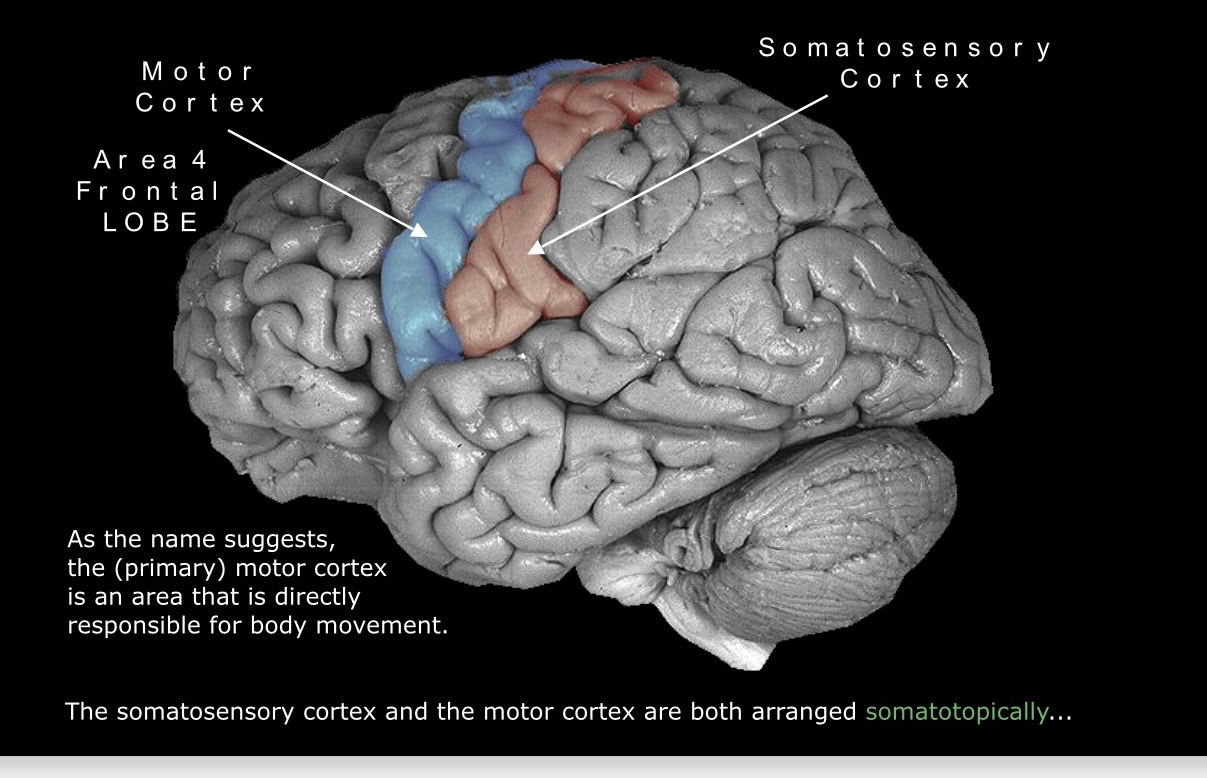
To show somatotopical arrangement
use frontal plane
the primary visual cortex is located in the
occipital lobe

the temporal and parietal lobes are also involved in
visual processing: for identification of objects (what) and location of objects (where)
somatopic arrangement
Different regions of these cortices are devoted to sensation in (sensory) or control of (motor) different parts of the body
Larger regions represents more fine gained sensation or controlr

recap of brain
Recap: Introduction to the brain
Functional localization: different functions of the mind can be localized in different parts of the brain
• Case studies from brain lesions (early days)
• Cytoarchitecture (Brodmann areas)
• Parts of the brain:
Cerebrum, cerebellum, brain stem, thalamus, hypothalamus
• Cerebral cortex (information processing) on the four parts of the cerebrum:
• Frontal lobe
• Parietal lobe
• Temporal lobe
• Occipital lobe
• Motor cortex and somatosensory cortex (somatotopic arrangement)
• Plasticity: the brain’s ability to reorganize and adapt after damage
gyrus
a ridge of the cerebral cortex. Plural: gyri. Also called a convolution.
sulcus
a furrow (valley) of the cerebral cortex. Plural: sulci. Also called a fissure, especially for the major sulci.
central sulcus
separates the frontal and parietal lobes

lateral or sylvan fissure
separates the temporal lobe from the frontal lobe and parietal lobes
naming gyri and sulci
Relative directions and lobes are used to name gyri and sulci:
Directions
superior
medial
inferior
anterior
posterior
Lobes
frontal
temporal
parietal
occipital

lateralization of language
the cerebrum is organized into two hemispheres
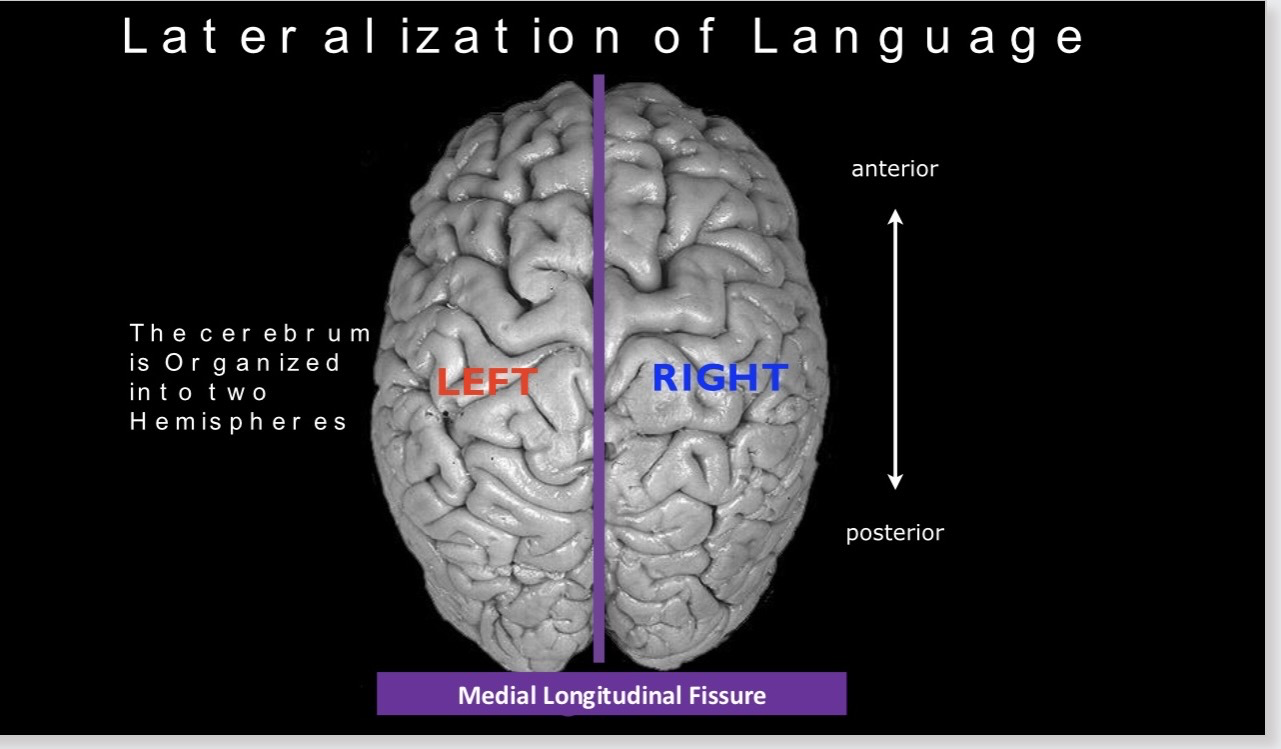
in 95% of right handed people
language function is lateralized in the left hemisphere
among left handed people language function is more symmetrical
aphasia
is the medical term for the inability (or impaired ability) to understand or produce speech as a result of a brain disease or damage.
• Different linguistic impairments have been found to correspond to differences in what areas in the brain are affected. This suggests that different areas of the brain are associated with different linguistic capacities.
left inferior frontal gyrus (IIFG)
Broca’s area
Posterior superior temporal gyrus (pSTG)
Wernicke’s area

brains involved in language

syntax and morphology
Broca’s area
Phonology
Wernicke’s area
temporal lobe
morphology/ lexicon
broca’s aphasia background
• Pierre Paul Broca (1824-1880) was a French physician who studied two cases that led him to the idea that brain function is localized.
• One patient, Leborgne (Tan), produced only the syllable ‘tan’. Another, Lelong, only produced the French words for yes, no, always, three and ‘Lelo’.
• After their deaths, Broca discovered that they both had brain lesions in the same area, the Left inferior Frontal Gyrus (lIFG), which we now refer to as Broca’s Area
broca’s area has been analyzed as
an impairment of structure building in syntax and morphology
broca’s aphasia characterized by two deficits
1. Production is impaired and non-fluent. The individual’s speech typically lacks function words (auxiliaries, determiners,…) and inflectional affixes.
2. Comprehension is poor for syntactically complex sentences. In SVO languages like English, any divergence from basic SVO order can confuse the individual.
example of broca’s area aphasias
RC (two years after his stroke): “Um water um man, no, woman um child [pointing to the boy] no man, boy, and girl um um boo um plate [pointing to the plate] cupboard um oh cup and … cup, shoes … socks …
Examiner: “Can you tell me what you think is happening?”
RC: “Oh yes um yes no cha tap … no”
AL : “Well its a place and its a girl and a boy … and they’ve got obviously something which is is made made made well its just beginning to go and be rather unpleasant (ha!ha!) um and this is in the this is the the woman and she’s putting some stuff and the its its that’s being really too big to do and nobody seems to have got
anything there at all all all and er its … I’m rather surprised that there you are this this er this stuff this is coming they were both being one and another er um um I suppose the idea is that er two people should be fairly good but I think its going to go somewhere and as I say its down again … let’s see what else has gone er the the
this is just I don’t know how she di’ how they did this but it must have been fairly hard when they did it and er I think there isn’t very much there I think.”
where is broca’s area aphasia
left inferior frontal gyrus
werenicke’s aphasia background
Carl Wernicke (1848-1905) was a German physician inspired by Broca to study language disorders.
• Wernicke encountered several patients with language impairments with different symptoms from Broca’s patients.
• Like Broca, he autopsied these patients’ brains after their deaths to see what pathology caused the symptoms.
• Wernicke found that his patients had damage in the Posterior Superior Temporal Gyrus (pSTG), now called Wernicke’s area.
symptoms of wernicke’s area
1. Patients are often able to produce grammatical sentences, but these sentences make no sense. It appears that the words selected are not the intended ones. In fact, the sentences often include invented (nonsense) words.
2. Comprehension is totally impaired. They simply cannot understand what is said to them.
• This has been analyzed as an impairment of phonological speech processing: the ability to map sounds to meaning (comprehension) is disrupted. This regards also the monitoring of one’s own speech.
anomia
is a disorder that involves an inability to find the words for certain (kinds of) objects. The term a+nomia means “no+names”.
• Unlike Wernicke’s aphasia, patients are able to understand what is spoken to them.
• They also succeed in word repetition tasks.
tends to result from various lesion sites in the temporal lobe.
anomia experiment
This suggests to researchers that entries in the mental lexicon are localized at different points throughout the temporal lobe.
• Corina et al. (2010) implanted electrodes in patients’ brains before
surgery to treat epilepsy. To locate ’’essential language areas’’ for preservation, they induced temporary anomia by activating these electrodes. The most difficulties with naming were associated with middle and posterior medial temporal gyrus (mMTG, pMTG)
category specific anomia
Patients with anomic aphasia often show difficulty with naming objects throughout a particular class of objects.
• Ferreira et al. 1998 studied three patients who show more trouble
with animals than tools.
• Cappa et al. 1997 studied patients who show more trouble with tools than animals.
• This suggests that we may store lexical items for animate objects in different
locations than lexical items for inanimate objects.
MRI
is a brain imaging technique that allows us to measure the the location and density of a given element in the body.
structural MRI
measures the location and density of hydrogen to create an image of the anatomical structures inside the body, including the brain, reveals very fine-grained details.
gives a static detailed picture
functional MRI
shows us which parts of the brain are active during the performance of a cognitive task. It measures changes in blood flow and oxygen-levels.
gives a dynamic picture of the brain in action with less anatomical detail
conclusion of language and brain
Studies of brain trauma and brain imaging provide converging evidence that language abilities are localized in certain areas of the brain.
• Structure building of syntax and morphology appears to be localized in Broca’s area the left inferior frontal gyrus (lIFG).
• Phonological speech processing appears to be localized in Wernicke’s area, the posterior superior temporal gyrus (pSTG) .
• The mental lexicon appears to be distributed in the temporal lobe and is possibly localized by category.
reminder of brain and brain and language
Functional localization: different functions of the mind can be localized in different parts
of the brain
• Case studies from brain lesions (early days)
• Cytoarchitecture (Brodmann areas)
• Parts of the brain
• Cerebrum, cerebellum, brain stem, thalamus, hypothalamus
• Cerebral cortex (information processing) on the four parts of the cerebrum:
• Frontal, parietal, temporal, and occipital lobe
• Motor cortex and somatosensory cortex (somatotopic arrangement)
• Brain areas involved in language and evidence for the localization of linguistic functions:
• Evidence: lesions and MRI (static and functional)
• Dominant hemisphere (typically left for right-handed people)
• Broca’s area, inferior frontal gyrus (IFG): structure building in syntax and morphology (evidence: Broca’s aphasia)
• Wernicke’s area, posterior superior temporal gyrus (pSTG): phonological processing (form-meaning- map), (evidence: Wernicke’s aphasia)
• Temporal lobe: mental lexicon, possibly localized by semantic category (evidence: anomia)
critical period for language acquisition
In this class, we will argue that there is a span of their lifetime during which humans must acquire a first language or risk being unable to acquire full competence in any language.
• Such a window of opportunity is called a critical period.
• Critical periods are typical of domain-specific aspects of the mind.
• We will see evidence that critical periods exist in the development of many animals.
• We will link critical periods with plasticity.
• We will see evidence for the critical period of language acquisition from cases of children denied early exposure to language
critical periods
is a stage in the development of an organism during which it must receive the right kind of input in order to acquire a specific function.
have been intensively studied and well-documented in the development of primary sensory areas of the brain (e.g., vision, hearing).
• We know the most about sensory critical periods in animals. Our knowledge of human sensory critical periods is less precise, since controlled studies cannot be carried out.
cat vision
David Hubel and Torsten Wiesel won a Nobel Prize in medicine/physiology for their research mapping the functional structure and development of the visual cortex in cats.
• In 1963, they published a series of papers demonstrating critical periods
for different aspects of feline vision.
• They manipulated the visual inputs kittens received by sewing eyes shut or clouding vision with translucent covers.
They later repaired these impairments and measured the kittens’ visual abilities and recorded activity in their visual cortex.
• If the kitten was deprived of input between 4 weeks and 4 months, the kittens’ binocular vision did not recover. H&W showed that the visual cortex rearranged itself during deprivation and could not change back.
• If the deprivation occurred after 4 months, there was no effect on vision later (after restoring vision).
• Cat vision critical period: 4 wks - 4mos
humans vision
Monkeys (macaques) and humans have also been found to have a critical period for binocular vision. In humans, it is roughly between 4 months and 20 months.
From this we have learned that it is crucial to correct vision problems is children as early as possible. This includes conditions likecataracts (that cloud vision) and strabismus (crossed eyes that interfere with binocular vision).
song birds
Some birds’ songs are innate and require no learning. Other birds need proper input from the environment to develop their species’ songs.
Furthermore, it has been shown that songbirds such as the zebra finch have a critical period for input in their species’ songs.
Deprivation or delayed exposure causes disruptions that differ by species.
critical period for language
Beginning with Lenneberg 1970, researchers have gathered evidence that there is a critical period for language acquisition.
• Without linguistic input in childhood, eventual language development is significantly impaired.
• Cases of delayed first language that have been studied:
• Feral children (US: Genie, Isabelle)
• Some deaf children
plasticity
When we studied the brain, we noted that sometimes brains recover function after injury. Often an uninjured part of the brain will take over the function of an injured part.
• Alternatively, if a part of the brain is not used for its usual function, that part of the brain will be recruited for another function. The cat vision experiments are an example of this, since the visual cortex does not receive its usual input.
• Together these two potential reorganizations of the brain are called brain plasticity.
There is an important connection between plasticity and critical periods. Critical periods tend to occur early in the lifespan of an organism. There is evidence that plasticity is also greatest early in development.
• For example, it is well known that children are able to recover from brain injuries (trauma or seizures) much more quickly and much more fully than full grown adults. (Aram 1998)
• This is likely due to children’s greater brain plasticity.
genie
Genie was a child who was discovered in Los Angeles in 1970, severely abused and neglected.
She was kept in isolation and denied language input until age 13.
A team of doctors, linguists and psychologists worked to help her recover after her discovery.
She was never able to reach full linguistic competence. At age 17, she had the vocabulary of a five-year old and could combine words but not following English syntax. She never progressed further.
Mama wash hair in sink.; Like go ride yellow school bus.; Man motorcycle have. ; Father hit Genie cry long time.
Isabelle
Isabelle was born in 1932 as the illegitimate daughter of a deaf and mute woman. Afraid of the stigma, her mother’s parents hid them away together in isolation.
• Isabelle and her mother escaped in 1938 when Isabelle was six.
• At that time, she had no language.
• Unlike Genie, Isabelle recovered quickly. By age 9, she had a large vocabulary, formed complex sentences and showed an IQ in the normal range.
genie/ Isabelle
It can be hard to draw conclusions from isolated, unique cases such as these. Genie’s isolation was more substantial, and she suffered from many deficits beyond language.
• However, this pair of cases is suggestive. Isabelle likely succeeded in language acquisition, and Genie failed, because Isabelle was still within the critical period when she received first language exposure, and Genie was not.
• This suggests that 13 years old is too late to acquire a first language, but 6 years old is not.
deaf children
The vast majority of deaf children are born to hearing parents. Hearing parents may not realize their children are deaf for some time. If they do realize, they may not know how to support their development.
• As a result, some deaf children are exposed to sign language, and some are not.
• Among those not exposed to sign, some are able to succeed with oral language.
• Many however do not succeed and consequently:
• Can’t access oral language
• Aren’t exposed to sign language for some years
• Begin exposure to sign language in later childhood
Late learners can learn individual words and basic combinations of signs.
• They are able to use sign language for everyday communication.
• But they do show some effects of late exposure. For example, they never master the finer details of complex morphology or sign formation.
• Deaf late learners also struggle to acquire (written) English as a second language.
• Difficulty is greater than for second language learners with strong first language. Problems especially with complex syntax, morphology
deaf late learners
Comparing children who were born deaf (ASL is first language) with children who lost hearing in later childhood (ASL = second language).

conclusion for critical period for language acquisition
Evidence from delayed acquisition of a first language and from second language acquisition suggests that human language acquisition is subject to a critical period.
• It appears that the window for full acquisition begins to close around age 8 and is fully shut by the end of puberty.
• Critical periods in development are well documented in other animals.
• Critical periods appear to partially coincide with ages of greatest plasticity.
second language acquisition
Many people who acquire a first language acquire a second language later in life. This is common among people who immigrate.
• Johnson and Newport (1989) studied the English ability of people who immigrated to the US who arrived in the country at different ages.
• They made sure that every person in the study had the same amount of exposure to English, the same motivation to learn English, and the same amount of instruction in English.
• So, the only thing that varied was how old they were when they first started learning English.
They found a steady decrease in success starting around age 8, followed by no effect of age after age 16.
This looks like an effect of a critical period

no shared language
What happens when there is no single language available to the
community? (Different languages spoken by everyone, including
family members.)
• Finding: in such circumstances, children’s acquisition of language is
crucially guided by Universal Grammar.
• Another case of development of language in children under some
exceptional circumstances.
what are the three types of linguistic solution?
Lingua Franca
• Pidgin
• Creole
lingua franca
What solutions do adults adopt when wanting to communicate while not speaking a shared language?
• Medieval Europe: Classical Latin (a dead language) was adopted as a common language for communication within the church, between states, and between scholars.
• When a language is selected that may not be the native language of either individual needing to communicate, that language is commonly called a lingua franca.
• English plays a similar role today in international aviation, for example
pidgin
Selecting (a modified version of) one language as a lingua franca
usually requires a central authority (medieval Europe: the church) and
access to instruction in that language for everyone who needs to
communicate.
• Where these conditions are not met, if a group of adult speakers have
no common language but need to associate and communicate
frequently over a long period of time, a communication system often
develops organically.
• Such a system is referred to as a pidgin.
• The word `pidgin’ comes from the Chinese pronunciation of the
English word `business’
Pidgins do not have the characteristic properties of full natural languages. Instead, they show significant variation between speakers, using a simplified mixture of grammatical features from different languages.
• Pidgins typically have:
- No stable lexicon
- No consistent word order
- No embedded clauses
- No established use of affixes or function words
- No native speakers!
history of pidgins
Historically, pidgins are very common. Many are short-lived and go
undocumented.
• The conditions that favored the development of pidgins are trading
outposts in which speakers of different languages have consistent but
infrequent contact.
• Pidgins also developed on international merchant and whaling ships

creole
A creole is a full human language that developed under conditions of close contact between two or more communities of speakers of different languages.
• Creoles have developed historically in places that have undergone colonization. In this case, a powerful external group arrives that speaks a different language from the local population.
• Well-known examples of creoles are Haitian Creole, Jamaican Creole English and Saramaccan (Surinam).
creole displays all the features that pidgins lack
- Creoles have a larger, settled vocabulary.
- Creoles have consistent grammatical rules, including for word order.
- Creoles allow one sentence to be embedded in another.
- Creoles show much less variation between speakers.
Typically, there is one language that contributes the most words to a creole. This language is referred to as the
lexifier of the creole
Pidgins and creoles have frequently arisen in the context of
foreign colonization
substrate language
the language of the community into which outsiders are bringing their language.
super substrate language
the language of the socially dominant group (often colonizers).
the pidgin creole life style
A prominent theory in the study of creoles posits that all creoles develop from earlier pidgins.
• This is plausible in a situation where a trading post that developed a pidgin was later taken over as a colony bringing about closer contact between the language communities.
• A question remains about how a creole develops the features of a full language given that it develops from a pidgin and is distinct from both the superstrate and substrate languages.
the language bioprogram hypothesis
Bickerton 1984 put forward the idea that pidgins become full languages when the pidgin is the primary linguistic input that children are exposed to. This is the Language Bioprogram Hypothesis.
• We argued: during the critical period children’s language development is guided by Universal Grammar through the Language Acquisition Device.
• The LAD guides children to fundamentally change the pidgin by imbuing it with the features of a full natural language.
• In this sense, children invent a new language - a creole – from input that does not itself rest on a full grammar.
two examples of creoles
• Bislama (Vanuatu)
• Hawaiian Creole English
Bislama
A creole spoken in Vanuatu. First spoken in the late 1800’s.
• The national language of Vanuatu, official language together with French and English.
• The lexifier is English. Approximately 85% of Bislama vocabulary derives from English.
bislama grammar
The phoneme inventory of Bislama is different from English. Bislama
does not have [ʃ] “sh” or [ð] “th”.
• So, other sounds are substituted in English derived words:
brother → brata, shine → saen
• Transitive verbs in Bislama are marked with a special suffix –im:
Man ia i stap stil oltaem.
‘That man is always stealing.’
Man ia i stilim mane blong mi.
‘That man stole my money.
Bislama has a complex set of tense and aspect markers.
• The auxiliary stap has the meaning of a progressive or habitual
marker.
• Hem i stap kuk long kijin.
She is cooking in the kitchen.
• Hem i kukum taro long sospen.
She cooked taro in the saucepan.
• The auxiliary bin is a general past tense marker.
• Mi bin go luk dokta from we mi sik.
I went to see the doctor because I was sick.
hawaiian croele english
Laborers were brought in from around the world to harvest sugarcane in Hawaii starting in 1835.
• This included people from China, Korea, Japan, the Philippines, Puerto Rico, Spain, Portugal, Russia and the many different languages they spoke.
• A pidgin based on English became a full-fledged creole around 1900.
• Hawaii has two official languages English and Hawaiian (the native Polynesian language of the islands). But Hawaiian Creole English is widely spoken and gaining prestige. (Note: Hawaiian ≠ Hawaiian Creole English)
HCE grammar
phonology
• The “th” sound in General American English is replaced by a “t” or “d”
(depending on whether it is voiced or voiceless).
• think -> tink
• this -> dis
• The “r” sound after vowels is deleted. Better-> beta
Past tense: wen + Verb (from “went”)
• Future tense: go, gon, gona + Verb (from “going to/gonna”)
• Progressive: ste + Verb, ste + Verb-ing, Verb-ing
• Dey wen pein hiz skin ‘They painted his skin.’
• Da kaet ste it da fish ‘The cat is eating the fish.’
Da kaet ste iting da fish
Da kaet iting da fish
• Yu gon trn in yaw pepa leit? ‘Will you turn in your paper late?
status of HCE
HCE sounds very similar to General American English (GAE). Leads to
common misconception: HCE is a sub-standard form of English.
• But: HCE is a rule-based language, just like GAE. It has a set of phonemes that are similar but different from GAE, and it has a set of lexical items and syntactic rules that are similar but different from GAE.
• It is important for everyone (speakers of HCE, and speakers of GAE) to realize that HCE is a full language, just like GAE, and not to perpetuate any negative stereotypes about speakers.
idioma de senas de Nicaragua
This evidence suggests that the Cohort 2 children at the school for the deaf in Managua created a new sign language from the system created by the Cohort 1 children.
• In many ways, the process was similar to creolization as exemplified with Hawaiian Creole English or Bislama.
• To think about: What is special about Nicaraguan Sign Language? >is that linguists were able to watch a new, fully natural language form almost from scratch, in real time—which is extremely rare. it was learned and creative and done by children
cohort 2 grammar
The language of Cohort 2 has a fully developed grammar. For example, use of space became systematized in Cohort 2
• Gestures are iconic. Gestures typically combine Path and Manner.
• Cohort 1 signers combine Path and Manner
• Languages are primarily non-iconic. Languages typically separate Path from Manner (compare English roll towards me’ vs. roll away from me’)
• Cohort 2 signers separate Path from Manner (just like spoken English)
The ball rolled that way
Cohort 1 > one movement, squiggly line
Cohort 2 > two movements
cohorts
There were young children in cohort 1, but the system of communication was not yet in place for them to acquire.
• Cohort 1 created the system of signs over several years, but even for the children who had arrived young (<6) this development took too long (their critical period closed before enough of a communication system was in place).
• The children in Cohort 2 who arrived still within their critical period were able to
take the signs of Cohort 1 and converted them to a full sign language.

cohorts part 1
Kegl labelled the children who had arrived at the school earlier (before 1983)
Cohort 1, and the children who arrived later (1983 and later) Cohort 2.
• The chart on the right compares Cohort 1 and Cohort 2 with respect to their signing rate (morphemes per minute).
• Among children who received early exposure, Cohort 2 children signed much more fluently than Cohort 1.
• Children who received late exposure (after age 10) preformed poorly in both
a linguist arrives
In 1986, the school brought in an American linguist Judy Kegl to advise them on sign language education.
• She studied the students’ communication and found that there was a difference in the signing of the older students and the younger students.
• The signing of the younger students was more fluent and more syntactically consistent.
meanwhile.,….
Form early on, the children had informal interactions with each other
outside of the classroom using gestures and their individual home signs.
• The children shared their home signs with each other, invented some new ones, and gradually developed a system for communication.
• This system still however did not have all the features of a full natural language.