L9 - Clostridium Enterotoxic
 Call Kai
 Learn
 Practice Test
 Spaced Repetition
 Match
 Flashcards
 Knowt Play
1/38

There's no tags or description
Looks like no tags are added yet.
39 Terms
Clostridium is Gram-__________
positive
Clostridium is what shape?
rods + bacillus

Clostridium growth is _____________, irregular colonies form on plate, and are ___________ on blood agar
anaerobic, hemolytic
in terms of transmission, Clostridium is __________-forming
spore
in terms of disease symptoms, Clostridium is _______-producing
toxin
Clostridium can be found in sources that are _____________ (like soil), or ______________ (like intestine)
exogenous, endogenous
what are 3 predisposing factors that Clostridium can cause?
1. distruption of normal gut microbiota
2. sudden change in diet
3. disease can also form from ingestion of preformed clostridial toxins
what are the 4 main virulence factors of Clostridium?
1. toxins
2. spores
3. surface proteins --> mediate adhesion to host cells
4. surface-associated structures --> pilus, flagellum
_________ made by Clostridium are resistant to drying, heat, and disinfectants, and their vegetative cells are ___________
spores, anaerobic
which 5 species of Clostridium are enterotoxic?
1. C. perfringens
2. C. difficile
3. C. colinum
4. C. spiroforme
5. C. piliforme
Clostridium ______________ = most important clostridial disease in domestic animals
- has 5 toxin types --> A-E
perfringens
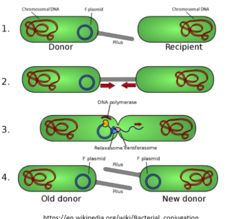
Clostridium perfringens has high ___________ to different host species, and will use its conjugative plasmids to infect various species
adaptability
C. perfringens is harbored in the ___________ of normal, healthy animals, and on its own won't cause disease
intestine
when does disease occur resulting from C. perfringens?
when conditions change to favor its overgrowth + toxin production
____________ is a risk factor for enterotoxaemia (aka conditions improve for overgrowth of C. perfringens) in the following 2 pathways:
1. ____________ --> reduced digestion --> more undigested material reaches intestine --> provides rich medium for bacterial growth + toxin production
2. ___________ --> reduced intestinal motility --> bacteria are retained longer + toxins have more time for absorption
overeating
in patients that are _________ in age, β-toxin-mediated diseases are favored
young
in patients that are _____ in age, ε-toxin mediated diseases are favored
old
what are the 6 main toxins that promote overgrowth of C. perfringens?
1. α-toxin --> Cpa or phospholipase C
2. β-toxin --> Cpb
3. ε-toxin --> Etx
4. ɩ-toxin --> Itx
5. C. perfringens enterotoxin --> Cpe
6. necrotic enteritis toxin B --> NetB
which toxin:
- phospholipase C
- acts on cell memb, hemolytic, lethal
α-toxin
which toxin:
- pore-forming
- CNS clinical signs
- trypsin sensitive
β-toxin
which toxin:
- secreted as a pro-toxin --> intestinal proteolytic enzymes --> activation
- deemed by CDC Select Agent List as the most toxic toxin
ε-toxin
which toxin:
- targets skeletal muscle
iota-toxin
what is a minor toxin that binds to cholesterol + forms pores --> causes cell death
Perfringolysin O
toxin Type ____:
- young ruminants --> fatal necrotizing abomasitis
- chickens --> necrotic enteritis
- neonatal foals, pigs, dogs --> hemorrhagic enteritis/diarrhea
A

toxin Type ____:
- lamb dysentery --> newborn lambs
- colostrum --> antitrypsin --> breaks trypsin --> protects β-toxin
B
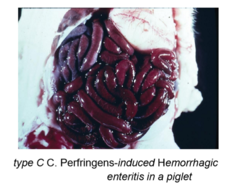
toxin Type ____:
- newborns --> absence of microbiota
- chickens --> necrotic enteritis
- struck --> intestinal toxemia --> sudden death in older sheep
C
toxin Type ____:
- found in older lambs and goats EXCEPT NEONATES
- "overeating disease" or "pulpy kidney disease"
- enterotoxaemia
D

toxin Type ____:
- hemorrhagic enteritis in calves
E
how should you diagnose C. perfringens in the lab?
1. isolation --> blood agar anaerobically, heat to 80 degrees C, spores will survive
2. staining --> Gram, Wright's, Giemsa
3. PCR
4. ELISA --> for toxin identification in the stolls of infected dogs or cats
what are 3 ways to control C. perfringens?
1. active immunization
2. passive immunization
3. abx
___________ ____________ infection = known to cause antibiotic-associated diarrhea in humans
Clostridium difficile
Clostridium difficile infection (CDI) can be seen in:
- ___________ foals --> hemorrhagic necrotizing enterocolitis
- ____________ horses --> nosocomial diarrhea + typhlitis
neonatal, adult
CDI's are worse in species with ___________ large intestines like horses, rabbits, swine
enlarged
a CDI is common following the intake of what?
an antimicrobial
lab diagnosis for CDI?

____________ __________ = prevalent in quails + poultry
Clostridium colinum
_____________ ____________ = seen in rabbits with typhlocolitis
Clostridium spiroforme
___________ ___________ = seen in laboratory animals (mice) and foals, and causes Tyzzer's disease
Clostridium piliforme
C. piliforme can be caused by __________ __________ in foals, and is 50-100% fatal
hepatic necrosis