monitoring anesthesia lab quiz 3
 Call Kai
 Learn
 Practice Test
 Spaced Repetition
 Match
 Flashcards
 Knowt Play
1/73

There's no tags or description
Looks like no tags are added yet.
74 Terms
Atelectasis
collapse of alveoli
palpebral, cornal, PLR
name three reflexes assessed in anesthesia monitoring
nystagmus
involuntary, jerking movements of the eyes
stage 1 anesthesia
start of induction
loss of consciousness
what marks the border between stage 1 and stage 2 of anesthesia
loss of muscle movement
what marks the border between stage 2 and stage 3
stage 1
which stage is characterized by fear, disorientation, struggling, increased HR AND RR?
stage 2
which stage is known as the excitement stage?
stage 3
what stage is period of surgical anesthesia
stage 3 plane 2
what is the surgical stage
stage 3 plane 1
Light Anesthesia. Most reflexes (pedal, corneal, palpebral) are still present.
stage 3 plane 2
optimal surgical depth
-rr may be shallow
hr, bp, rr, pulse strength might be mildly decreased.
moderate pupil size
stage 3 plane 3
deep anesthesia
shallow and slow RR
bradycardia well below normal
pale MM
stage 4
what is considered the period of anesthetic overdose?
laryngeal reflex
-Epiglottis and vocal cords close immediately when larynx is touched by an object
-Prevents tracheal aspiration
-Observed during intubation if animal is in the light plane of anesthesia
-Makes intubation difficult: Especially in cats, pigs, and small ruminants
pedal reflex
Flexion or withdrawal of limb in response to
squeezing, twisting, or pinching a digit or pad
- Used in small animals only
- Varies from subtle muscle contraction to full
withdrawal of limb
Varies with depth of anesthesia
- Present in light anesthesia
- Absent in medium anesthesia
Requires a high intensity stimulus
corneal reflex
blinking in response to corneal stimulation by a sterile object
stage 3 plane 3
PLR reflex will be lost during stage ____
corneal reflex
what reflex is primarily to tell the anesthetist when a large animal patient is anesthetized too deeply.
jaw tone/anal tone
name two muscle tone indicators
mydriatic
dilated pupil
miotic
constricted pupil
true
t/f An increase in HR, RR, Vt or BP in response to surgical stimulation does not usually reflect a conscious perception of pain.
lead II
what ecg lead is best to evaluate heart rhythm in small animals
Sinus Arrhythmia
HR increases during inhalation and decreases during expiration
sinus tachycardia
abnormally fast hR
1st degree AV heart block
prolonged P-R interval
2nd degree AV heart block
Occasional missing QRS intervals, prolonged and varied P-R interval
3rd degree av heart block
atrial and ventricular waveform occur independently, complete loss of the normal relationship between the P waves and the QRS complexes, random and irregular P-R interval
ventricular tachycardia,
series of three or more VPCs in a row

fibrillation
chaotic, uncoordinated contraction of small muscle bundles within the atria or ventricles that appears as an undulating baseline with or without QRS complexes

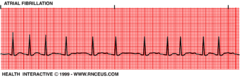
atrial fibrillation
fine undulations of of the baselines, an absence of P waves, a high HR and normal QRS complexes with irregular intervals
ventricular fibrillation
regular, undulating baseline, with complete absence of recognizable QRS complexes

capillary refill time
the rate of return of color to oral mucous membranes after the application of gentle digital pressure
mean arterial pressure
what is the average pressure through the cardiac cycle and the most important value from anesthetist stand point; best indicator of blood perfusion of the internal organs
MAP
During anesthesia, ______ is a good indicator of tissue perfusion
60-70mmHg
MAP fall below _________, blood flow to internal organs is reduced and tissues may become hypoxic.
systolic at 80-90mmHg
When using a Doppler blood flow detector and sphygmonanometer, every effort should be made to maintain a Psys (systolic) at or greater in small animals
doppler and oscillometric
two basic indirect blood pressure monitors
30-50%
When the BP is measured, the width of the cuff should be_______ of the circumference of the extremity and the cuff should be placed firmly but not too tight over a peripheral artery.
saturation
In non anemic animals (with normal hemoglobin concentration), what gives the anesthetist a good estimate of oxygen available to the tissues.
decrease
Decreased inspired oxygen or lung disease will ______ partial pressure and o2 saturation
true
T/F in a patient is anemic, neither Pao2, nor Spo2 gives and accurate measure of oxygen availability.
pulse oximeter
Estimates the saturation of hemoglobin (So2) expressed as a percentage of total binding sites
hypoxemic
A pulse oximeter reading of 90-94% must be investigated because it indicates that the patient is_______
90%
Saturation of less than _____ indicates serious hypoxemia and need for therapy
85%
Saturation of less than______for longer than ______ is a medical emergency
carboxyhemoglobin
Hemoglobin bound to carbon monoxide, reducing oxygen transport.
methimoglobin
hemoglobin that is unable to carry oxygen due to exposure to certain drugs or toxins
paco2
Partial pressure of carbon dioxide in arterial blood.
tidal volume
Amount of air inhaled during a breath
10-15 mL/kg
capnograph
an end tidal Co2 monitor is known as a
Capnogram
The visual representation of the expired CO2 waveform

Capnograph
Also known as an end-tidal CO2 monitor. A monitoring device that measures the amount of CO2 in the air that is breathed in and out by the patient, by sampling air passing between the endotracheal tube connector and the breathing circuit.
the first 20 minutes
During anesthesia, body temp loss is greatest in ____
towels , blankets or bubble wrap
examples of External passive warming
Circulating warm water blankets or warm air blanket
sexamples of external ACTIVE rewarming
IV fluid warmers
core rewarming
overheating
complications of rewarming
Central venous pressure
venous blood pressure within the right atrium that influences the pressure in the large peripheral veins
Doppler blood flow detector
A monitoring device that uses ultrasound frequency to convert the motion of red blood cells in small arteries into an audible "whooshing" sound. Used to monitor pulse rate and, if used in conjunction with a sphygmomanometer, systolic blood pressure.
Flaccid
(adj.) limp, not firm; lacking vigor or effectiveness
Multiparameter monitor
tracks cardiovascular function, resp function, body temp and anesthetic depth
Partial pressure of oxygen
higher in the alveoli than the pulmonary artery
Percent oxygen saturation
ratio of oxygen content to oxygen carrying capacity
Pulmonary thromboembolism
The presence of one or more blood clot in the lungs
Respiration
processes by which oxygen is supplied to and used by the tissues and carbon dioxide is eliminated from the tissues
Tachypnea
Increase in resp rate
Ventilation
movement of gases in and out of the alveoli
sphygmomanometer
instrument to measure blood pressure
medial aspect of proximal forelimb, palmer aspect of metacarpus
what are two location for taking blood pressure
85%
saturation less than ___ for longer than 30 seconds is a medical emergency
anatomic dead space
formed by nasal cavity, pharynx, larynx, trachea, bronchi, bronchioles, and terminal bronchioles
alpha 2 agonist, opioids
which medications are more likely to cause bradycardia