Intro to ABA Final Exam
 Call Kai
 Learn
Learn Practice Test
 Spaced Repetition
 Match
Match Flashcards
 Knowt Play
1/79

There's no tags or description
Looks like no tags are added yet.
Name | Mastery | Learn | Test | Matching | Spaced | Call with Kai | Chat |
|---|
No analytics yet
Send a link to your students to track their progress
80 Terms
Response and stimulus
There are two general types of prompts - what are they?
True
TRUE OR FALSE Instead of grunting as a greeting, I want a child to say hi. This is a new topography of a behavior. This is shaping
Differential reinforcement of other behavior
This type of differential reinforcement occurs when reinforcement is delivered for the total absence/0 rate of behavior
True
TRUE OR FALSE Examples of components of verbal behavior include: tact, mand, echoic, intraverbal
Non-exclusionary
What type of time out? Person remains in the reinforcing environment, but access to reinforcement is removed
True
TRUE OR FALSE The 4 types of response prompts are verbal, gestural, modeling, and physical
True
TRUE OR FALSE An example of a DRI would be reinforcing sitting instead of standing OR raising your hand instead of yelling out answers
Predictability, repetition, and high contrast
What are the three essentials of teaching good behavior?
tact
Saying "cookie" when you see a cookie is an example of what verbal operant
True
TRUE OR FALSE Differential negative reinforcement: desirable behavior produces escape. Problem behavior does not produce escape
Guided compliance
Contingent on the problem behavior following a request, the individual is physically guided to comply. What is this?
Exclusionary
What kind of time out is being used when the person is removed from the reinforcing environment?
Exaggeration
When additional dimensions (ex: color, shape, size) are added to a target stimulus, this is a _____ stimulus prompt
Positional
When the therapist moves a target stimulus closer to child, this is an example of a _____ stimulus prompt
Extinguish it
Shaping: if a child has performed the next approx. of a behavior, what do you do if they perform the previous behavior?
Overcorrection, contingent exercise, guided compliance, physical restraint
What are 4 examples of application of aversive activities?
Restitution and postive practice
Overcorrection (application of aversive activity) consists of 2 components - what are they?
Mand
Saying "cookie" when you want to eat a cookie is an example of what verbal operant?
Consequences applied, regardless of function
What describes behavior modification, but not applied behavior analysis?
Frequency
What do we call the number of times a behavior occurs?
Receiving a text about the party and ignoring it
When considering escape and avoidance as functions of behavior, what is an example of avoidance?
Fixed ratio
A therapist provides a child with a cookie following every 3rd correct response. What is this schedule of reinforcement?
Extinction burst
A vending machine eats someone's $. The person shakes the machine and pushes multiple buttons before walking away. This is an example of what?
Variable interval
A therapist provides a child with a goldfish approximately every 2 minutes. What is this schedule of reinforcement?
level, trend, variabilitiy
What are 3 ways discussed in class to analyze single subject design?
Useful for large N studies
What is NOT a benefit of single subject design?
Latency
A mother tells her child to pick up her toys. 3 minutes pass before the child complies. What is the 3 minutes a measurement of?
Contingency-governed behavior
What kind of behavior is this: Every time a child says "cookie" they receive a cookie
Rule-governed behavior
What kind of behavior is this: I pay my taxed every year because I don't want the IRS at my front door and potential jail time.
Variable ratio
I give my client time to play on the iPad after every 3rd correct response, then after the 5th, then after the 4th. What is this schedule of reinforcement?
Fixed interval
I give my client access to reinforcement every 2 minutes. What is this schedule of reinforcement?
False
TRUE OR FALSE Extinction is simply ignoring a problem behavior
Watson
This scientist conducted the little Albert study and began the movement of behaviorism
Behaviors that are like reflexes
Response conditioning targets which kind of behavior?
adds; increase
Positive reinforcement ____ stimulus to ____ behavior
removes; increase
Negative reinforcement ____ stimulus to ____ behavior
adds; decrease
Positive punishment ____ stimulus to ____ behavior
removes; decrease
Negative punishment ____ stimulus to ____ behavior
An appropriate behavior that is functionally equivalent to problem behavior
What is a replacement behavior?
Antecedent intervention
What is preventative intervention?
True
TRUE OR FALSE In order to use differential reinforcement the behavior must be occurring at least occasionally
True
TRUE OR FALSE I want a child to say "Hi" instead of grunt when I walk in the room, which is considered to be a new topography of a behavior. This is considered shaping
No
YES OR NO I am wanting to shape the behavior of clapping, so I choose to start by reinforcing the behavior of raising both hands. This is a behavior that the child I am working with does not currently do. Is this shaping?
Verbal, gesture, modeling, physical
List the response prompts
Position cues, exaggeration
List the stimulus prompts
Physical prompt
What is any physical movement of another person that leads to the correct behavior in the presence of the SD?
Verbal prompt
Instructional, hint, reminder, and questions are all examples of ____
Extinction
Reinforcement is withheld
Time-out
Access to reinforcement is removed contingent on the problem behavior
Response cost
Contingent on the problem behavior a specific amount of a reinforcer is removed, but not necessarily the reinforcer for the problem behavior
Restitution and positive practice
What are two components of overcorrection?
Restitution
Contingent on the problem behavior, the individual is required to fix the environment disrupted by the problem behavior
Positive practice
Contingent on the problem behavior the individual has to engage in correct forms of relevant behavior for a period of time
Extinction
A student screams most often after is provided with work. It is observed that typically staff have taken away work when this happens. A BCBA instructs staff to no longer remove work when the child screams and it is observed that screaming declines. This is an example of what?
B: Johnny loves his toys, so his mom removes him from his toys for 1 minute when he hits
Which of these is the best example of time-out?
A: Johnny's mom takes him to another room and makes him sit in a chair for 1 minute
B: Johnny loves his toys, so his mom removes him from his toys for 1 minute when he hits
C: Johnny must sit in a corner for 1 minute and then apologize to his mom before returning
D: Johnny's mom makes him sit quietly for 1 minute and starts the timer over if he doesn't
Response cost
Mrs. Johnson gives her class tokens for raising their hand, but takes one away each time they speak out. This is an example of what?
Restitution
Jill's mom requires her to pick up all of the toys she threw during her tantrum. This is an example of what?
Reinforcement and extinction
What two procedures are involved in the use of DRA?
DRO
After a set amount of time (5 minutes) without engaging in any inappropriate vocalizations, Mark's teacher gave him a sticker on his sticker chart. What type of differential reinforcement schedule is this?
Quid pro quo contract
What type of behavior contract is this: the behavior change of one party serves as the reinforcer for the behavior change of the other party
Parallel contract
What type of behavior contract is this: two independent contracts are created, one for each party
Eating more vegetables
I am trying harder to eat mire vegetables. In order to do this, I have been including spinach and kale in a smoothie in the morning. In terms of this example of self-management, what is the controlled behavior?
One-party contract
I make a contract with my teacher that I won't be late to class anymore. If I am late to class, my teacher can make me stay late after however many minutes I was late. What type of contract is this?
Counterfeit, the teacher might forget to have her hole punch with her when a student engages in a good behavior, it many not be easily deliverable
A teacher plans to implement a token economy in her classroom. She chooses to use a regular hole punch to serve as the tokens. What are the potential problems with using this as the token?
The whole class could be brought down by the behavior of one or a few
What is the problem with using a dependent group contingency?
Independent group contingency
When access to reinforcement is dependent on the individual child's behavior (ex: everyone who gets a 90% on the exam will have an open book final) this is called:
Simple phase change (AB)
What kind of single subject design is this graph?

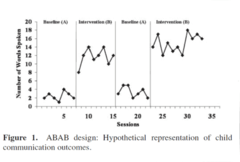
Withdrawal design (ABAB)
What kind of single subject design is this graph?
Combined simple phase change (ABAC)
What kind of single subject design is this graph?

Changing criterion element (AB)
What kind of single subject design is this graph?

Alternating treatment design
What kind of single subject design is this graph?

Multiple baseline design
What kind of single subject design is this graph?

Unconditioned stimulus (US)
Katie's dog Wilson loves treats. Every time Wilson sees a treat be begins to drool. Wilson receives a treat every time Katie leaves the house. Wilson's treats are kept in a glass jar that clicks open when Katie grabs a treat. So, overtime there was a "click" then a treat and then Wilson drooled. Now each time Wilson hears the click, he begins to drool.
The treat is the:
Unconditioned response (UR)
Katie's dog Wilson loves treats. Every time Wilson sees a treat be begins to drool. Wilson receives a treat every time Katie leaves the house. Wilson's treats are kept in a glass jar that clicks open when Katie grabs a treat. So, overtime there was a "click" then a treat and then Wilson drooled. Now each time Wilson hears the click, he begins to drool.
Wilson's drooling over the treat is:
Conditioned response (CR)
Katie's dog Wilson loves treats. Every time Wilson sees a treat be begins to drool. Wilson receives a treat every time Katie leaves the house. Wilson's treats are kept in a glass jar that clicks open when Katie grabs a treat. So, overtime there was a "click" then a treat and then Wilson drooled. Now each time Wilson hears the click, he begins to drool.
Wilson's drooling over the click is:
Neutral stimulus (NS)
Katie's dog Wilson loves treats. Every time Wilson sees a treat be begins to drool. Wilson receives a treat every time Katie leaves the house. Wilson's treats are kept in a glass jar that clicks open when Katie grabs a treat. So, overtime there was a "click" then a treat and then Wilson drooled. Now each time Wilson hears the click, he begins to drool.
Prior to being paired with the treat, the click was a:
The parent's behavior was negatively reinforced
A parent is trying to check out of a local grocery store. While checking out the parent's toddler asked for a candy bar. After being told no, the toddler started crying loudly, which was embarrassing to the parent. The parent bought a candy bar and gave it to the toddler. The toddler stopped crying.
Considering the parent and the parent's candy giving behavior, what happened?
The toddler's behavior is positively reinforced
A parent is trying to check out of a local grocery store. While checking out the parent's toddler asked for a candy bar. After being told no, the toddler started crying loudly, which was embarrassing to the parent. The parent bought a candy bar and gave it to the toddler. The toddler stopped crying.
Considering the toddler and the toddler's crying behavior, what happened?
The toddler's behavior was positively punished
A parent is trying to check out of a local grocery store. While checking out the parent's toddler asked for a candy bar. After being told no, the toddler started crying loudly which was embarrassing to the parent. The parent yelled at the toddler "NO! Stop crying or you are going to get a spanking!" The toddler stoped crying.
Considering the toddler and the toddler's crying behavior, what happened?
The parent's behavior was negatively reinforced
A parent is trying to check out of a local grocery store. While checking out the parent's toddler asked for a candy bar. After being told no, the toddler started crying loudly which was embarrassing for the parent. The parent yelled at the child "NO! Stop crying or you are going to get a spanking!" The toddler stopped crying.
Considering the parent and the parent's yelling behavior, what happened?