MRI pulse sequences and parameters
 Call Kai
 Learn
 Practice Test
 Spaced Repetition
 Match
 Flashcards
 Knowt Play
1/11

There's no tags or description
Looks like no tags are added yet.
12 Terms
What is a pulse sequence?
• A pulse sequence is a programmed set of changing magnetic gradients
• Each pulse sequence has a number of parameters that we can control
• Different combinations of parameters form different pulse sequences
What are three common pulse sequences?
• Spin Echo
• Gradient Echo
• Inversion Recovery

Spin echo
• Widely used
• The pulse sequence timing can be adjusted to give T1-weighted, proton density, and T2-
weighted images
• Dual echo and multi-echo sequences can be used to obtain both proton density and T2-weighted images simultaneously
• The two variable parameters of interest in spin echo sequences are the repetition time (TR) and the echo time (TE)
• All spin echo sequences include a slice selective 90-degree pulse followed by one or more 180 degree refocusing pulses

Gradient echo
• Gradient echo sequences (GRE) are an alternative technique to spin-
echo sequences, differing from it in two principal points:
• Utilisation of gradient fields to generate transverse magnetization
• Flip angles of less than 90°
• Compared to spin-echo and inversion recovery sequences, gradient
echo sequences are more versatile
• Flip angle is a key parameter that determines a GE sequence from
other sequences – it is usually at or close to 90 degrees for spin
echo, but is less than 90 for a gradient echo (between 10-80 degrees)
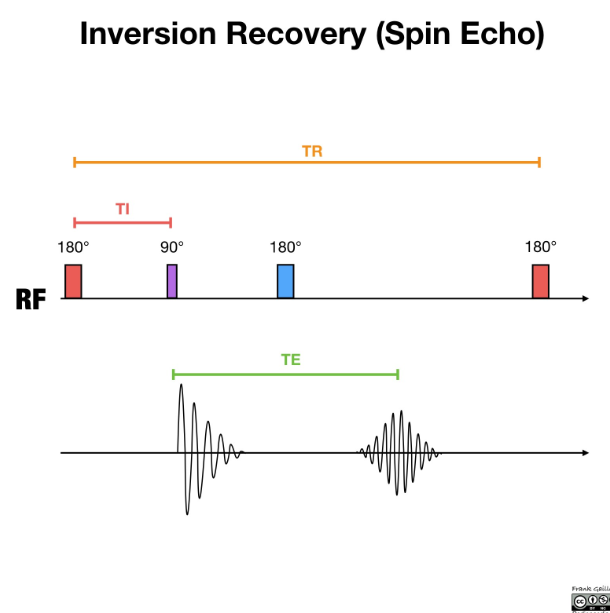
Inversion recovery
• Inversion recovery pulse sequences are a type of MRI sequence used to
selectively null the signal for certain tissues (e.g., fat or fluid)
• Inversion recovery can also generate heavily T1-weighted images and was
originally developed for this purpose
• An inversion recovery (IR) pulse sequence is a spin echo pulse
sequence preceded by a 180° RF pulse
• The preparatory pulse inverts longitudinal magnetization
• Tissues regain original alignment at different longitudinal (T1) relaxation
rates determined by their T1 relaxation times
• The spin echo 90° readout pulse is applied at the exact time when
longitudinal magnetisation reaches the null point for the tissue we wish to
suppress
• The time elapsed between the preparatory 180° pulse and the 90°
excitation (slice selection) RF pulse is termed time to inversion (TI)
Inversion recovery tissue suppression
• By choosing the appropriate TI,
suppression of different tissues is
possible:
• STIR - short tau inversion recovery
= fat is nulled
• FLAIR - fluid attenuated inversion
recovery = fluid is nulled
What are the core sequence parameters?
• TR – Repetition Time
• TE – Time to Echo
• Flip Angle
• TI – Inversion Time

TR – Repetition Time
• Repetition Time = Amount of time between successive pulse sequences
applied to the same slice
• TR controls degree of T1 weighting = short TR produces T1 weighting

TE – Time to Echo
• Echo Time – TE is the time between the delivery of the RF pulse and the
receipt of the echo signal
• TE controls degree of T2 weighting = long TE produces T2 weighting
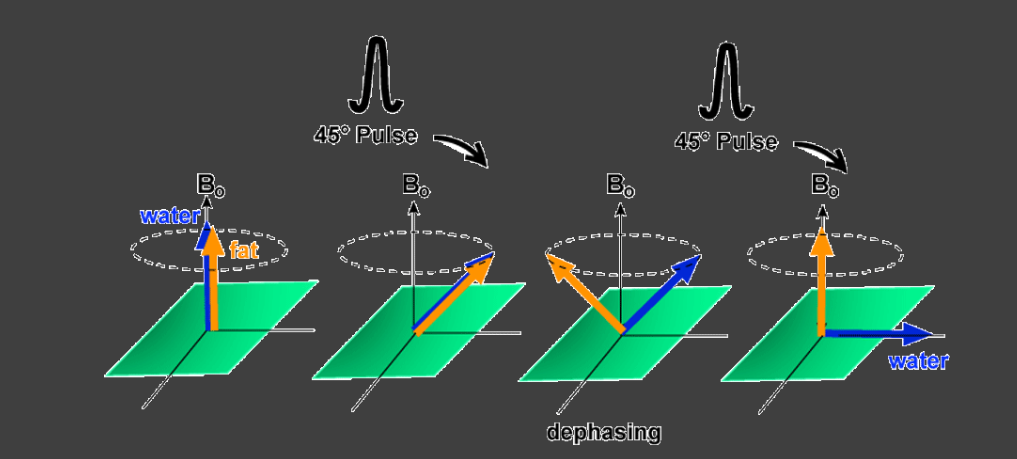
Flip angle
• Flip angle is the amount of rotation the net magnetization (M) experiences
during application of a radiofrequency (RF) pulse
(essentially, it is the angle at which the hydrogen proton is ‘flipped’ by when the
RF pulse is applied)

TI – Inversion Time
• The time between the 180° inverting pulse and the 90°pulse is called the
inversion time (TI) (relevant for inversion recovery pulse sequences

Identify the sequence used
A. T1W
B. FLAIR
C. SWI
D. MRA TOF
E. DWI
F. T2W