Text Chapter 6: Vision and Visual Processing
 Call Kai
 Learn
 Practice Test
 Spaced Repetition
 Match
 Flashcards
 Knowt Play
1/216

There's no tags or description
Looks like no tags are added yet.
217 Terms
What is the primary sensory structure that intercepts electromagnetic waves in the visible spectrum?
The eye

What are the two types of photoreceptors in the retina?
Rods and cones
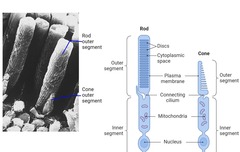
What is the role of the cornea and crystalline lens in the eye?
They intercept and bend light rays to form a focused image on the retina.

What is the term for the region where ganglion cell axons leave the eye?
Optic disk
What is the fovea?
A region of tightly packed photoreceptors that provides the highest visual acuity.

What condition results when the image is focused in front of the retina?
Myopia

What condition results when the image is focused behind the retina?
Hyperopia
What is presbyopia?
A condition where the lens becomes less flexible with age, making it difficult to focus on nearby objects.
What is the visible spectrum?
The range of electromagnetic wavelengths that our eyes can detect.

What happens to light when it reflects off objects?
Different wavelengths are absorbed or reflected, which our visual system interprets as color and shape.
What is the role of the ciliary muscle in the eye?
It adjusts the shape of the lens to focus on objects at varying distances.
What is the aqueous humor?
A clear liquid that fills the space between the cornea and the lens.
What is the vitreous humor?
A jelly-like substance that fills the globe of the eye.
How does the brain process visual information?
It constructs a mental image based on the sensory information received from photoreceptors.

What is light?
A form of electromagnetic radiation made up of particles called photons.
What is the significance of the optic nerve?
It transmits visual information from the retina to the brain.
What is the choroid?
A layer behind the retina that nourishes it and absorbs stray light.
What is the sclera?
The tough white outer layer of the eye.
What is the difference between short and long wavelengths in terms of energy?
Short wavelengths have high energy, while long wavelengths have low energy.
What is the relationship between brightness and the number of photons?
Bright lights produce many photons per second, while dim lights emit few.
What is the primary function of rods in the retina?
To detect light and dark, contributing to night vision.
What is the primary function of cones in the retina?
To detect color and fine detail in bright light.
What is the process of visual perception?
The brain's ability to interpret light reflected from objects to create a mental image.
What happens to the image projected on the retina?
It is upside-down and left-right reversed due to the lens's properties.

What is the role of the ganglion cells in the retina?
They process visual information and send it to the brain via the optic nerve.
What is the significance of the blind spot in our vision?
It is an area without photoreceptors where visual information cannot be detected.
What is the electromagnetic spectrum?
The range of all types of electromagnetic radiation, including visible light.
What is the primary purpose of the visual system?
To construct a mental representation of the environment based on light reflections.
What are the five major cell types in the retina?
Rods, cones, bipolar cells, ganglion cells, horizontal cells, and amacrine cells.
What is the primary function of rods?
Rods function best in dim light and are responsible for low-acuity vision.
What is the primary function of cones?
Cones are responsible for high-acuity color vision in bright light.
What process converts light energy into a neural signal?
Phototransduction.

How do rods and cones respond to light?
They hyperpolarize in response to light, becoming more negative.

What is the resting potential of photoreceptors in the dark?
About -40 mV.
What happens to sodium channels in photoreceptors when light is captured?
Some sodium channels close, leading to hyperpolarization.

What is the role of bipolar cells in the retina?
Bipolar cells connect photoreceptors (rods and cones) to ganglion cells.

What is the significance of the fovea in the retina?
The fovea allows light to hit photoreceptors directly for sharpest visual acuity.
What are the two types of photoreceptors?
Rods and cones.
How many cones are typically found in the human retina?
About 6 million.
How many rods are typically found in the human retina?
About 120 million.
What is the anatomical arrangement of the retina?
The retina has distinct layers with different types of neurons.
What is the role of horizontal cells in the retina?
Horizontal cells provide lateral connections for visual processing.
What is the role of amacrine cells in the retina?
Amacrine cells provide lateral connections between bipolar and ganglion cells.
What is the absorption spectrum of cone visual pigments?
Cones have different visual pigments with maximal sensitivity to different wavelengths of light.

What is the evolutionary significance of the retina's structure?
The retina's structure is an outpocketing of the brain and has been subject to evolutionary adaptations.

What is the impact of bright light on rod function?
Bright light saturates rods, preventing them from responding.

What is the pigment epithelium's role in the retina?
The pigment epithelium supports photoreceptors and absorbs excess light.
What is the optic nerve's function?
The optic nerve transmits visual information from ganglion cells to the brain.
What is the relationship between photoreceptors and neurotransmitter release?
Photoreceptors release glutamate when depolarized; light exposure interrupts this release.
What are the two theories explaining the photoreceptors' position in the retina?
1. Receptors require a dense blood supply; 2. Receptors evolved from ciliated cells.
What is the significance of the Golgi method in retinal studies?
The Golgi method allowed researchers to identify various retinal cell types.
What is the typical resting potential of other neurons compared to photoreceptors?
Other neurons typically have a resting potential of about -60 mV.
How do photoreceptors contribute to color vision?
Color vision depends on three types of cones with different absorption spectra.
What is the role of the choroid layer in the retina?
The choroid layer supplies blood to the photoreceptors.
What is the effect of dim light on rod response?
Rods can respond to as little as a single photon of light in dim conditions.
What is the primary neurotransmitter released by photoreceptors?
Glutamate.
What are the two components of rhodopsin?
Opsin (a large protein) and 11-cis retinal (derived from Vitamin A)
What happens to 11-cis retinal when it captures a photon?
It straightens to its all-trans shape, activating the opsin protein.
What is the role of cGMP in phototransduction?
cGMP keeps sodium channels open in the dark; its reduction leads to closure of these channels.
What occurs to the cell's resting potential in response to light?
The cell becomes hyperpolarized due to the closure of sodium channels.
What are the three types of cones in the human retina?
S cones (blue), M cones (green), and L cones (red).
What is the absorption peak of rhodopsin?
498 nm, in the middle of the spectrum.
How do the absorption spectra of cone pigments differ?
They differ in their opsin proteins, allowing them to absorb light at different peak wavelengths.
What is the significance of having three types of cones?
It allows for trichromatic color vision, enabling the perception of a wide range of colors.
What are the primary colors of light used in screens?
Red, green, and blue (RGB).

What are the primary colors for subtractive color mixing?
Cyan, magenta, and yellow (CMY).

What is color blindness?
A genetic variation that results in the inability to distinguish certain colors due to having only two cone types or an anomalous pigment.
Which gender is more commonly affected by red-green color blindness?
Males, occurring in about 8% of them.
What is the difference between on-center and off-center bipolar cells?
On-center cells respond to light in the center of their receptive field, while off-center cells respond to light in the surrounding area.
How do horizontal cells contribute to visual processing?
They facilitate the center-surround nature of bipolar cell receptive fields.
What are retinal ganglion cells responsible for?
They transmit visual information from the retina to the brain.
What is the function of opponent color responses in retinal ganglion cells?
They help detect color edges and contrast in visual perception.

How do rods and cones compare to digital camera pixels?
They function similarly by capturing light and contributing to image formation.
What is the effect of bright light on rod cells?
It leads to the closure of most sodium channels, resulting in hyperpolarization.
What is the evolutionary significance of having three cone types in humans?
It enhances color discrimination, aiding in tasks like detecting ripe fruits.
What is the typical response of cones to low light conditions?
They are less effective in low light, as rods are more sensitive.
What happens to the visual pigment when exposed to continuous light?
It can become bleached, reducing its effectiveness in capturing photons.
What is the role of Vitamin A in vision?
It is a precursor for 11-cis retinal, essential for the formation of rhodopsin.
What is the primary function of the visual pigments in the retina?
To absorb photons and initiate the process of phototransduction.
How does the presence of different pigments in cones affect color perception?
It allows for the detection of different wavelengths of light, contributing to the perception of various colors.
What is the significance of the evolutionary divergence of cone types?
It reflects adaptations to different visual environments and enhances color discrimination.
What is the role of bipolar cells in visual processing?
Bipolar cells transmit information from photoreceptors to ganglion cells, facilitating the detection of edges.
What are the two types of bipolar cells?
On-center and off-center bipolar cells.
How do on-center bipolar cells respond to light?
They depolarize when light covers the center of their receptive field and a darker region surrounds it.
How do off-center bipolar cells respond to light?
They depolarize when a dark patch falls in the center of their receptive field.
What is the function of horizontal cells in the retina?
Horizontal cells modulate the synaptic responses of bipolar cells by connecting to photoreceptors in the surround.
What is a receptive field?
A receptive field is the area of the retina that influences the activity of a particular bipolar or ganglion cell.
What is the significance of center-surround receptive fields?
They allow for the detection of contrast between light and dark regions, enhancing edge detection.
How do bipolar cells contribute to visual perception?
They respond to contrast rather than absolute brightness, helping to detect edges.
What neurotransmitter do bipolar cells respond to?
Glutamate.
What happens to on-center bipolar cells in the dark?
They are depolarized by the continuous release of glutamate from photoreceptors.
What happens to off-center bipolar cells when light is present in the center of their receptive field?
They hyperpolarize due to the interruption of glutamate release from photoreceptors.
What is the primary function of retinal ganglion cells?
To transmit visual information from the retina to the brain.
What is the role of ganglion cells in color detection?
They contribute to detecting color edges through opponent color responses.
Why are bipolar cells considered 'non-spiking'?
They do not generate action potentials but instead make graded changes in potential.
What is the primary visual processing step performed by bipolar cells?
Detecting borders between light and dark regions.
How does uniform illumination affect bipolar cell response?
Uniform illumination does not elicit a significant response; contrast is necessary for activation.
What is the relationship between photoreceptors and bipolar cells?
Photoreceptors synapse directly onto bipolar cells, providing input for their responses.
How do the responses of on-center and off-center bipolar cells differ?
On-center cells depolarize in response to light in the center, while off-center cells depolarize in response to darkness.
What is the effect of light on the center of the receptive field for on-center bipolar cells?
It interrupts glutamate release, leading to depolarization of the bipolar cell.