color perception (ch 6) - exam 2 (3/3)
 Call Kai
 Learn
 Practice Test
 Spaced Repetition
 Match
 Flashcards
 Knowt Play
1/43

There's no tags or description
Looks like no tags are added yet.
44 Terms
how photons of light interact with the world (absorption/reflection)
what eyes and brains do with the light
2 reasons we see color
newton’s apparatus
putting white light from the sun through a crystal prism resulted in the diffraction of light/a rainbow (ROYGBIV)
sunlight = composite light
spectral lights (1 WL) cannot be divided = pure light
composite light
type of light discovered through newton’s apparatus - made up of different wavelengths to produce white light (sunlight)
pure light
type of light discovered through newton’s apparatus - 1 wavelength, a spectral light
monochromatic
signal and organization/detection
functions of color vision
signal
function of color vision - tells us something about the world
ex: traffic lights, raw v. cooked
organization/detection
function of color vision - helps with pattern detection
it’s harder to find patterns in monochromatic (B/W) images than in colored images
absorption
of the three functions of light (absorb, pass through, reflect), this gives objects their color
grass ____ red and blue to reflect green
reflectance curve
shows what is reflected or absorbed by objects
achromatic colors: flat in graph b/c they only absorb ALL wavelengths of light, and what we see is the ratio they reflect
white: ALL wavelengths are reflected
grey: SOME reflected
black: LESS reflected
chromatic colors: selective reflections - reflecting some more than others
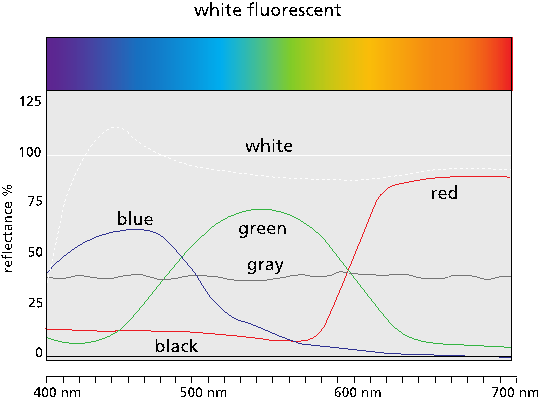
spectral reflectance
ratio of light reflected by an object at each wavelength
achromatic colors
flat lines in a reflectance curve - they only absorb ALL wavelengths of light, and what we see is the ratio they reflect
white: ALL wavelengths are reflected
grey: SOME reflected
black: LESS reflected

chromatic colors
other lines in a reflectance curve - selective reflections
some objects reflect more WLs than others, resulting in how we perceive color

hue, brightness, saturation
color characteristics
hue
color characteristic - the name of a color
representative in a color wheel with saturation
saturation
color characteristic - paleness/vividness of light
increased ____ = increased vividness of color
representative in a color wheel
edges: most saturated
inner: white
brightness (value)
color characteristic - lightness/darkness
amount of light present; makes it easier to see color when more present
color terms, color mixing
ways to describe the color experience
color terms
way to describe the color experience - names
100s/1000s, but condensed to about a dozen across cultures
habituation and dishabituation
how we know babies can recognize color
paying attention to a new color/stimulus until it gets old/bored (____)
when a new color is presented, baby pays attention again (_____)
additive
type of color mixing that lights obey
combination of WLs reach the eye - making a new color by adding lights together without destroying their individual properties
in a pigment: yellow + blue = green
in lights: yellow + blue = white

subtractive
type of color mixing that pigments obey
colors absorb/reflect different wavelengths, so when combined, their middle ground is reflected, thus subtracting out what’s absorbed
removal of wavelengths
blue reflects shorter WLs and absorbs longer WLs
yellow reflects longer WLs and absorbs shorter WLs
green = what both blue and yellow reflect

trichromatic theory of color and opponent-process theory of color vision
neural code for color vision (2 theories)
trichromatic theory of color
Young and Helmholtz, 1802 - theory of color vision that proposes that colors can be coded by 3 principle receptors in the eye
no single type of receptor can give appropriate color vision, resulting in 3 cone systems
using metamer psychophysical color matching to determine that all 3 primary color lights are needed to match other colors - possible to match all colors in the visible spectrum with an appropriate mix of the three
CRITIQUE: does not explain afterimages
metamer color matching
part of trichromatic theory of color
having an individual, in a dark space, match a given patch of color with 3 primary color lights (red, green, and blue)
task cannot be done with only 2 lights
possible to match all colors in the visible spectrum by mixing the 3 primary colors appropriately
opponent processing theory
Hering - theory of color vision that proposes that there is a distinct pattern to the color of the afterimages we see with 3 distinct channels
channels based on complementary colors/opposite sides of the color wheel
opponent chromatic channels
red/green
yellow/blue
achromatic channel
white/black (light v. dark)
when processing 1, we don’t see the other, but when the image goes away, there’s an influx from the other end of the channel, resulting in us seeing green after red is flashed
hue cancellation: can use the channels to cancel out the other’s presence in a mixed color
red/green, blue/yellow, black/white
channels in opponent-process theory
hue cancellation method
Hurvich and Jameson - psychophysical evidence that supports opponent processing theory
bluish green presented: add yellow to remove the blue and leave green
can use the channels to cancel out the other’s presence in a mixed color
trichromatic: receptor
opponent process: neural
how do both the trichromatic theory and opponent-process theory explain different aspects of color vision?
monochromacy, dichromacy (protanopia, deuteranopia, tritanopia)
types of color deficiencies
monochromacy
type of color deficiency in which a person has no functioning cones, leading them to only see in black and white
dichromat
type of color deficiency in which an individual is missing 1 cone system, resulting in 2 functioning cones
three types: protonopia, deuteranopia, tritanopia
protonopia, deuteranopia, tritanopia
3 types of dichromats
protanopia
type of color deficiency in which an individual is missing long WL cones (L-cones)
reds affected - R/G colorblind
sex-linked to X chromasome
deuteranopia
type of color deficiency in which an individual is missing medium WL cones (M-cones)
greens affected - R/G colorblind
sex-linked to X chromasome
tritanopia
type of color deficiency in which an individual is missing short WL cones (S-cones)
blues affected - B/Y colorlblind
NOT sex-linked
protanopia and deuteranopia
sex-linked color deficiencies
L cones, reds
cone system protanopes are missing + corresponding color affected
M cones, greens
cone system deuteranopes are missing + corresponding color affected
S cones, blues
cone system tritanopes are missing + corresponding color affected
tetrachromacy
females with 4 cone systems, resulting in vivid colors/colors we cannot see in their vision
color constancy
in which color perceived the same with changes in WL composition
ex: inside v. outside, daylight vs. evening light
Young and Helmholtz
pioneers of trichromatic theory of color
hering
pioneer of opponent-processing theory
Hurvich and Jameson
pioneers of the hue cancellation method (which supports opponent-processing theory)