Realism, Post/Impressionism, Symbolism, and Art Nouveau Exam
 Call Kai
 Learn
 Practice Test
 Spaced Repetition
 Match
 Flashcards
 Knowt Play
1/44

There's no tags or description
Looks like no tags are added yet.
45 Terms
Darwinian Evolution
Species evolve through natural selection
Japonisme
Western art influenced by Japanese design
lithography
Printing based on oil and water repelling
Marxism
Workers overthrowing capitalism for a classless society
photography
Capturing images using light on sensitive surfaces
positivism
Knowledge based purely on scientific facts
Social Darwinism
Misapplying evolution to justify social inequality
Which artist was the first artist ever to stage a private exhibition of his work, rejecting the salon system?
Gustave Courbet. After the official art show rejected his work in 1855, he built his own temporary building called the "Pavilion of Realism" to show his paintings himself.
Who developed the theory of social Darwinism?
Herbert Spencer. He took Darwin's ideas about nature and applied them to human society, coining the phrase "survival of the fittest."
Who is considered the “father” of Impressionism?
Camille Pissarro (or Édouard Manet as the main inspiration). Manet inspired the whole movement, while Pissarro mentored the artists and showed his work in every single Impressionist exhibition.
What was the goal of Realist artists?
To paint real life and ordinary people as they actually were. They rejected fake, ideal fantasy scenes and focused only on the modern world right in front of them.
What two reasons was Gustave Courbet important in art history?
He started the Realism movement by painting normal working people instead of fancy historical heroes and he broke away from the government art system by holding the very first private, independent art show.
Explain the influence of Social Darwinism on the practice of Colonialism.
Powerful countries used Social Darwinism as an excuse to take over weaker nations. They claimed Europeans were naturally "fitter" than other races, so invading and ruling over other people was just natural science.
Explain in detail, how Luncheon on the Grass by Edvard Manet is a commentary and critique of the history of painting.
Manet copied the layout of famous old masterpieces, but he swapped the classic goddesses for a stark naked modern woman sitting with fully clothed French men. By showing a real nude woman instead of a fake goddess, he exposed the hypocrisy of traditional art. He also painted with rough, flat brushstrokes to break academic rules about smooth, realistic depth.
What was the painting objectives of the Pre-Raphaelite Brotherhood?
They wanted to throw out the fake, formulaic style taught in art schools and go back to simple, highly detailed art inspired by nature. They loved bright colors, sharp details, and serious moral stories.
How did photography impact painting, science, history, and journalism?
Painting: Since cameras could copy reality perfectly, painters were freed to focus on feelings, light, and abstract styles like Impressionism.
Science: Scientists could freeze split-second movements—like a running horse—that human eyes were too slow to see.
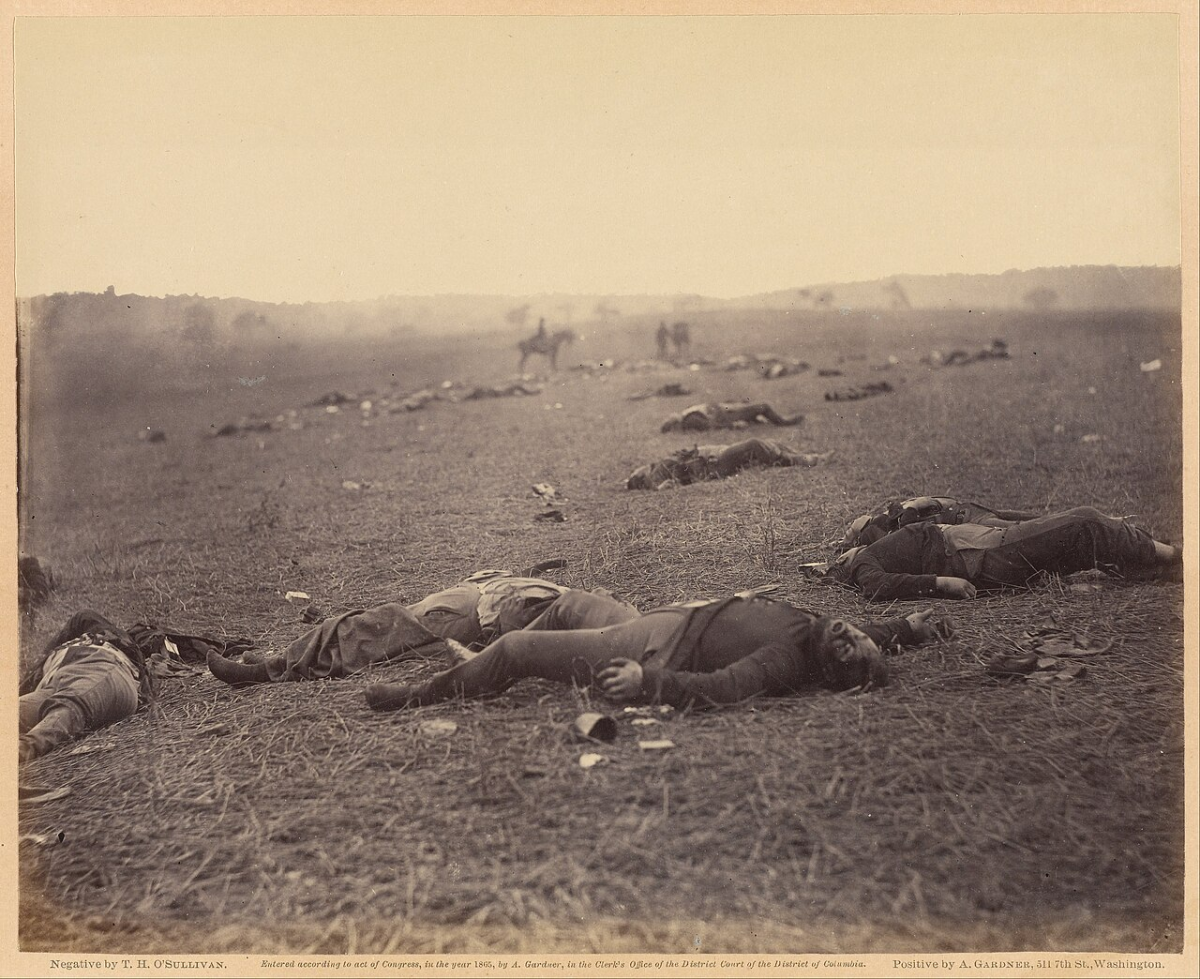
History & Journalism: Photographers could capture real war scenes and news events as they happened, giving people proof of real history.
Explain the influence of Japonisme on Edgar Degas artwork, titled The Tub.
Degas copied ideas from popular Japanese prints, like looking down from a high angle and cutting off shapes at the edges. In The Tub, he tilted the floor upward and cropped the woman off-center, making the scene feel flat and modern just like a Japanese woodblock print.
The Stone Breakers 1849 Realism Gustave Courbet

Ophelia 1852 Pre-Raphaelite John Everett Millais

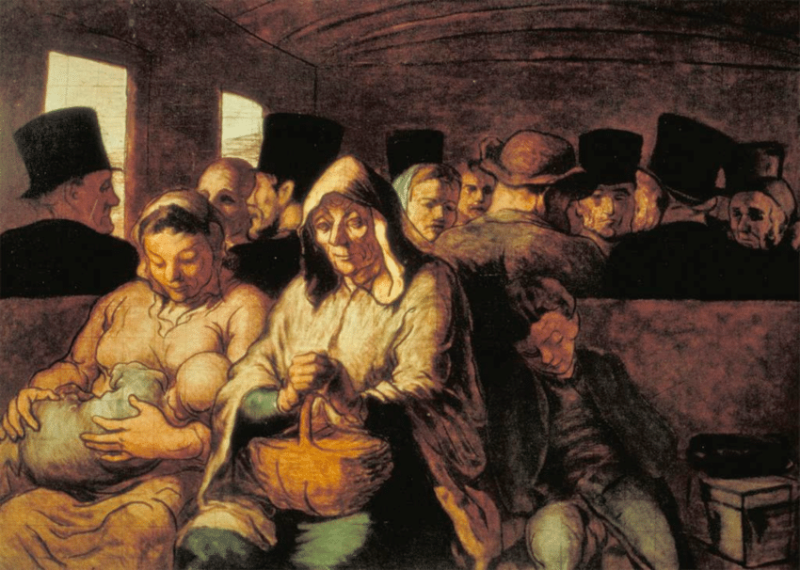
The Third-Class Carriage 1862 Realism Honore Daumier
A Harvest of Death 1863 Photography Timothy O’Sullivan
Luncheon on the Grass 1863 Realism Edouard Manet

Impression Sunrise 1872 Impressionism Claude Monet

Ballet Rehearsal 1874 Impressionism Edgar Degas

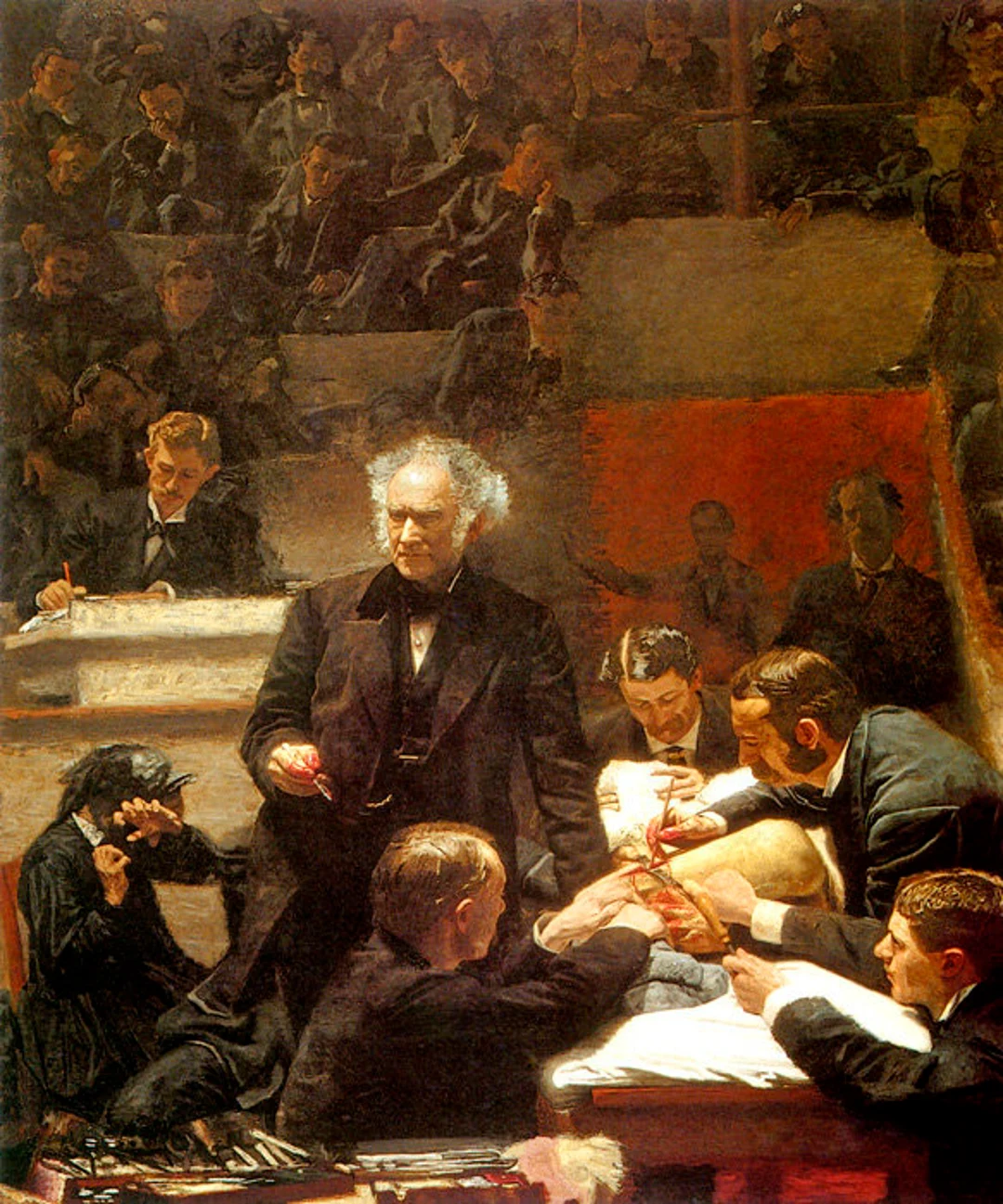
The Gross Clinic 1875 Realism Thomas Eakins
Le Moulin de la Galette 1876 Impressionism Pierre-Auguste Renoir

Horse Galloping 1878 Photography Eadweard Muybridge

fin-de-siecle
French for "end of the century," referring to the mood of anxiety, social restlessness, and cultural decay that characterized European art and society in the late 1800s.
optical mixture
A technique where small dots or strokes of distinct colors placed side-by-side are visually blended by the viewer's eye from a distance, creating a single vibrant hue.
pointilism
A systematic painting technique pioneered by Georges Seurat that uses tiny, distinct dots of pure color applied in patterns to form an image using optical mixture.
successive contrast of color
An optical phenomenon where viewing a color intensely and then looking at a neutral surface causes the eye to see an afterimage of its complementary color.
How did photography change Impressionism and post-impressionist painting?
Photography freed artists from just copying real life, letting them focus on emotion, bright colors, and fresh ideas instead. It also inspired them to try cool new framing tricks, like cropping edges and painting from weird angles.
What new color theories did scientists develop which influence Post-Impressionism? List at least one term and describe that term in relation to at least one artist work.
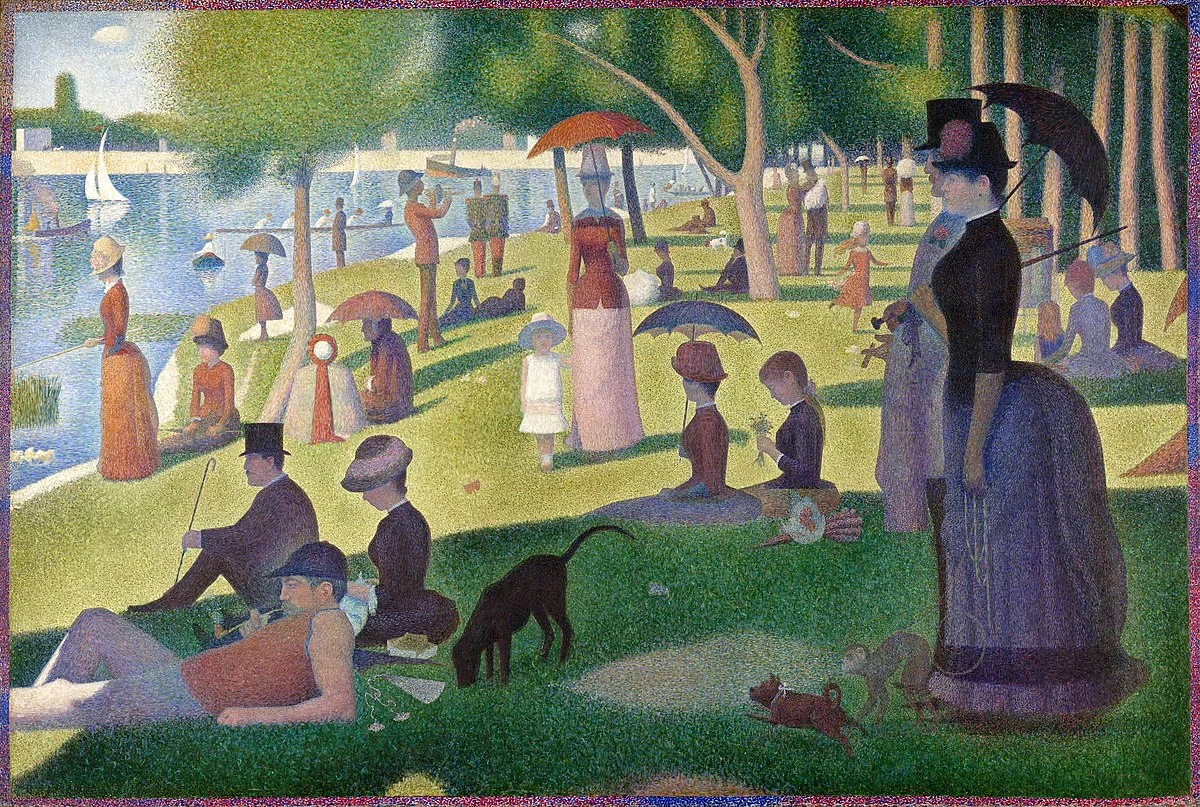
Scientists found that placing two complementary colors next to each other makes both look brighter and blend together in your eyes. Georges Seurat used this idea called optical mixture in A Sunday on La Grande Jatte, putting tiny dots of pure paint side by side so the viewer's eyes mix them naturally.
What technical applications did Van Gogh implement in his paintings which made his paintings so innovative?
Van Gogh used a technique called impasto, putting thick layers of paint on the canvas with bold, swirling brushstrokes. He also picked bright, wild colors based on how he felt rather than what things actually looked like in real life.
What was the Symbolists' philosophy and artistic objective?
Symbolists turned away from real life to focus on dreams, feelings, and inner thoughts. Their main goal was using colors, lines, and shapes as symbols to show human emotions and psychological states.
Explain how Auguste Rodin’s sculpture show it was influenced by the Impressionists.
Rodin left his sculptures with rough, bumpy surfaces instead of smoothing them out, much like Impressionist paint marks. This texture caught light and shadows in ways that made his statues look like they were actively moving.
Explain Auguste Rodin’s position concerning photography as documenting “truth”.
Rodin felt photography lied because freezing a split second of movement makes a person look stiff and fake. To him, real motion takes time, so an artist tells the truth by blending several steps of an action into a single figure.
A Sunday on La Grande Jatte 1886 Post-Impressionism Georges Seurat
Vision after the Sermon or Jacob Wrestling with the Angel 1888 Post-Impressionism Paul Gauguin

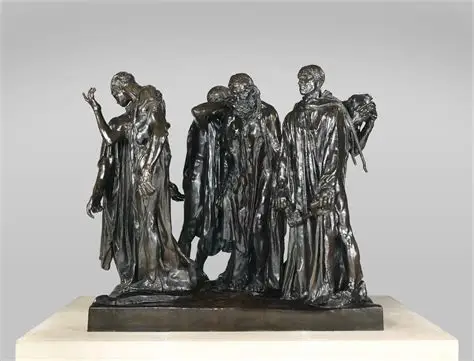
Burghers of Calais 1889 Impressionist Auguste Rodin
At the Moulin Rouge 1895 Post-Impressionism Henri de Toulouse-Lautrec

Basket of Apples 1895 Post-Impressionism Paul Cezanne

staircase in the Van Eetvelde House, Brussels 1895 Art Nouveau Victor Horta

Casa Mila 1907 Art Nouveau Antonio Gaudi

The Kiss 1908 Symbolist Gustav Klimt
