UW Madison Bio 101 Exam 3
 Call Kai
 Learn
 Practice Test
 Spaced Repetition
 Match
 Flashcards
 Knowt Play
1/84

There's no tags or description
Looks like no tags are added yet.
85 Terms
Dendrite
Receives signals from other neurons
Cell body
Contains cell machinery
Axon hillock
Decider, chooses what signals to send
Axon
Carries signals AWAY from cell body
Synaptic Terminal
Sends signal to other neurons
Central Nervous System
consists of the brain and spinal cord
Peripheral Nervous System (PNS)
Sensory and motor neurons connecting CNS and rest of the body
glial cells
Non-neural cells that hold neurons in place
Ogliodendrocytes (CNS), Schwann Cells (PNS)
Glial cells
Astrocytes
Blood-brain barrier, support/nourish neurons
Microglia
Brain's immune cell
myelin sheath
Made of glial cells, increase signal speed
diffusion
Random thermal motion in moist surfaces
3 components of circulatory system
Fluid, heart, interconnecting vessels
Arteries vs veins
Arteries- away from heart, thick walls
Veins- to heart, thinner walls
atria vs ventricles
Atria- receive blood from veins
Ventricles- pump blood to arteries
open vs closed circulatory system
Open - circulatory fluid is also interstitial fluid, requires less energy, ex. Insect
Closed - blood is confined to vessels, effective delivery of O2/CO2, ex. Fish/frog/human
Countercurrent
Fish, water flows away from the head and blood flows toward the head
Cross current
Birds, two fluids that travel at right angles to each other
Sinoatrial Node
In R Atrium, acts as a pacemaker
Atrioventricular Node
Between atria and ventricles, act as gatekeeper
Capillaries
Where exchange occurs, blood moves slowly here
4 components of blood
plasma
red blood cells
white blood cells
platelets
Plasma
Liquid made of dissolved hormones/nutrients/gases
RBC
Transport O2
WBC
Immune defense
Platelets
Aid in blood clotting
how do RBC carry O2?
Protein Hemoglobin has 4 hemes with iron at the center, O2 binds to iron
Hypoxia
Low O2 in blood
EPO
Hormone secreted by kidney, release causes O2 to be released, high EPO level send signal for no more O2 to be released
Ammonia
Toxic- high
Energy cost- low
H2O loss- high
Excreted- in water(fish)
Urea
Toxic- med
Energy cost- med
H2O loss- med
Excreted- in urine(mammal)
Uric Acid
Toxic- low
Energy cost- high
H2O loss- low
Excreted- paste(birds)
2 Functions of Kidneys
Remove toxic waste, prevent dehydration
Renal Medulla vs Cortex
Cortex- outer layer
Medulla- inner layer
Juxtamedullary vs Cortical nephrons
Juxtamedullary- longer
Cortical- shorter

Filtration
blood enters Bowman's Capsule and is filtered into plasma
Reabsorption
useful stuff(vitamins, hormones, water) is removed from filtrate
Secretion
Solutes are added back
Excretion
leaves body in/as urine

Proximal Tubule
recovers valuable stuff from filtrate

Descending Loop of Henle
reabsorption of water

Ascending Loop of Henle
reabsorbs Na+ and Cl- from the filtrate into the interstitial fluid

Distal Tubule
Final tubule, fine tunes the filtrate
3 types of neurons
Sensory, interneurons, motor
Neurons on more positive on the ____, and more negative on the _____
outside(Na+), inside(K+)
Hyperpolarization
inside more NEGATIVE, K+ channels open and K+ leaves
Depolarization
inside more POSITIVE, Na+ channels open, Na+ enters
Action Potential
all or none DEpolarization


Rising Phase
MANY Na+ channels open, Na+ rushes into cell, becomes very positive inside

Falling Phase
K+ channels open, K+ rushes out depof cell

Undershoot
Na+ inactivated, K+ slowly closing

Nodes of Ranvier
Gaps in the myelin sheath, packed with Na+ channels, action potential JUMPS to next node(very quick)
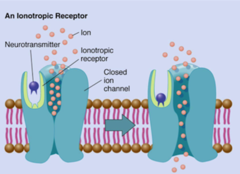
Ionotropic Receptor
a receptor that contains a binding site for a neurotransmitter, opens when correct neurotransmitter binds
Excitatory Postsynaptic Potenial
Na+ channels open(depolarization)
Inhibitory Postsynaptic Potential
K+ channels open(hyperpolarization)
GABA
a major inhibitory neurotransmitter
Seratonin
Affects mood, hunger, sleep, and arousal
Endocrine System
Cells that secrete long distance hormones
3 Classes of Hormones
Amines, Peptides/Proteins, Steroids
Amines, Peptides/Proteins
Water soluble, act on membrane receptors, stored in vesicles, rapid responses, activate signal-transduction pathways, ex: glucagon
Steroids
Lipid soluble, act on intracellular gland, made on demand, slow gene transcription effects, ex: testosterone

Pituitary Gland
Master gland, Posterior- directly connected to brain, Anterior- connected to brain by vessels
neurosecretory cells
Neurons that release hormones into blood
Receptor upregulation
makes tissue MORE sensitive to a signaling molecule
Receptor downregulation
makes tissue LESS sensitive
Oxytocin
Regulates birth/milk ejection
Sensory input to hypothalamus(kitten suckling)
Oxytocin release
Muscles contract- milk produced
POSITIVE FEEDBACK
ADH
conserves H20 by reducing water loss in urine
Posterior Pituitary- neurons in Hypothalamus generate thirst, releases ADH to Distal Tubule
Thirst lowers blood osmolarity
ADH goes back to normal osmolarity
Sweat/dehydration increases osmolarity
Receptor triggers ADH release
Osmolarity
solute concentration in blood(ex. too salty, not enough H20)
Anterior neurosecretory cells NEVER...
leave hypothalamus
Andrenal gland
Prepares body for stress
Cortex- releases steroids(glucocorticoids)LONG TERM STRESS
Medulla- releases amines(epinephrine/norepinephrine)SHORT TERM STRESS
Behavioral Ecology
How behavior contributes to survival/reproduction
Proximate Causation
HOW behavior occurs
Ultimate Causation
WHY a behavior evolves
Fixed Action Pattern
Unlearned, innate behaviors
Ex: mother goose rolling eggs back to nest
Sign Stimulus
External stimulus that triggers FAP
What regulates behavior?
Genes, learning, and environment
Piloting
use of familiar landmarks
Orientation
Movement along compass line(ex: monarch butterfly migration)
Navigation
Compass lines and map(ex: messenger pigeon)
How do bees communicate?
Waggle dance: shows direction and location of food in relation to sun
Round dance: food near to hive
Intersexual Selection
Female chooses mate based off characteristics
Intrasexual Selection
Competition between males, winner mates with all females
Polygamy
Multiple partners
Seen in mammals(mom feeds, internal fertilization, independent young)
Monogamy
One partner
Seen in birds(both feed, helpless young, external fertilization)