Intra-uterine & Perinatal Infection
 Call Kai
 Learn
 Practice Test
 Spaced Repetition
 Match
 Flashcards
 Knowt Play
1/139

There's no tags or description
Looks like no tags are added yet.
140 Terms
Why are pregnant women particularly vulnerable to infection?
• Hormonal and physical changes – pregnant uterus places pressure on abdominal organs which may cause renal tract dilation.
• Immunosuppressed state.
• +/- impaired glucose tolerance
3 types of infections pregnancy makes you more susceptible to
More susceptible to infection generally but especially:
• Urinary tract infections (UTI)
• If membranes ruptured – then risk of ascending infection (chorioamnionitis)
• Influenza and other viral infections tend to be more severe
Congenital infections tend to manifest as what 3 things
Growth Retardation- low birth weight
Congenital Malformations
Foetal Loss- Stillbirths
Name the organisms most responsible for congenital infections
Rubella
CMV
HIV
Toxoplasma gondii
Treponema pallidum (syphilis)
Parvovirus B19
HSV
VZV
How do perinatal (around time of birth) infections manifest
Meningitis
Septicaemia
Pneumonia
Preterm labour
Name the organisms most responsible for perinatal infections
Neisseria gonorrhoeae
Chlamydia trachomatis
HSV
Group B Streptococcus (Streptococcus agalactiae)
E. coli
Listeria monocytogenes
How do postnatal infections manifest
Meningitis
Septicaemia
Conjunctivitis
Pneumonitis
Name 2 organisms that cause postnatal infections that are transmitted through the umbilicus
Staphylococcus aureus, Clostridium tetani (tetanus)
Name 3 organisms that cause postnatal infections that are transmitted by person-to-person contact
Group B Streptococcus, Listeria monocytogenes, E. coli
Name 3 organisms that cause postnatal infections that are transmitted through breast milk
HIV, CMV, HBV
Name 2 organisms that cause postnatal infections that are transmitted by contact with eyes/conjunctiva
N. gonorrhoeae, C. trachomatis
Are congenital infections usually mild/moderate/severe
Often mild/no apparent maternal infection
Wide range of severity in the baby
How are congenital infections diagnosed
Serological diagnosis
Common features of congenital infections
◦ Thrombocytopenia
◦ Ear and/or eye abnormalities
◦ Rash
◦ Cerebral abnormalities
◦ Hepatosplenomegaly; hepatitis; jaundice
Name 5 congenital infections routinely screened for
• Hepatitis B
• HIV
• Syphilis
• Rubella
• +/- VZV (chicken pox)
Name 4 congenital infections not routinely screened for
• Toxoplasmosis
• Herpes group viruses e.g. CMV, HSV
• Parvovirus
Is Hepatitis B an RNA/DNA virus
DNA virus
What is the commonest mode of transmission for Hepatitis B
Vertical transmission
If hep B is acquired vertically, what % develop chronic infection with risk of cirrhosis and HCCa (Hepatocellular carcinoma)
90%
If hep B is acquired in adulthood, what % develop chronic infection with risk of cirrhosis and HCCa (Hepatocellular carcinoma)
10%
When hep B is transmitted vertically is is generally in utero or around delivery
around delivery
(In utero transmission <2%)
Which specific antigen do you screen for in Hepatitis B antenatal screening
HBV surface antigen (HBVsAg)
What happens once someone is diagnosed with Hep B in an antenatal screening
Notifiable disease
Household contacts screened & vaccinated if not immune
Hepatitis B Immunoglobulin (HBIG) ASAP after birth & vaccine at birth/0, 2, 4 & 6 months of age. (4 doses) (usually 3 doses of 6 in 1 (DTaP/IPV/Hib/Hep B)
Maternal referral for treatment
What happens if someone is found to be HIV positive in a pregnancy screening
• Treatment with anti-retroviral drugs.
• C-section delivery.
• Avoid breastfeeding in developed world. In developing countries, not breastfeeding is a greater risk to the child – encouraged
Name some interventions that can be done to avoid HIV vertical transmission

In a baby born to HIV positive mother, what Ig(s) would be detectable in the baby, how
IgG will be detectable due to maternal transfer across placenta
In a baby born to HIV positive mother, when would you expect Ig levels to be gone again
Usually 9 months, but maybe up to 15 months
Risks to a baby born to a mother with untreated syphilis in first 2 years after infection
• Foetal/Perinatal death (20%)
• Preterm delivery (20%)
• Congenital syphilis (40%)
How might a baby born to a mother with untreated syphilis present
At birth - may be asymptomatic or multi-system involvement or present much later

What type of organism is Syphilis – T. pallidum
A spirochaete
Name the screening tests for Syphilis
ELISA (+/- RPR and TPHA).
Why are high risk pregnancies rescreened in 3rd trimester
Reinfection can occur
What do you do if pregnancy screening tests positive for Syphilis
Positive results need repeat for confirmation
Get previous treatment details
Penicillin is treatment of choice.
Refer to GUM/ID service
What is another name for Rubella
German measles
Is rubella a DNA/RNA virus
RNA virus
True/False Rubella is self-limiting
True
Rubella symptoms
Rash & fever
Does rubella present more severe in adults/children
Often more severe in adults.
How is rubella transmitted (& high/low infectivity)
Droplet spread – high infectivity
A sample of what is tested for rubella
Serology / Oral secretions
Is rubella notifiable
Yes
What type of vaccine is rubella & significance of this?
Included in MMR vaccine (live vaccine – do not give in pregnancy and delay pregnancy for 1 month after giving).
During what weeks of pregnancy is there the greatest risk of transmission (what is the % risk of transmission)
1st 11 weeks
>90% risk of transmission
The 1st 11 weeks is also when contracting rubella is riskiest - why
Greatest risk of severe congenital infection affecting hearing, heart, eye and brain
Transmission % risk & risk of what problems if rubella is contracted at 16-20 weeks of pregnancy
45% transmission risk
Deafness only.
There is a risk of what problems if rubella is contracted at 20+ weeks of pregnancy
No increased adverse foetal outcome
What Ig for rubella is most important to test for in mothers - why?
IgG
IgG can cross placenta from mother
What IU/ml if IgG would lead you to offer rubella vaccination post-partum
<10 IU/ml
Why would you only offer rubella vaccination post-partum
Avoid live vaccines in pregnancy
What can you take from if a baby tests positive for Rubella IgM
IgM can’t cross placenta – if detected, means baby has been infected in-utero
If congenital rubella confirmed, urine and oral secretions are infectious for how long
Up to one year
What precautions are taken with babies with congenital rubella in hospital
Need to isolate baby if in hospital
What poses the highest risk of rubella in Ireland
Imported cases of rubella through international travel/migration
Herpes group viruses are not part of the routine screening programme. Name 3 of these viruses
VZV – varicella zoster virus
HSV – herpes simplex virus
CMV - cytomegalovirus
Are Herpes family viruses DNA/RNA
DNA
Another name for VZV – varicella zoster virus
Chickenpox
Risk with VZV (general & specific problem)
Chickenpox in pregnancy can be more severe than in non-pregnant adults
Can → pneumonia
How to treat VZV → pneumonia
If pneumonia – admit; isolate; IV aciclovir
Foetal varicella syndrome is seen in up to 2% of foetuses in what stage of pregnancy
Foetal varicella syndrome = up to 2% in 1st 20 weeks
Foetal varicella syndrome Sx
Limb deformities
Skin scarring
Chorioretinitis
If someone has had significant exposure, test blood for which VZV Ig
VZV IgG
What do you do if IgG is present/not present for VZV
If VZV IgG detected – already immune – reassure.
If VZV IgG not detected and significant exposure, PEP may be indicated
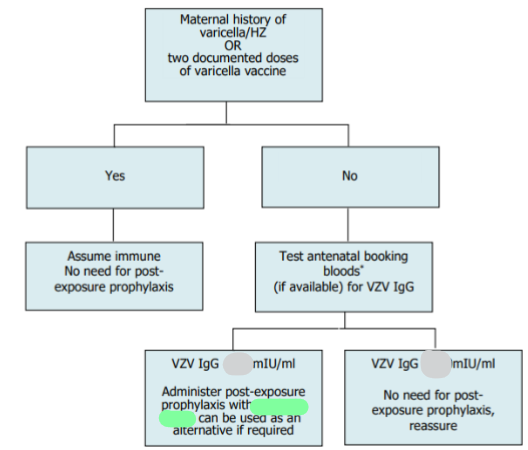
Grey = how much
Green = Tx

Describe the process for Post exposure prophylaxis (PEP) – if non-immune and significant exposure
• Management discussed with Obstetrician/Microbiologist/ID re the use of PEP & option risks/benefits discussed with woman.
• Immunoprophylaxis with oral aciclovir is as effective as VZIG. Little evidence that prophylaxis will prevent cong varicella syndrome in the first 20/40.
• Aciclovir (800mg QDS days 7-14 post-exposure) first-line option for prophylaxis; VZIG reserved if the woman is unable to take aciclovir. Aciclovir preferable in view of administration, limited VZIG supply and potential for donor-related illness from VZIG. Aciclovir not licensed in pregnancy but robust safety data to recommend its use in the setting of VZV.
• If >7 days post exposure, 7 day course of aciclovir can be started up to day 14. VZIg can be given up to 10 days post exposure but ideally <96 hours.
• Subsequent exposure to VZV: Risk assess; Repeat VZV IgG; If further PEP warranted - additional 7 day course aciclovir. If >3/52 or more after the first dose of VZIG, an additional dose may be given
Grey = how long.
Green = Tx

HSV1 Sx in primary infection & reactivation
1ry infection may be asymptomatic or severe painful ulceration of throat & mouth.
Reactivation → cold sores
HSV2 Sx in primary infection
Painful ulceration of GU (genitourinary) tract
Risks in Neonatal herpes
Can cause a severe systemic viral infection with high morbidity and mortality
When is neonatal herpes acquired
Usually acquired at, or around, delivery.
Sx of Neonatal herpes
Encephalitis
Disseminated infection – CNS, skin, eyes
Localised eye, skin or mouth disease
How would the virus reach the foetus if the primary infection is contracted in 3rd trimester
May be HSV2 or HSV1 from maternal genital tract especially if 1ry infection in 3rd trimester
How can Neonatal herpes be prevented
C-section delivery
Tx for Neonatal herpes
Aciclovir
Cytomegalovirus (CMV) is a common cause of viral infection, which can cause what Sx
Neonatal hearing loss and brain damage
How does a primary CMV infection present in mother
asymptomatic or 'flu-like illness
When in pregnancy is the greatest risk of transmission of a primary infection
1st 12 weeks
What can cause a non-primary CMV infection
Reactivation or infection with different CMV strain
Best way of preventing CMV
The most common source of infection is saliva/urine of young children so risk can be reduced by hygiene-based measures, e.g. handwashing
If screening doesn’t exist for CMV, how is anyone tested
CMV testing is usually offered only to pregnant women who develop symptoms of influenza, glandular fever or hepatitis, or routine U/S scan detects foetal anomalies
If a pregnancy woman gets a primary CMV infection in the first 12/40, what is given to reduce the risk of the baby becoming infected
Valaciclovir
All babies born to women with confirmed/suspected CMV infection should be tested for CMV how & when
In urine or saliva within the first 21 days of life
What fraction of babies born with CMV infection will have clinically detectable signs at birth
1/8
All infants with CMV infection at birth should be followed up for minimum of how long to check for what
2 years
Check hearing and brain development
How could symptomatic CMV infection at birth present
Jaundice, rash, microcephaly, hepatosplenomegaly or small for gestational age
What Tx is given for symptomatic CMV infection at birth & why?
Valganciclovir treatment can reduce hearing loss in 5/6 babies, and improve long-term brain development outcomes in some
Toxoplasmosis is also not screened for. What organism causes this (name & type)
Toxoplasma gondii - Protozoan parasite
What is the definitive host for Toxoplasma gondii
Cat

Toxoplasmosis Sx
Often asymptomatic or mild 'flu-like illness in healthy non-pregnant people
What happens with Toxoplasmosis in pregnancy
Can cross placenta & cause serious developmental abnormalities.
(At birth, 40% symptomatic; 60% asymptomatic, may have long term sequelae)
If Toxoplasmosis is diagnosed in pregnancy, when does tx for mother/baby occur
If diagnosed in pregnancy, treatment of mother during pregnancy and baby after birth may attenuate (reduce) serious damage
How to prevent transmission of Toxoplasmosis
• Wash hands before handling food.
• Thoroughly wash all fruit and vegetables.
• Thoroughly cook raw meats and ready-prepared chilled meals.
• Wear gloves and wash hands after handling soil/gardening.
• Avoid cat faeces in cat litter or soil
Parvovirus B19 signs/sx
“Slapped cheek syndrome” mostly in children
Adults can get acute arthritis
Targets RBCs → aplastic crisis esp. if immunodeficiency or haemolytic anaemia
What fraction of maternal Parvovirus B19 infections during pregnancy are transmitted across the placenta to the foetus
1/3
Risk of maternal Parvovirus B19 infections transmitting across the placenta to the foetus
Hydrops foetalis & Death (esp. in first 20/40).
If a Parvovirus B19 infection has transmitted across the placenta to the foetus
Intervention with intrauterine transfusion
Zika virus is also not screened for but how would it present
Zika is a viral infection that usually causes a mild illness that typically lasts between 2 and 7 days. 80% of people who become infected by Zika virus have no symptoms.
How is Zika virus transmitted
Zika virus is spread through the bite of a mosquito that is in certain countries and unprotected sexual contact (without a condom) with an infected partner.
How many Corona viruses are known to infect humans
7
Sx of these 4 CoVs (HKU1, NL63, OC43, and 229E)
Mild - moderate URTI
10-30% common cold
Viral pneumonia occasionally