2. cells and tissues of the immune system
 Call Kai
 Learn
Learn Practice Test
 Spaced Repetition
 Match
Match Flashcards
 Knowt Play
1/48

Earn XP
Description and Tags
Describe the different cells of the innate immune response and how they respond to infection. Identify the primary and secondary lymphoid organs and their functions. Describe how innate and adaptive immune cells are generated in the bone marrow and briefly outline their main functions.
Name | Mastery | Learn | Test | Matching | Spaced | Call with Kai | Chat |
|---|
No analytics yet
Send a link to your students to track their progress
49 Terms
What is the primary function of the immune system
to eliminate pathogens and minimise the damage they cause
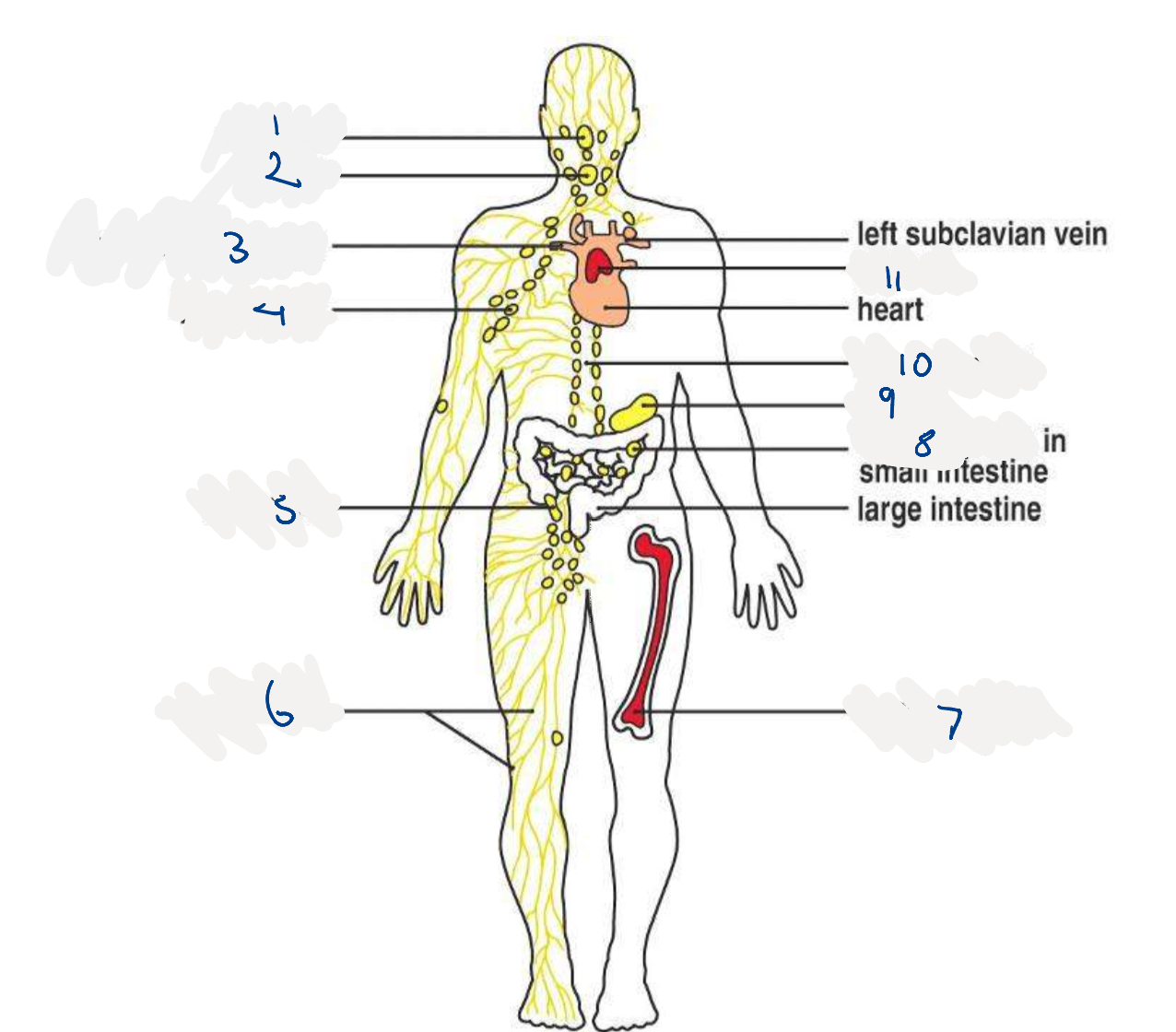
LABEL
adenoid
tonsil
(right subclavian vein)
lymph node
appendix
lymphatics
bone marrow
Peyer’s patches
spleen
thoracic duct
thymus
What do primary lymphoid organs do
develop and mature adaptive immune cells (lymphocytes)
what are the primary lymphoid organs, and for what cells
Bone marrow for B cells, Thymus gland for T cells
what do secondary lymphoid organs do
let the mature lymphocytes meet pathogens to practice being cool
what are the secondary lymphoid organs?
spleen, adenoids, tonsils, appendix, lymph nodes, Peyer’s patches, mucosa-associated lymphoid tissue (MALT)
Where are lymph nodes
all over the place. strategically
what do they act as
a ‘meeting place’ for immune cells like T and B lymphocytes, which enter the node and congregate at specific regions
what do T and B lymphocytes do there?
they encounter a matching dendritic cell showing off an antigen, and activate and multiply to find and destroy the source of invasion.
what’s the shape and size of the node
it changes in response to lymphocytes being activated.
how’s the shape and size of the node change
the dendritic cells crawl across the meshwork of fibroblast cells (that keep the shape intact) to warn them that the node’s gonna fill up.
fibroblasts relax, allowing the node to expand. meanwhile, the meshwork expands too.
when the lymphocytes leave, the node less full, the fibroblasts regain tension and the node gets smaller.
what’s the spleen do
It does a similar thing to lymph node, though not as organised as lymph nodes. it’s also the biggest secondary lymphoid organ

What the MALT do?
takes all the food w bacteria in it
translocates some of it throught the gut epithelium
innate immune cells pick them up and present them to lymph nodes
etc~
where is MALT?
lining intestinal epithelium in big lymphoid follicles lining it.
what’s haematopoiesis?
the making of blood in the bone marrow.

LABEL (good luck)
multipotent stem cell
myeloid progenitor
megakaryocyte
platelets
erythroblast
reticulocyte
red blood cells
myeloblast
monocyte
macrophage
dendritic cell
neutrophil
basophil
eosinophil
lymphoid progenitor
B-lymphocyte
Plasma cell
T-lymphocyte
NK cell
abundance distribution of leukeocytes
50-70% neutrophils
20-40% lymphocytes
1-6% monocytes
1-3% eosinophils
<1% basophils
what are innate immune systems like
non-specific
fast response (minutes)
no memory
what is an adaptive immune system like
highly specfic (discriminates among other molecular entities)
slow response (days)
memory ( recalls previous contact w an antigen & shows a stronger response the 2nd time)
diversity (has capacity to respond to almost any antigen that may be encountered)
what happens w monocytes → macrophages
Monocytes circulating in the blood migrate to tissues where they either differentiate to macrophages.
macrophages can then either become activated, or differentiate again into smth specific
macrophages for the lung
alveolar macrophages
macrophages for connective tissue
histocytes
macrophages for kidneys
mesangial cells
macrophages for brain
microglial cells
macrophages for liver
kupffer cells
macrophages for bone
osteoclast
What is phagocytosis
the ingestion and destruction of particles/microbes by macrophages
steps of phagocytosis
bacterium becomes attached to membrane evaginations called pseudopodia
bacterium is ingested, forming phagosome
phagosome fused with lysosome
lysosomal enzymes digest captured material
digestion products are released from the cell.
why are granulocytes called that
they have lots of different granules, that stain differently depending on the cell type
3 types & the granule stain colour
eosinophil- pink
basophil- blue
neutrophil- purple

neutrophil abundance percentage in granulocytes, live length, notable component, roles
95%
short-lived
major component of pus
do phagocytosis and release antimicrobial factors
eosinophil, basophil and mast cell roles
killing parasites using target recognition.
Associates w allergies too
how do the three kill parasites
they use IgE to grab a parasite and release the granule contents onto the helminth, killing it <3
How are they associated with allergies
they release cytokine, which triggers inflammation
difference between the phils and mast cells here?
mast cells reside in tissues while eosinophils and basophils circulate in the blood.
natural killer cells use
they recognise and destroy “abnormal cells” such as cells that’re virus-infected and cancer cells, cuz those are small. they do so with cytotoxic granules containing perforins and granzymes
how do natural killer cells detect the cells
problem cells don’t have MHC class I molecules peeking out of the cell.
how are T and B cells similar
morphologically when not activated
how’s activation happen
antigen-presenting cells displaying them and blah blah blah.
three steps of B-cell activation
Selection
Multiplication
Differentiation
selection
a B cell is for a specific receptor for the antigen is selected among millions
multiplication
the B cell multiplies and gives a clone on B cells after binding of the antigen
differentiation
multiplied B cells differentiate into plasma cells and memory cells
what do plasma cells do
they produce antibodies specific for the antigen
what do memory cells do
they’re kept to be ready for the second entry of the same antigen.
diffentiation of T cells
T helper 1 cells
T helper 2 cells
Cytotoxic T cells
what do T helper 1 cells do
they help macrophages digest pathogens
what do T helper 2 cells do
they help B cells produce antibodies
what to cytotoxic T cells do
they kill virus-infected cells