physics chapter 2 kinematics
 Call Kai
 Learn
Learn Practice Test
 Spaced Repetition
 Match
Match Flashcards
 Knowt Play
1/14

Earn XP
Description and Tags
Name | Mastery | Learn | Test | Matching | Spaced | Call with Kai | Chat |
|---|
No analytics yet
Send a link to your students to track their progress
15 Terms
Speed and velocity
** must know definition of speed+velocity

Example question

Example question
** remember displacement can be negative (when go opp dircetion)
** have to state both magnitude + direction
** must state statement
eg, take the direction right as positive (can also use cardinal direction)
if we state dircetion we can drop the -ve

Representing direction
** can also state to the left/right
** taking the direction right as positive

Acceleration
a = v-u/t

uniform acceleration
** must memorise definition of uniform acceleration

Example question

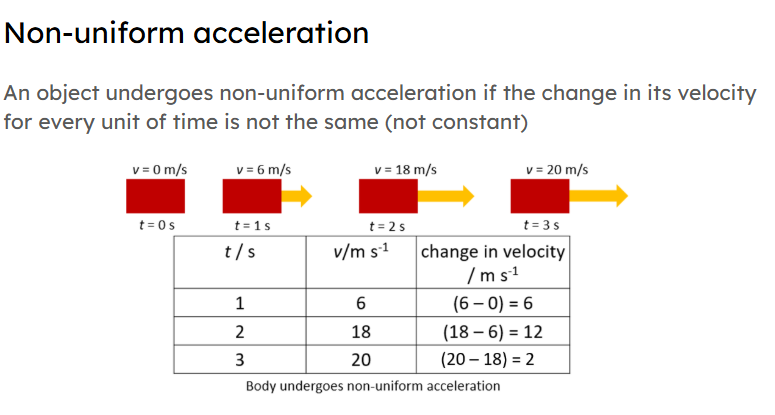
Non-uniform acceleration
Distance-time graphs

Distance-time graph of motion
Gradient of dist time graph —> speed
gentle —> steep ( increasing speed)
steep—> steep (decreasing speed)

speed-time graph
increasing speed = acceleration
decreasing speed = deceleration
constant speed, acceleration = 0
Gradient of speed-time graph = acceleration
gentle to steep —> increasing acceleration/ deceleration
steep to gentle —> decreasing acceleration/deceleration
** must state both speed and accleration

Area under speed-time graph
** distance= area under speed-time graph (must write this)

acceleration of freefall (5)

acceleration of freefall

reminders
** remember displacement can be negative (when go opp dircetion)
** have to state both magnitude + direction
** must state statement
eg, take the direction right as positive (can also use cardinal direction)
if we state direction, we can drop the -ve
use ruler to split parts
describing motion of speed-time graph→ must state bothe speed + acceleration
s^-1 → per second
acceleration =-2 → deacceleration = 2
acceleration of freefall can work both upwards and downwards