The Cultural Landscape-Chapter 2 Unit 2
 Call Kai
 Learn
Learn Practice Test
 Spaced Repetition
 Match
Match Flashcards
 Knowt Play
1/60

There's no tags or description
Looks like no tags are added yet.
Name | Mastery | Learn | Test | Matching | Spaced | Call with Kai | Chat |
|---|
No analytics yet
Send a link to your students to track their progress
61 Terms
Ecumene
The portion of the Earth's surface occupied with permanent human settlement
Epidemiological Transition
Distinctive causes of death in each stage of the demographic transition
Agricultural Density
The ratio of the number of farmers to the total amount of land suitable for agriculture
Arithmetic Density
The total number of people divided by the total land area
Census
A complete enumeration of a population
Crude Birth Rate (CBR)
The total number of live births in a year for every 1,000 people alive in the society
Crude Death Rate (CDR)
The total number of deaths in a year for every 1,000 people alive in the society
Demographic Transition
The process of change in a society's population based on the CDR, CBR and NIR
Natural Increase Rate (NIR)
The percentage growth of a population in a year computed as the CBR minus the CDR (does not include migration)
Demography
The scientific study of population characteristics
Doubling Time
The number of years needed to double a population, assuming a constant NIR
Industrial Revolution
A series of improvements in industrial technology that transformed the process of manufacturing goods
Infant Mortality Rate (IMR)
The total number of deaths in a year among infants under 1 year of age for every 1,000 live births in a community
Medical Revolution
Medical technology invented in Europe and North America that has diffused to the LDCs in Latin America, Asia, and Africa. Improved medical practices have eliminated many of the traditional deaths in LDCs and enabled more people to live longer and healthier lives
Life Expectancy
The average number of years an individual can be expected to live, given certain social, economic, and medical conditions
Overpopulation
A situation where the number of people in an area exceed the captivity of resources and the environment to support life at a decent standard of living
Pandemic
Disease that occurs over a wide geographic area and affects a very high portion of the population (plagues)
Epidemic
A widespread occurrence of an infectious disease in a community at a particular time (outbreaks)
Degenerative Diseases
Chronic disorders associated with aging (cancers)
Delayed Degenerative Diseases
Chronic disorders associated with aging (cancers) but the life expectancy is extended through medical advances
Physiological Density
The number of people per unit of area of able land, which is suitable for agriculture
Population Pyramid
A bar graph that represents the population distribution of population by age and sex

Sex Ratio
The number of males per 100 females in the population
Total Fertility Rate (TFR)
The average number of children a woman will have throughout her childbearing years (ages 15-49)
Zero Population Growth
A decline of the TFR to the point where the NIR equals 0
Nonparticipation
Census is somewhat inaccurate because homeless people, undocumented citizens and ethnic minorities do not participate in the census forms
Demographics
The study of human population distribution and migration
World Population Distribution
•Almost 90% of all people live in the Northern hemisphere and 10% in Southern
•Urban areas are increasingly growing
•Most people live near sea level (most arable lands are located at low altitudes)
•About 2/3 of the world population are concentrated within 300 miles of an ocean
East Asia
1/4 of the world population-Includes eastern China, the islands of Japan, the Korean peninsula, and Taiwan. Unlike Japan/Korea where 93% of people work in urban areas, nearly half of China's people work in rural areas
South Asia
1/4 of the world population-Includes India, Pakistan, Bangladesh and Sri Lanka. The largest concentration of people live along a 1,500 km corridor from Lahore, Pakistan, through India and Bangladesh to the Bay of Bengal.
Europe
Includes four dozen countries-Most of population is concentrated in cities and fewer than 5% of the people are farmers.
Southeast Asia
Around 600 million people live here, mostly on a series of islands that lie between the Indian and PAcific oceans-Includes Indonesia which is the 4th most populous country in the world containing 13,677 islands.
What are the four major clusters of human population?
Europe, East Asia, South Asia, and Southeast Asia
Population Density
The relationship between the number of people and the area they occuy
Dependency Ratio
The number of people too young or too old to work compared to the number of people old enough to work
Population Growth through History
Increased from
3-4 billion in 14 years
4-5 billion in 13 years
5-6 billion in 12 years
6-7 billion in 12 years
Will saving poor children lead to overpopulation?
No
Carrying Capacity
The ability of the land to sustain a certain number of people
Environmental Degradation
The harming of the environment
Thomas Malthus
A British man that concluded that the rate of population was growing at a faster rate than agriculture productivity in the 1700s
Linear Growth (Arithmetic)
A constant rate of growth across each unit of time
Exponential Growth
Rate of growth is defined as a percentage across each unit of time
Population Projections
Uses demographic data to determine future populations
Demographic Momentum
A continued population increase as a result of a large segment of the population being young
Natality Rate
CBR
Suffrage/Enfranchisement
The right to vote
Dowries
A woman must pay the man's family for the right to marry that man
Dowry Death
The groom's family will kill the bride because of her inability to pay the dowry
Disease Diffusion
The spread of disease
What are the main causes of population increase?
•Medical advances
•Quantity and quality of food
•Ethnic and religious issues
•Economic issues
What are the main causes of population decrease?
•Natural hazards and disasters
•War or political turmoil
•Economic issues
Place Utility
The process of increasing the attractiveness of a product to a group of consumers by altering its physical location
How can the concentration of the world's population be determined?
Earth's land area is divided into seven portions, each containing around 1 billion people (for land area) or can be displayed in a cartogram (for the size of population for each country)
Dry Lands
These areas are too dry for farming and lack sufficient water and therefore most people do not live here but because these areas contain natural resources such as petroleum, these areas aren't necessarily useless
Wet Lands
These areas receive very high levels of humidity and precipitation, which rapidly depletes nutrients from the soil and thus hinders agriculture
Cold Lands
The polar regions are unsuitable for planting crops, few animals can survive the extreme cold and very few people live there
High Lands
Because oxygen is sparser in higher altitudes and mountains are typically covered in snow, the high mountains are sparsely settled
Do MDSs or LDCs have higher NIRs? Why?
LDCs have higher NIRs because typically, less people are educated in developing nations, which causes people to have more children (birth control, expenses information, jobs, etc)
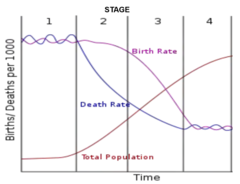
Demographic Transition
A model that represents the process of change in a nation's population using the CBR, CDR and NIR of that nation

Demographic Transition: Stage 1
Consists of a very high CBR, very high CDR and a very low NIR-No country in the world in is this stage because this stage represents when people would find found by hunting and gathering (indigenous people still practice this such as people living in the Amazon Rainforest)
Demographic Transition: Stage 2
Consists of a high CBR, rapidly decreasing CDR and a very high NIR-