AQA A level Bio 5.1 Photosynthesis
 Call Kai
 Learn
Learn Practice Test
 Spaced Repetition
 Match
Match Flashcards
 Knowt Play
1/32

Earn XP
Description and Tags
33 Terms
The photolysis of water is an important part of the process of photosynthesis. Describe what happens in the photolysis of water. (2)
Water forms H+ and e- (1)
Oxygen is formed (1)
Describe the effect of light energy in the light-dependent reaction of photosynthesis (2)
Light (is absorbed by chlorophyll which) excites the electrons (1)
causes electrons to leave chlorophyll (1)
Describe the role of electron transport chains in the light-dependent reactions of photosynthesis (6)
Electron transport chain accepts excited electrons (1)
from photosystems (1)
Electrons lose energy as they pass down the chain (1)
ATP is produced (1)
From ADP + Pi (1)
Reduced NADP is formed (1)
The products of the light-dependent stage are used in the light-independent stage of photosynthesis. What are these products used for? (1)
Needed for the production of glucose (1)
Describe how the products of the light-dependent reaction are used in the light-independent reaction to produce triose phosphate. Do not include the role of ribulose bisphosphate (RuBP) in your answer. (3)
ATP and reduced NADP (1)
ATP provides energy (1)
GP reduced to triose phophate (1)
A student used chromatography to separate the different photosynthetic pigments in a chlorophyll solution. She had the following materials. Chromatography paper A, ruler, and pencil ,Suitable glassware, A solvent (solvent A) 2 cm3 of the chlorophyll solution Describe how she could use these materials to separate the photosynthetic pigments by chromatography. (4)
Draw line/origin on chromatography paper (using ruler and pencil) (1)
(Use pipette) to add chlorophyll/solution to origin (1)
Add solvent/A below line/origin (1)
Remove/stop (from glassware) before solvent reaches end (of chromatography paper)
OR
mark (position) where solvent reaches/front (1)
In the following passage the numbered spaces can be filled with biological terms.
During photosynthesis, plants produce (1) compounds which contain carbon, such as carbohydrates, lipids and proteins. Most of the sugars synthesised by plants are used by the plant in (2) . The rest are used to make other groups of biological molecules. These biological molecules form the biomass of the plants. Biomass can be measured in terms of mass of (3) per given area per given time. The chemical energy store in dry biomass can be estimated using (4) . Write the correct biological term beside each number below, that matches the space in the passage. (2)
1- Organic
2- respiration
3- animals
4- calorimetry (2)
Describe the light-independent reaction of photosynthesis. (6)
Carbon dioxide combines with RuBP (1)
Produces two GP molecules using (enzyme) rubisco (1)
GP reduced to triose phosphate (1)
Using reduced NADP (1)
and using energy from ATP (1)
Triose phosphate converted to glucose/RUBP /organic substance (1)
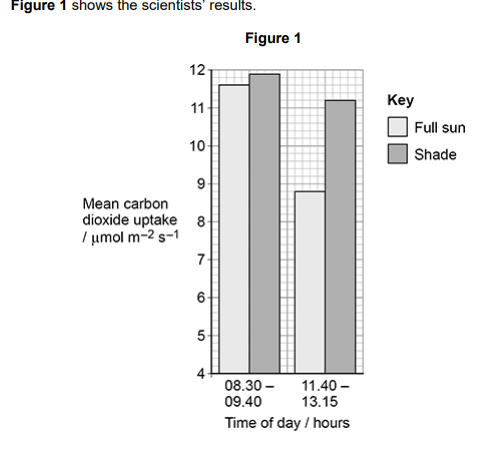
Scientists investigated the effect of full sun and shade on the rate of photosynthesis in a species of shade-tolerant tree. To estimate the rate of photosynthesis, the scientists measured uptake of carbon dioxide by trees in a forest. They measured uptake of carbon dioxide during two parts of the day:
• 08.30 – 09.40 hours
• 11.40 – 13.15 hours.
In this species of tree, very high light intensities can inhibit the release of electrons from chlorophyll. Suggest how this could explain the results shown in Figure 1 for 11.40 to 13.15 hours. (4)
Less ATP and reduced NADP produced (1)
Less GP reduced/converted to triose phosphate (1)
Less triose phosphate to regenerate RuBP (1)
Less RuBP to react with carbon dioxide (1)
Mature leaves from slow-growing, shade-tolerant plants produce poisonous chemicals that are a defence against being eaten by herbivores. Suggest how this benefits slow-growing, shade-tolerant plants. (3)
(In the shade, so) less/slower rate of photosynthesis (1)
(slow-growing, so ) would take a long time to replace (mature leaves) (1)
Plants can maintain (a large enough) surface area for photosynthesis (1)
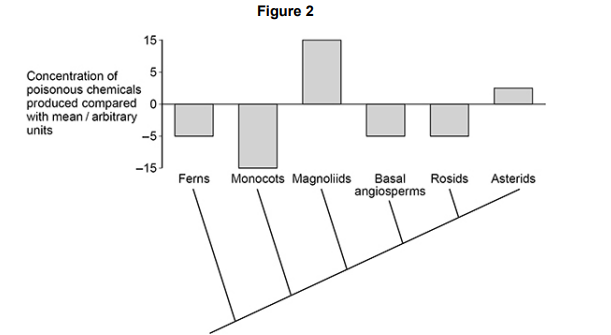
Scientists measured the concentration of poisonous chemicals produced by shade-tolerant plant species in six taxa. They compared this with the mean concentration of poisonous chemicals produced by all plants and the phylogenetic relationships between the six taxa. Figure 2 shows the scientists’ results
A journalist published the following summary of these results. ‘The more recently a shade-tolerant plant species evolved, the greater the concentration of poisonous chemicals it produces.’ Do the data in Figure 2 support this summary? Justify your answer. (2)
No
the highest concentration was not in the most recently evolved species (1)
The least recently evolved species/ferns have the same concentration as more recently evolved species/basal angiosperms/rosids (1)
Heat stress is a condition that often occurs in plants exposed to high temperatures for a prolonged period of time. Heat stress is a major factor in limiting the rate of photosynthesis
Heat stress decreases the light-dependent reaction of photosynthesis
Explain why it leads to a decrease in the light-independent reaction (2)
less ATP is made (1)
less NADPH (1)
Another effect of heat stress is a decrease in the activity of the enzyme rubisco. A decrease in the activity of an enzyme means that the rate of the reaction it catalyses becomes slower. A decrease in the activity of the enzyme rubisco would limit the rate of photosynthesis. Explain why. (2)
Less CO2 available to react with RuBP (1)
Less/no GP (1)
Describe how NADP is reduced in the light-dependent reaction of photosynthesis (2)
NADP is reduced by electrons (1)
from photolysis/chlorophyll (1)
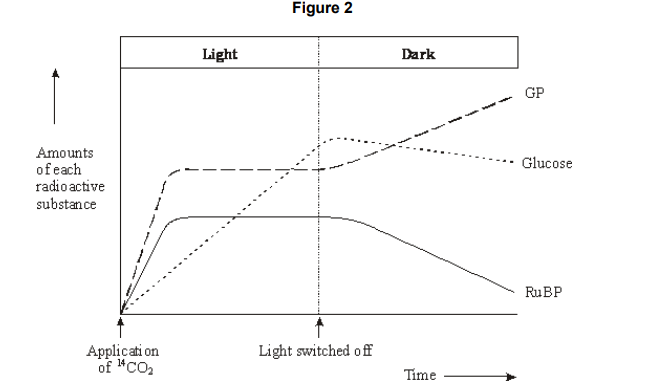
Figure 2 shows the results of an experiment in which photosynthesising cells were kept in the light and then in darkness.
In the experiment the cells were supplied with radioactively labelled 14CO2 . Explain why the carbon dioxide used was radioactively labelled. (1)
CO2 is used in photosynthesis and this allows detection of products (1)
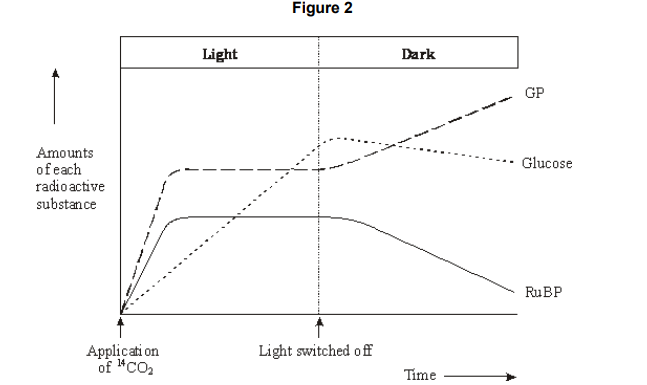
Figure 2 shows the results of an experiment in which photosynthesising cells were kept in the light and then in darkness.
In the experiment the cells were supplied with radioactively labelled 14CO2 .
Explain how lack of light caused the amount of radioactively labelled glycerate-3-phosphate to rise (2)
ATP and reduced NADP is not found (1)
GP is not being converted to form RuBP (1)
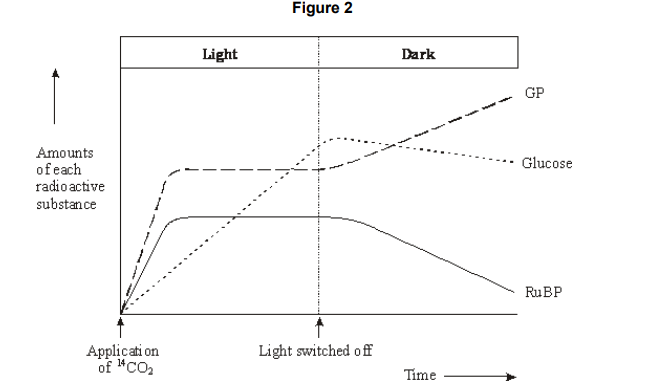
Figure 2 shows the results of an experiment in which photosynthesising cells were kept in the light and then in darkness.
In the experiment the cells were supplied with radioactively labelled 14CO2 .
Explain what caused the amount of radioactively labelled glucose to decrease after the light was switched off. (1)
Used in respiration (1)
Photosynthesis takes place in the chloroplasts. These are disc-shaped organelles surrounded by outer envelope consisting of two layers of membrane. Inside, there are further membranes which are arranged in stacks called grana. Surrounding these is the stroma. Chlorophyll and other light-capturing pigments are found on the membranes of the grana and it is here that the light dependent reaction takes place. This generates the ATP and reduced NADP which are used in the light-independent reaction in the stroma
Using information in the passage, describe how the structure of a chloroplast is adapted to its function in photosynthesis (3)
Membranes / disc shape provides large surface for light absorption (1)
layering of membranes allows a lot of pigment (1)
stroma contains enzymes for Calvin cycle (1)
Describe what happens in the photolysis of water (2)
light excites electrons (1)
water is broken down into protons, electrons and oxygen (1)
The products of the light-dependent stage are used in the light-independent stage of photosynthesis. What are these products used for ? (1)
needed for the production of glucose (1)
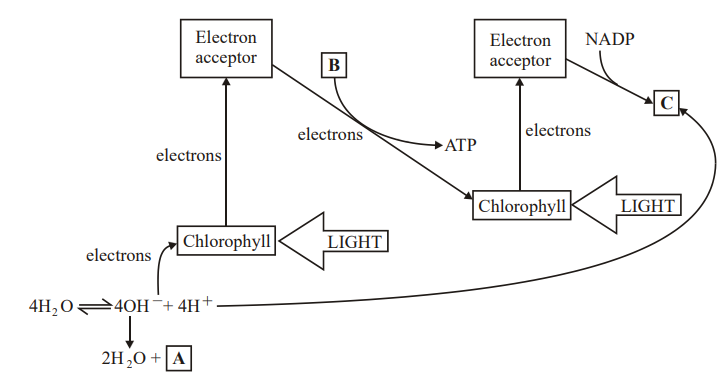
The diagram shows the light-dependent reactions of photosynthesis
Use information in the diagram to explain the role of chlorophyll in photolysis (3)
Chlorophyll absorbs light (1)
loses electrons/become positively charged (1)
Accepts electrons from photolysis of water (1)
Some bacteria use hydrogen sulphide, H2S, to produce organic compounds.
The hydrogen sulphide has a similar role to that of water in photosynthesis.
A simple equation for this process in bacteria is shown below:
hydrogen sulphide + carbon dioxide → glucose + sulfur + water
Suggest what the hydrogen sulphide is used for in these bacteria (2)
H2S provides H+ ions and electrons (1)
The H+ will reduce NADP to produce NADPH since co-enzyme gains the H+ (1)
Describe the role of electron transport chains in the light-dependent reactions of photosynthesis (6)
Electron transport chain accepts excited electrons (1)
from photosystems (1)
electrons lose energy as they pass down the chain (1)
ATP is produced (1)
from ADP + Pi (1)
Reduced NADP is formed (1)
Describe what happens during photoionisation in the light-dependent reaction. (2)
Chlorophyll absorbs light or light excites/moves electrons in chlorophyll (1)
Electrons are lost/Chlorophyll becomes positively charged (1)

A student obtained a solution of pigments from the leaves of a plant. Then the student used paper chromatography to separate the pigments. The diagram shows the chromatogram produced.
Explain why the student marked the origin using a pencil rather than using ink. (1)
ink and (leaf) pigments would mix
OR
(with pencil) origin/line still visible (1)
Where precisely is rubisco found in a cell (1)
Stroma (1)
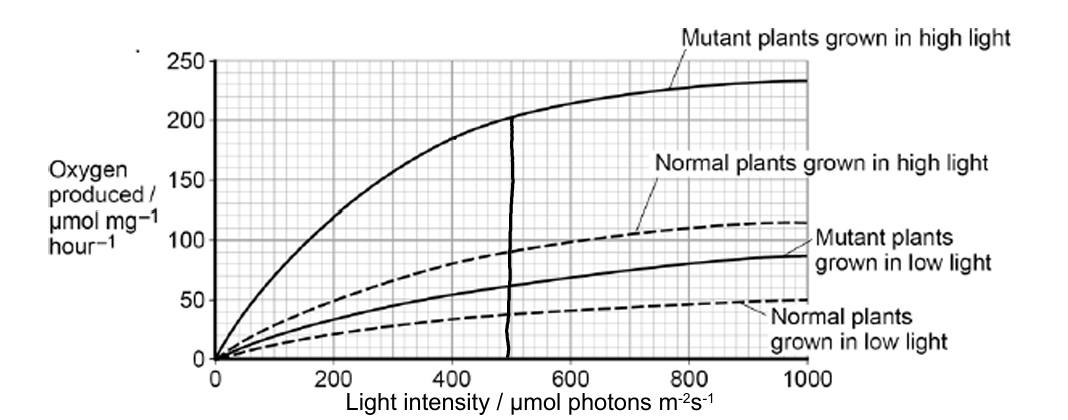
Chloroplasts contain chlorophyll a and chlorophyll b. Scientists found tobacco plants with a mutation that caused them to make more chlorophyll b than normal tobacco plants. They investigated the effect of this mutation on the rate of photosynthesis.
The scientists carried out the following investigation.
• They grew normal and mutant tobacco plants. They grew some of each in low light intensity and grew others in high light intensity.
• They isolated samples of chloroplasts from mature plants of both types.
• Finally, they measured oxygen production by the chloroplasts they had isolated from the plants. The figure below shows the scientists’ results.
The figure below shows the scientists’ results
In each trial, the scientists collected oxygen for 15 minutes.
Calculate the difference in the oxygen produced by the chloroplasts from mutant plants grown in low and high light intensities at a light intensity of 500 μmol photons m-2 s–1. Show your working. (2)
(200-60)/4 = 35 μmol Oxygen per mg chlorophyll (2)

The diagram below shows one type of calorimeter.
A calorimeter can be used to determine the chemical energy store of biomass. A known mass of biomass is fully combusted in a calorimeter. The heat energy released from this combustion increases the temperature of the water in the calorimeter. The increase in the temperature of a known volume of water is recorded. Other than the thermometer, explain how two features of the calorimeter shown in the diagram above would enable a valid measurement of the total heat energy released (2)
Stirrer distributes heat (energy) (1)
Insulation/space/ai reduces loss/gain of heat (1)

Chloroplasts contain chlorophyll a and chlorophyll b. Scientists found tobacco plants with a mutation that caused them to make more chlorophyll b than normal tobacco plants. They investigated the effect of this mutation on the rate of photosynthesis.
The scientists carried out the following investigation.
• They grew normal and mutant tobacco plants. They grew some of each in low light intensity and grew others in high light intensity.
• They isolated samples of chloroplasts from mature plants of both types.
• Finally, they measured oxygen production by the chloroplasts they had isolated from the plants. The figure below shows the scientists’ results.
The figure below shows the scientists’ results
The scientists suggested that mutant plants producing more chlorophyll b would grow faster than normal plants in all light intensities. Explain how these data support this suggestion. (4)
At all light intensities, chloroplasts from mutant plants :
Have faster production of ATP and reduced NADP (1)
So have faster/more light-independent reaction (1)
so produce more sugars that can be used in respiration (1)
so have more energy for growth (1)
Plants and algae produce fuels called biofuels. Scientists have used Chlorella to produce biofuel. Chlorella is a genus of single-celled photosynthetic alga. Chlorella can be grown in open ponds and fermenters.
In natural ecosystems, most of the light falling on producers is not used in photosynthesis. Suggest two reasons why (2)
Light is reflected (1)
Light is wrong wavelength/rf to absorbing specific wavelengths (1)
OR
CO2 concentration or temperature is a limiting factor.
A teacher studying these data with her students told her class that no definite conclusions could be drawn when comparing the mean values in the graph. Suggest why the teacher said this. (2)
No error bars/SD (1)
To show if overlap occurs so difference (in means) is not significant/due to chance
OR
To show if no overlap occurs so difference (in means) is significant / is not due to chance. (1)
Atrazine binds to proteins in the electron transfer chain in chloroplasts of weeds, reducing the transfer of electrons down the chain. Explain how this reduces the rate of photosynthesis in weeds. (4)
Reduced transfer of protons across thylakoid membrane (1)
(so) less ATP produced (1)
(so) less reduced NADP produced (1)
(so) light-independent reaction slows (1)
When treated with Atrazine, weeds have been shown to give off small amounts of heat. Suggest an explanation for this observation. (1)
Idea that energy is released from high energy excited electrons (that were lost from chlorophyll) (1)