Exam 3 - Chemistry of Opioids (Jaki)
 Call Kai
 Learn
 Practice Test
 Spaced Repetition
 Match
 Flashcards
 Knowt Play
1/38

There's no tags or description
Looks like no tags are added yet.
39 Terms
Learning Objectives:
Describe the role of opium in history
➢ Differentiate the chemical characteristics of the opium alkaloids,
(semi)synthetic opioid alkaloids & endogenous peptides
➢ Explain structural characteristics/differences of the opioid agonists/antagonists
➢ Describe structure activity relationships
➢ Classify opioid drugs
➢ Describe drug metabolism
➢ Explain characteristics of the opiate receptors
What are narcotic analgesics?
Analgesics that cause sleep or loss of consciousness in junction with analgesic effect
Opioids are chemicals that work by binding to the opioid receptors which are found prinicipally in the CNS and GI tract
What was the prototype opioid?
Morphine
What structures make up opioid alkaloids and narcotic analgesics?
5-ring structure made up of:
A = aromatic ring
B = cyclohexane ring
C = cyclohexene ring
D = piperidine ring
E = tetrahydrofurane ring
Three dimensional structure: five rings
➢ three rings are approx. in the same plane.
➢ Two rings, including the nitrogen one, are each at right angles to the other trio
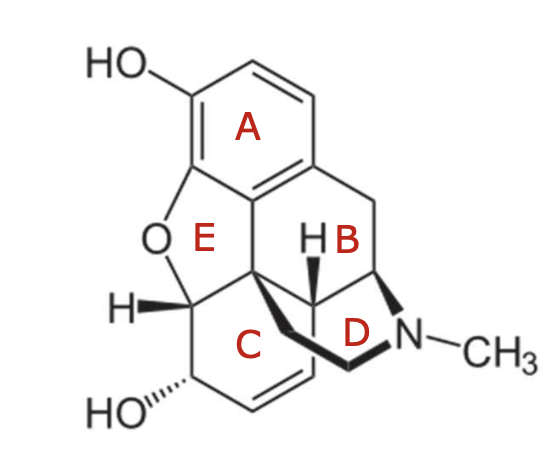

Which functional groups are present in the structure of narcotic analgesics and opium alkaloids?

Phenol
Ether
Tertiary amine
Allylic alcohol = alcohol group + double-bond on neighboring carbon
How many chiral carbons does morphine have? Which one is the active conformation?
5 chiral carbons but only the (-) isomer is active as an analgesic
5R
6S
9R
13S
14R

N-17 is a tertiary amine, which is protonated under physiologic conditions.
N-demethylation, via CYP3A4, yields nor-morphine which has decreased opioid activity and bioavailability, why might this be?
N-demethylation deactivates morphine
Makes the molecule less polar, more basic
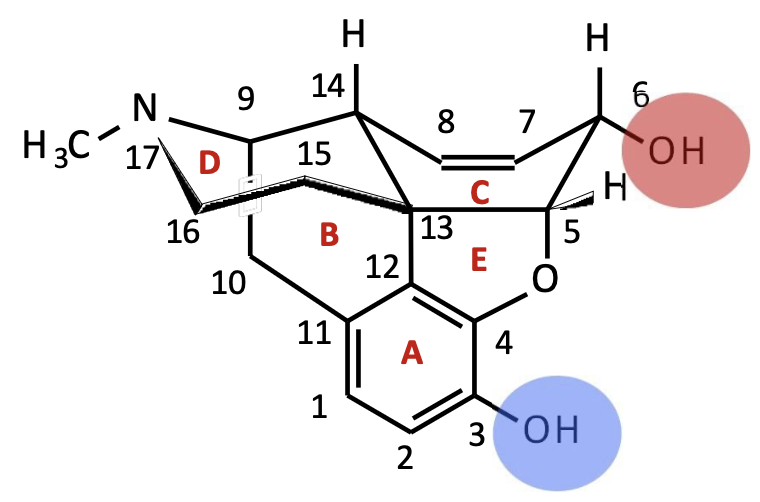
One of the major pathways of morphine metabolism is conjugation with glucuronic acid. There are -OH groups present on C3 and C6, which would yield an active mtabolite? Which yields an inactive metabolite?
Glucuronidation of OH-group on C6 → Active metabolite = Morphine-6-glucuronide
Glucuronidation of OH-group on C3 → Inactive metabolite = Morphine-3-glucuronide
Heroin is considered what kind of opioid? What is the structure?
Semi-synthetic opioid

Heroin = Di-acetylmorhpine
What are endogenous opioid peptides?
Peptides in the brain with pharmacologic actions similar to morphine- Ensogenous ligands = endorphins (derived from endogenous and morphine)
What are the two enkephalins? Which amino acid is essential for activity?
Met-enkephalin
Tyr-Gly-Gly-Phe-Met
Leu-enkenphalin
Tyr-Gly-Gly-Phe-Leu
The tyrosine at the first amino acid residue position is ESSENTIAL for endorphin activity
Enkephalins have higher affinity for the delta opioid receptor than for the mu-opioid receptor
Beta-endorphin (humans):
Tyr-Gly-Gly-Phe-Met-Thr-Ser-Glu-Lys-Ser10-Gln-Thr-Pro-Leu-Val-Thr-Leu-Phe-Lys-Asn20-Ala-Ile-Ile-Lys-Asn-Ala-Tyr-Lys-Lys-Gly-Glu31)
Beta-endorphin is the putative endogenous ligand for the mu-opioid receptor subtype
Note: the presence of Met-enkephalin sequence at the amino terminal***
Dynorphins
Tyr-Gly-Gly-Phe-Leu-Arg-Arg-Ile-Arg-Pro-Lys-Leu-Lys-Trp-Asp-Asn-Gln
All dynorphins have the Leu-enkephalin sequence at their amino terminals
Which endogenous opioid peptides contains the Met-enkephalin sequence at its amino terminal?
Beta-endorphins (human)
Which endogenous opioid peptides contains the Leu-enkephalin sequence at its amino terminal?
Dynorphins
What do ALL endogenous opioid peptides have in common?
They all have Tyrosine as a terminal amino acid
ALL opioid receptors are..?
G-coupled proteins receptors
Opioids are ligands to the receptors
What are the four types of opioid receptors?
mu
delta
kappa
Nociceptin aka ORL 1 (non-classical receptor)
Endogenous peptides have higher affinity to which opioid receptor subtype?
Mu-receptor → beta-Endorphin > enkelphalins > dynorphins
Delta receptor → Enkephalins >> endorphins and dynorphins
Kappa receptor → Dynorphins >> endorphins and enkelphalins
Demethylation of codeine (prodrug) by CYP2D6 yields which compound?
Morphine

N-demethylation of codeine (prodrug) by CYP3A4 yields which compound?
Norcodeine (inactive metabolite)

Glucuronidation of morphine (at C6 and C3) leads to which compounds? Which is active?
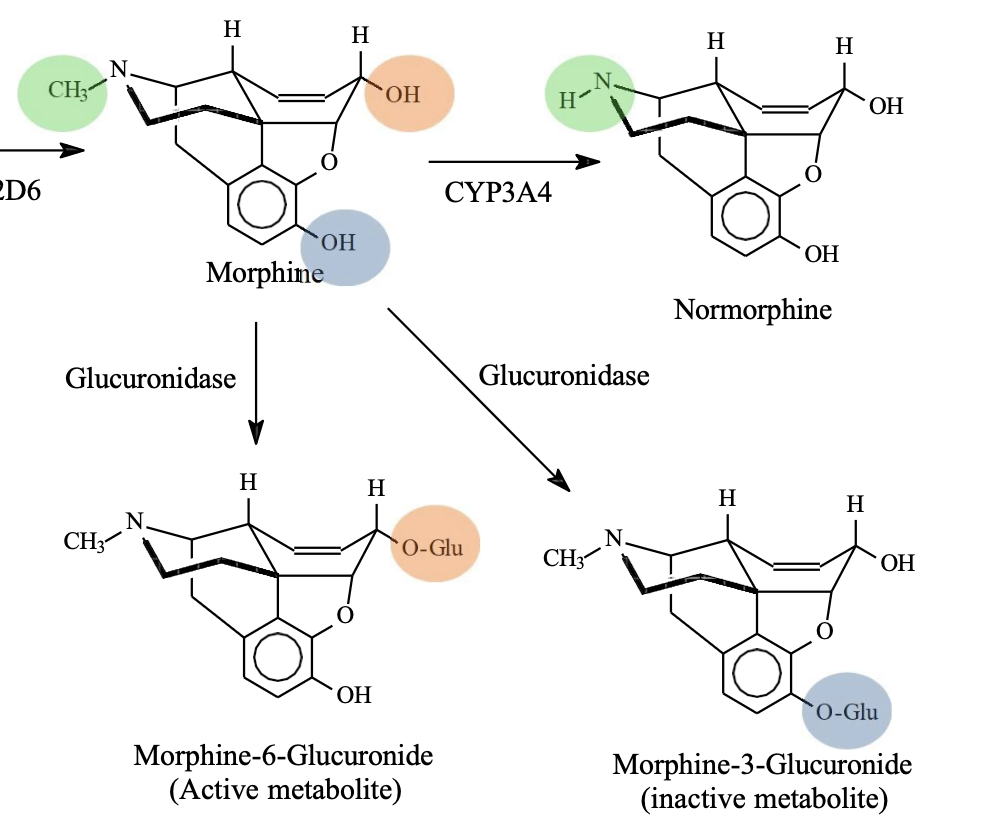
Morphine-6-Glucuronide → ACTIVE
Moprhine-3-Glucuronide → Inactive
CYP3A4 metabolism of morphine → Normorphine
What is the role of the aromatic ring in opioids?

Allows for pi-stacking → Tighter fit into the receptor
Fits like a key in a lock
This shows an enkephalin bound to its receptor. Which site is required to exert its effects?


T-site (Tyrosine binding site) is required → Binds at the same same as morphine
Phenolic aromatic ring
Enkephalins also have a second binding site (Phenylalanine binding site - P-site) but only the T-binding site is required
Which binding site is required for morphine to bind to its receptor?
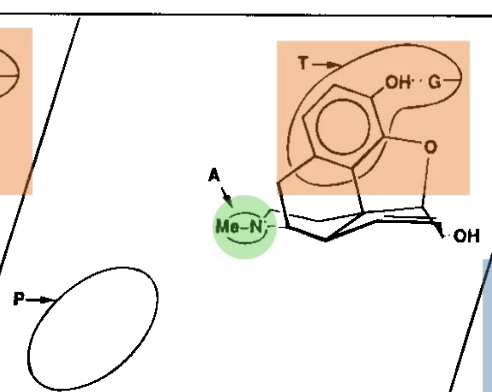
Tyrosine-binding site is required
Morphine does not have a P-binding site

What kind of endogenous opioid peptide is binding in this diagram?
Meperidine-type opioid binding to the receptor using the P-site (phenylalanine binding site)

What is the role of the OH-group on carbon 3?
OH-group helps binding to receptor because it can build H-bonds
Aromatic ring compounds bind tightly to the receptor due to pi-stacking and H-bond strengthen this interaction

How does substitutions on carbon 3 change the activity of morphine analogs?
Activity DECREASES if there’s H-atom on C3 (instead of OH-group)
Prodrug: If O-CH3 or CH3CO- on C3

How does the activity of morphine analogs change with substitutions to the OH-group on Carbon 6?
6-H
OCH3
CH3CO
ALL INCREASE ACTIVITY

How does the activity of morphine analogs change if there’s substitution (phenyl ring + ethyl chain) on the N-atom (N-17)?
Creation of P-binding site! (Phenylalanine binding site) → Increases activity
Which selective mu-opioid agonists are prodrugs? How can you tell?

Hydrocodone and Oxycodone are prodrugs
Ester (OCH3) = prodrug
What kindof activity does Buprenorphine have?
Buprenorphine = Antagonist at the delta and kappa receptor
N-dealkylation to the Nor-buprenorphine metabolite = Partial Agonist at mu-opioid receptor
Has antihyperalgesic effect due to its antagonistic activity at the kappa-opioid receptors
What are examples of fully synthetic opioids?
Meperidine and Pethidine
What are safety concerns with Meperidine?
Penetrates BBB quickly: rapid onset but with a high abuse potential.
Metabolized via N-demethylation to nor-meperidine (metabolite) →
High levels of normeperidine can cause CNS excitation (tremors, seizures)
What is a contraindication to Meperidine use?
SSRIs and MAO inhibitors!
Meperidine + MAO inhibitors → Absolute contraindication
Meperidine inhibits serotonin reuptake →
Potential concern for serotonin syndrome, especially with other serotonergic drugs
Insertion of what between the ring and phenyl group greatly diminishes CNS toxicities found in meperidine and related analogues (such as tramadol and propoxyphene)
Extra nitrogen
Fentanyl is considered 80x more potent than morphine, which might these be?
Phenethyl group on the piperidine nitrogen allows it to bind to both T- and P-sites of the mu-opioid receptors
Also, very lipophilic → Quick onset and quick metabolism lead to a short duration of action

What is the MOA of Methadone?
Fully synthetic opioid
mu-receptor agonist
NMDA antagonist
Inhibits both serotonin and norepinephrine reuptake
What is the MOA of tramadol?
Fully sythetic opioid
Weak mu-receptor agonist
It also works by inhibiting norepinephrine [via the (-) enantiomer] and serotonin re-uptake [via the (+) enantiomer].
Like codeine, tramadol is O-demethylated by CYP2D6 to a more potent mu-receptor agonist having ~200 X higher affinity than the parent compound.