Functions of political parties -- policy formulation and hidden
 Call Kai
 Learn
 Practice Test
 Spaced Repetition
 Match
 Flashcards
 Knowt Play
1/26

There's no tags or description
Looks like no tags are added yet.
27 Terms
Policy formulation of the ruling party and 6 groups involved
Policy formulation of ruling party = that of the govt (duh)
Includes
Political leaders - ministers
Civil servants
Advisory units and committees
Private advisors
(Backbench MPs)
(Peers)
Policy formation of the opposition
Very important as they’re trying to replace the govt of the day
Includes
Leader
Leadership of the group
General membership of the party through conferences and party committees on a local/regional/national level
Aggregation (= policy-formulating function) and those who undertake it
Process undertaken by political parties of converting policies, demands and ideas into practical policy programmes for govt
Includes
Identifying range of demands from party members, society and other groups
Converting demands into consistent and compatible actions
Involves
Removal of contradictions
Making compromises
Undertaken by
Party leadership as will be the ones to eventually put it into practice in govt
Policy formulation’s role in supporting democracy: accountability
Govts can be held responsible for their performance in govt using their manifesto promises
Policy formulation’s role in supporting democracy: choice
Clarity of choice: allows electorate a clear choice between potential govts by enabling the presentation of distinct policy options and ideologies
Breadth of choice: increasing numbers of parties post-WW2 gives more electoral choice
Breadth of choice - number of candidates put forward and number of seats won by 8 largest parties in 2019 election
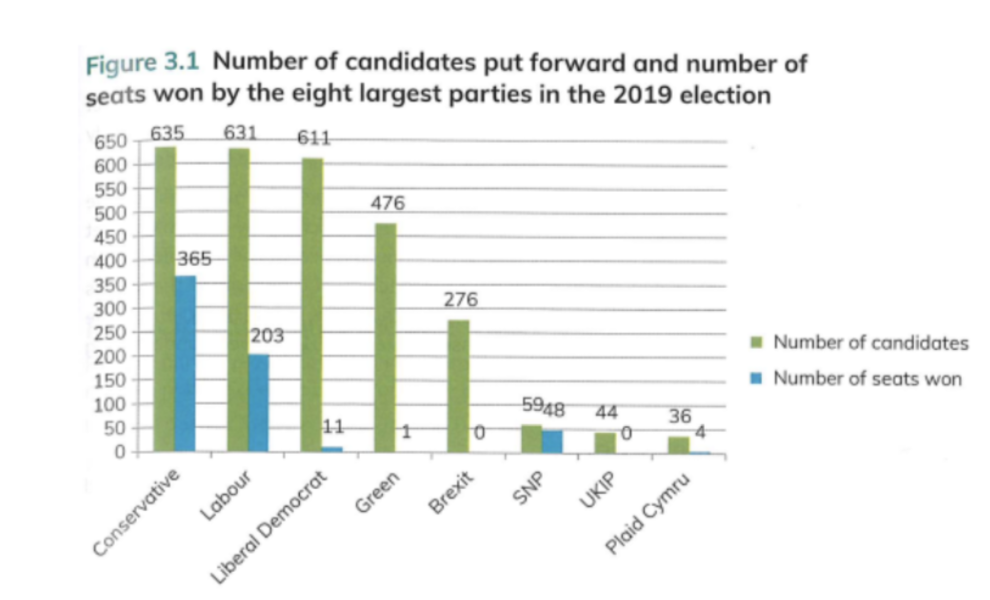
Number of C candidates put forward and number of seats won in 2019 election
635 candidates
365 seats
Number of L candidates put forward and number of seats won in 2019 election
631 candidates
203 seats
Number of LD candidates put forward and number of seats won in 2019 election
611 candidates
11 seats
Number of Green candidates put forward and number of seats won in 2019 election
476 candidates
1 seat
Number of Brexit Party candidates put forward and number of seats won in 2019 election
276 candidates
0 seats
Number of SNP candidates put forward and number of seats won in 2019 election
59 candidates
48 seats
Number of UKIP candidates put forward and number of seats won in 2019 election
44 candidates
0 seats
Number of PC candidates put forward and number of seats won in 2019 election
36 candidates
4 seats
Lack of efficacy of policy formulation: personalities over ideology
Parties have become less interested in long-term good for society and their ideological foundation
More interested in the technocratic choice of who will run the country better/which leader is more personable
They follow public opinion as opposed to shaping it
Lack of efficacy of policy formulation: lack of choice
C and L dominate seats in GEs, so there is no real choice for voters between potential govts
Lack of efficacy of policy formulation: apathy
Lack of clear ideology and voter choice leads to apathy and low turnout
% turnout and % of voters who percieved a large difference betwen parties - 2015
66% turnout
27% great difference
% turnout and % of voters who percieved a large difference betwen parties - 2010
65% turnout
23% great difference
% turnout and % of voters who percieved a large difference betwen parties - 2005
61% turnout
13% great difference
% turnout and % of voters who percieved a large difference betwen parties - 2001
59% turnout
17% great difference
% turnout and % of voters who percieved a large difference betwen parties - 1997
71% turnout
33% great difference
% turnout and % of voters who percieved a large difference betwen parties - 1992
78% turnout
56% great difference
% turnout and % of voters who percieved a large difference betwen parties - 1987
75% turnout
85% great difference
Explanation of hidden function
All main parties support the political system of Plmtary democracy
Therefore, they are part of the process that ensures the general population consents to the system
Parties that fundamentally challenge the nature of the poltical system
Seen as extremist
Are only marginal elements of the system
Events that would occur if parties fundamentally challenged the nature of the political system
Political conflict within society at large