5) International Trade
 Call Kai
 Learn
Learn Practice Test
 Spaced Repetition
 Match
Match Flashcards
 Knowt Play
1/15

There's no tags or description
Looks like no tags are added yet.
Name | Mastery | Learn | Test | Matching | Spaced | Call with Kai | Chat |
|---|
No analytics yet
Send a link to your students to track their progress
16 Terms
Why countries trade
Countries benefit from specialisation and exchange
Australia exports a lot of raw resources, buying them back refined. Not because of capability, bit rather opportunity cost
Countries specialise on prioritising what they can produce with the lost opportunity cost because it is what benefits them the most, trading for other goods
Basic Analysis
We can simplify the analysis into a two-country model
We compare the two goods produced by each country, measuring the input costs to allocate productive efficiency and identify advantages
Absolute and Comparative Advantage
Absolute Advantage
Being able to produce at a cheaper input cost than the other country
Comparative Advantage
Producing at a cheaper opportunity cost compared to the other country
Absolute advantage doesn’t imply comparative advantage
Country Production Possibility Frontier (PPF curve)
Shows the relationship between the production of each good (opportunity cost)
The Y intercept is the max amount of Good A you can produce
The X intercept is the max amount of Good B you can produce
The slope shows the opportunity cost between the two (ie -2 if it costs 2 Ga for a Gb)
International PPF Curve
The country with the lowest OC goes first until hitting their limit, the second continues with their slope until hitting their limit (X intercept for World Production)

Trading Rates
The trading rate would fall between both countries opportunity costs
OCA of LNG < 1 shipment of fuel < OCB of LNG
Trade determines consumption
Countries balance what supply they keep and what supply they trade
Countries may need to trade for resources to be able to consume that resource, meaning the level of trade between countries dictates their consumption
Benefits of international trade
International trade always increases economic surplus
Specialisation makes trading most effective
Countries can consume past their individual PPF as they import
How we analyse domestic welfare, and importers/exporters
To analyse international trade we compare the domestic autarky market against the international price for importing
If the international price is higher than the domestic, the country exports the product and vice versa
Comparative Advantage Market (Exporter)
When the international price is higher than domestic, producers can raise their price above equilibrium
The loss from reduced domestic demand is offset by international exports

Welfare in an exporting market
With the raise in price, producers take the lost consumer surplus, plus the size of exports
The total economic surplus is raised.
Domestic consumers are negatively affected, and producers benefit
Comparative Disadvantage (Importer)
When the domestic price is lower than the international price consumers will often buy from international producers
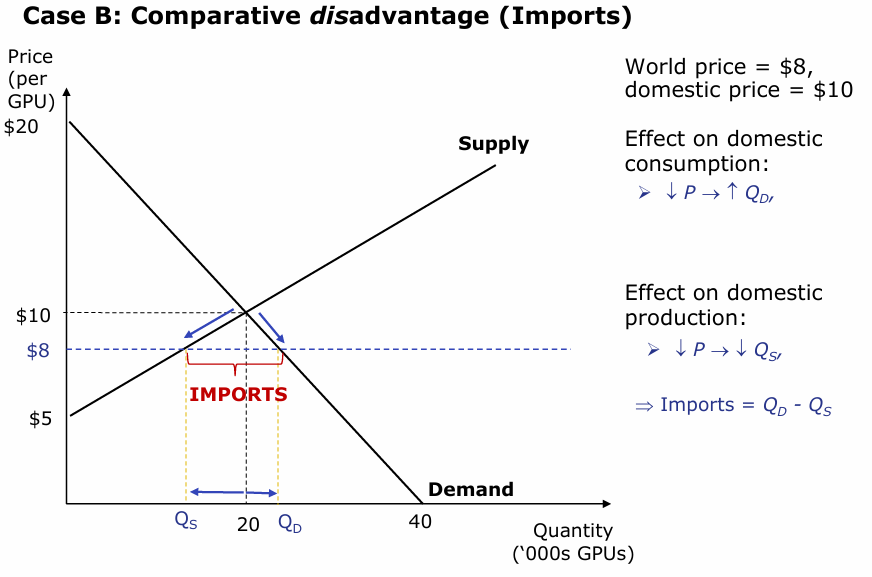
Comparative Disadvantage Welfare
Consumers gain the domestic producers’ loss in surplus, plus the size of imports
Total welfare in increased
Consumers benefit, domestic producers don’t
Tariffs
Tariffs are government taxes on imported goods to “raise the world price“ for domestic use

Tariff Welfare
Restricting potential trade will always reduce Total Welfare and cause DWL

Why are tariffs implimented
Protect local jobs
National security (level of independence)
Unfair competition