7 Introduction to Metabolism
 Call Kai
 Learn
Learn Practice Test
 Spaced Repetition
 Match
Match Flashcards
 Knowt Play
1/53

There's no tags or description
Looks like no tags are added yet.
Name | Mastery | Learn | Test | Matching | Spaced | Call with Kai | Chat |
|---|
No analytics yet
Send a link to your students to track their progress
54 Terms
Energy
required for mechanical work, active transport, and biosynthes
Phototrophs vs chemotrophs
phototrophs can capture energy from sunlight, chemotrophs capture energy through the oxidation of chemicals
metabolism
a highly integrated NETWORK of chemical reactions that carry out energy extraction and synthesis of new material
Common themes in metabolism
ATP is used as an energy currency to link exergonic and endergonic pathways
exergonic/endergonic, spontanaeity
exergonic is the release of energy, negative delta G and spontaneous. Endergonic is the take in of energy, positive delta G, not spontaneous.
enzyme complex
multiple enzymes close together allows efficient processing of unstable intermediates, increases efficiency
catabolism
the sum of reactions that BREAK DOWN (think catastrophe) molecules into simpler ones, product is energy as well
anabolism
the sum of reactions that construct a more complex molecule from simpler molcules by using energy.
Two criteria for a metabolic pathway
individual reactions must be specific
each of the reactions in the pathway must be thermodynamically favored under real conditions (negative delta G)
how do we get through metabolism if a positive delta G
Chemically couples series of reactions. The overall free energy change = the sum of the free energy changes of indv. steps. if the others have a much more negative delta G than one step, it’ll work out.
Cofactors with ATP and basics
Mg2+ or Mn2+, ATP rarely floats around as it's own molecule. ATP is free eenrgy derived from oxydation of food and from light.
why is ATP energy rich, and what gives more energy ATP to ADP or ADP to AMP
ATP to ADP gives more energy, and both because the triphosphate unit contains two phosphoanhydride linkages.
ATP hydrolysis is exer/ender gonic
ATP hydrolysis is exergonic because the products are lower energy and more stable than ATP.
nucloside
the base + the sugar
kinase
an enzyme that transfers a phosphate group from a high energy molecle, usually ATP, to a specific subtrate.
NMPs and NDPs
Nucleoside monophosphate and diphosphate kinases - enzymes that phosphorylate nucleoside mono/di phosphates by removing one of off ATP to make ADP.

ATP vs GTP vs CTP vs UTP
just other nuclroside triphosphates with different nitrogenous bases. They are all energetically equivalent.
important derivatives of ATP
NAD+ and FAD carriers, acyl group carrier coenzyme A.
phosphoryl transfer potential
the tendency of molecules to transfer a phosphoryl group to an acceptor molecule. usually the tendency for an organic molecule to transfer its terminal group to water.
Why does ATP have a high phosphoryl transfer potential (say, compared to glycerol 3 phosphate)?
Electrostatic repulsion of the triphosphate unit, the entropy of the products of ATP hydrolysis is greater, ADP and Pi (products) are stabilized due to hydration, Pi has a grater resonance stabilization than any of the ATP phosphoryl groups.
SAID SIMPLY: ATP + H2O → ADP + Pi. The products are very stable due to aboce reasons. Higher p transfer potential than other bc products are more stable and have more entropy.
ATP in muscle sustains contractile activity for
less than 1 second
Creatine and ATP
Creatine can rapidly regenerate ATP in the muslce because it has stored phosphate groups in the form of creatine phosphate. It can transfer this phosphate group to ADP to regenerate ATP.
Source of ATP change as exercize duration increases
1
ATP stores deplete rapidly
Creatine phosphate is then use for several seconds to minutes
Anaerobic respiration starts within seconds but plateaus relatively quick, like for a sprint.
Aerobic metabolism starts after a few minutes and can be sustained for hours. how people “settle in” to runs.
Why are fats a more efficient fuel source than carbs
By efficient, fats yield more energy because they have much more CH bonds than sugar CO bonds. However, sugars break down much quicker because they are simpler and water soluble.
G3P
Glyceraldehyde 3 phosphate, and intermediate when Glucose is broken down to ATP. This intermediate is oxidized to produce 1,3 BPG, which have a very high phosphoryl transfer potential.
what is the means of being able to couple thermodynamically unfavorable and favorable reaction metabolism
Ion gradients. in animals 90% of ATP is generated when the energy of a proton gradient is coupled with ATP synthesis.
NAD+
Nicotinamide adenine dinucleotie. Transfer their high potetntial electrons to O2. NAD accepts a proton and two elections.
FADH2
flavin adenine dinucleotide accepts TWO protons and two electrons. Electron carrier
NADPH
an electron carrier that supplies electrons for biosynthesis. The electron donor in most reductive biosyntheses.
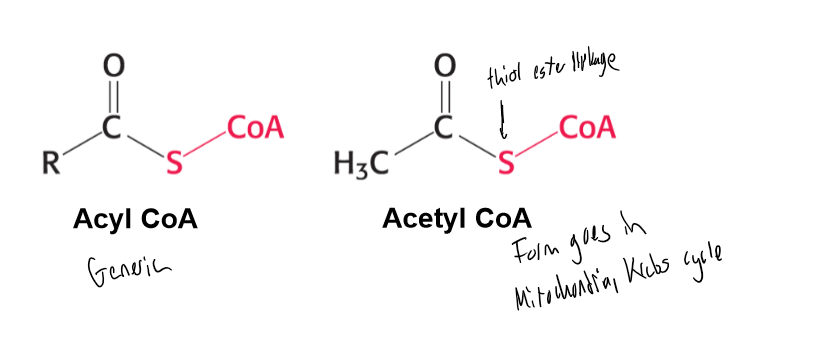
Coenzyme A
A carrier of Acyl Groups. The reactive part is the terminal sulfhydryl group. The acyl group is picked up by the CoA by thiodiester bonds to for acetyl coA. SO just the CoA and S part binds to the acyl part.
How many main types of metabolic reactions
6! ox-red, group transfer, hydrolytic, carbon bond clevage by means other than hydrolysis or oxidation, isomerization, and ligation requiring ATP clevage.
Oxidation reduction reactions
A transfer of electrons. a good example of this is reactions with the electron carriers.
Group transfer reactions
Transfers a functional group from one molecule to another. An example is that this is used to synthesize ATP using a kinase to transfer the functional group of phosphate.
Hydrolytic reactions
Cleavage (breaking of chemical connections like covalent or peptide bonds) of bonds by the addition of water. Ex. hydrolytic cleavage of proteins.
Carbon bond clevage
BY MEANS OTHER THAN HYDROLYSIS OR OXIDATION. Enzymes catalyze the reaction. Just breaking a carbon-carbon bond. Ex. breaking apart a six carbon molecule in glycolysis. Two substrates forming one product or vice versa. The subclass of dehydration also exists, where water is removed!
Isomerization reactions
Rearrangement of atoms to form isomers. Typically done to prepare a molecule for a subsequent reaction.
Ligation reactions
Requires ATP clevage from ATP hydrolysis, formation of new covalent C-C bonds.
How many mechanisms is metabolism regulated by
3! altering the physical AMOUNT of enzyme, restricting the accesibiliy of the substrates (WHERE are the substrates?), and regulating the catalytic activity of the enzymes THEMSELVES internally or externally.
Controlling amount of enzyme
Amount of an enzyme depends on both the rate of synthesis and its rate of degredation. The level of many enzymes is altered by changing the rate of transcription of the genes encoding them.
protein turnover
the degredation and resynthesis of proteins. inappropriate protein turnover can lead to cancer.
Ubiquitin and where it attatches
A small protein that TAGS proteins for destruction. Attatches by its carboxyl terminal Gly residue to the amino groups of 1+ Lys residues on the target protein.
Three enzymes that have a role in attatchment of ubiquitin to protein
E1 activates ubiquitin using ATP and temporarily attatches to itself. E2 recieves and carries it to E3, holding it by a high energy sulfur bond. E3 is the ubiquitin protein ligase, which recognizes the target protein and helps attatch to it.
How many molecules of ubiquitin get attatched
Usually more than one! E3 can remain bound to the target protein and make a chain of multiple. An effective signal for protein degredation is a chain of 4+ ubiquitin molecules linked via Lys 48.
Problems with E3…
Proteins wont be degraded and accumulate, clumping. Angelman syndrome is caused by a defect in a member of the E3 family, a severe neurological disorder characterized by unusally happy, hyperactivity etc.
Overexpression causes autism.