ch. 39 motor mechanisms and behavior
 Call Kai
 Learn
 Practice Test
 Spaced Repetition
 Match
 Flashcards
 Knowt Play
1/47

Earn XP
Description and Tags
48 Terms
Chapter 39 covers (1) _____ contraction, (2) _____ systems, and animal (3) _____.
1) muscle; 2) skeletal; 3) behavior
The muscular system creates (1) _____ forces that allow animals to move, manipulate objects, and perform body functions.
1) mechanical

The three muscle types are (1) _____, which moves bones voluntarily; (2) _____, which forms the heart; and (3) _____, which moves internal organs involuntarily. Muscle contraction requires (4) _____.
1) skeletal; 2) cardiac; 3) smooth; 4) ATP

Skeletal muscles contain bundles of muscle (1) _____. Each muscle fiber contains (2) _____. Thin filaments are made of (3) _____, and thick filaments are made of (4) _____.
1) fibers; 2) myofibrils; 3) actin; 4) myosin

Thin filaments contain (1) _____, troponin, and tropomyosin. Thick filaments contain (2) _____.
1) actin; 2) myosin

The functional unit of muscle contraction is the (1) _____. Thin actin filaments attach at the (2) _____ line, while thick myosin filaments are centered at the (3) _____ line.
1) sarcomere; 2) Z; 3) M

The sliding filament model explains that (1) _____ slides past (2) _____, causing the sarcomere to (3) _____. The filaments themselves do not shorten.
1) actin; 2) myosin; 3) shorten

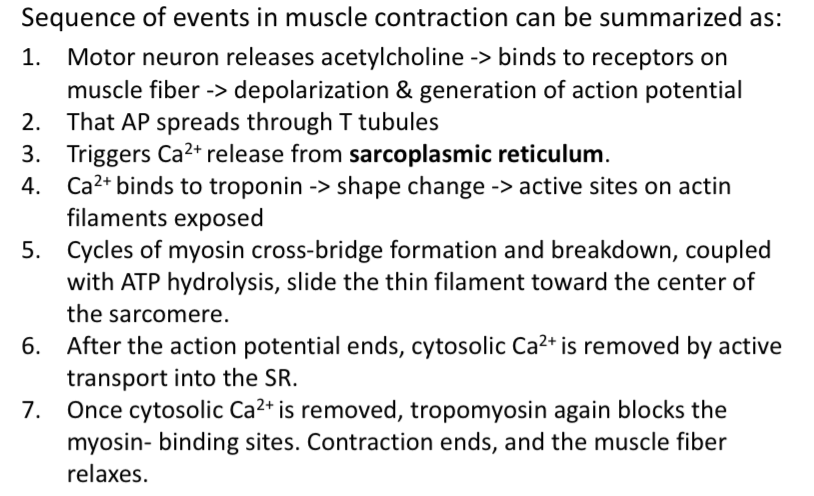
(SAQ) STEP 1: A motor neuron releases (1) _____, which binds receptors on the muscle fiber. This causes (2) _____ and produces an action potential.
1) acetylcholine; 2) depolarization

(SAQ) STEP 2: The action potential enters the (1) _____ tubules, causing the sarcoplasmic reticulum to release (2) _____.
1) T; 2) Ca²⁺

(SAQ) STEP 3: Ca²⁺ binds to (1) _____, causing (2) _____ to move away and expose binding sites on (3) _____.
1) troponin; 2) tropomyosin; 3) actin

(SAQ) STEP 4: Myosin breaks down (1) _____ into ADP and Pi. The energized myosin head attaches to (2) _____, forming a (3) _____.
1) ATP; 2) actin; 3) cross-bridge

(SAQ) STEP 5: The release of (1) _____ from myosin triggers the (2) _____ stroke.
1) Pi; 2) power

(SAQ) STEP 6: During the power stroke, myosin pulls (1) _____ toward the (2) _____ of the sarcomere. The muscle shortens and (3) _____ is released.
1) actin; 2) center; 3) ADP

(SAQ) STEP 7: A NEW (1) _____ molecule binds to myosin, causing myosin to (2) _____ from actin. The cycle repeats if (3) _____ remains available.
1) ATP; 2) detach; 3) Ca²⁺

Muscle contraction follows this sequence: acetylcholine release → action potential → (1) _____ release → calcium binds (2) _____ → actin-myosin cycling uses (3) _____. Relaxation occurs when Ca²⁺ is pumped back into the (4) _____.
1) Ca²⁺; 2) troponin; 3) ATP; 4) sarcoplasmic reticulum
The force of a muscle contraction depends on how many muscle (1) _____ are contracting and how (2) _____ they are stimulated.
1) fibers; 2) frequently

A motor unit contains one motor (1) _____ and the muscle fibers it controls. Recruiting (2) _____ motor units produces (3) _____ force.
1) neuron; 2) more; 3) greater

One muscle stimulus produces a (1) _____. Closely spaced stimuli cause (2) _____, while very rapid stimulation can produce sustained contraction called (3) _____.
1) twitch; 2) summation; 3) tetanus

Muscle fibers are classified by contraction (1) _____ and the main method used to produce (2) _____.
1) speed; 2) ATP

Oxidative muscle fibers use (1) _____ respiration, contain more (2) _____, and resist fatigue. Glycolytic fibers use (3) _____ and fatigue more easily.
1) aerobic; 2) myoglobin; 3) glycolysis

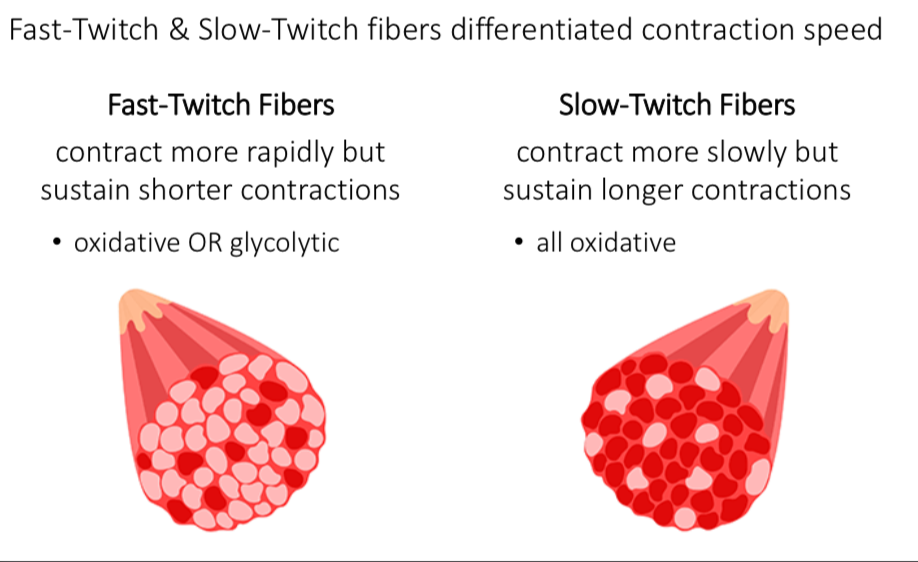
Fast-twitch fibers contract (1) _____ and may be oxidative or glycolytic. Slow-twitch fibers contract (2) _____ and are (3) _____.
1) rapidly; 2) slowly; 3) oxidative
Skeletal systems include (1) _____ skeletons made of pressurized fluid, (2) _____ skeletons outside the body, and (3) _____ skeletons inside the body.
1) hydrostatic; 2) exoskeletons; 3) endoskeletons
Muscles work in (1) _____ pairs. When the biceps contracts and triceps relaxes, the arm (2) _____. When the triceps contracts, the arm (3) _____.
1) antagonistic; 2) bends; 3) extends

The skeletal system provides (1) _____, protection, and helps animals with (2) _____.
1) support; 2) locomotion

A hydrostatic skeleton uses pressurized (1) _____ for support. It is found in animals such as (2) _____ and earthworms.
1) fluid; 2) cnidarians (or flatworms)

An exoskeleton is located (1) _____ the body. Arthropod exoskeletons contain (2) _____ and must be shed through (3) _____ to allow growth.
1) outside; 2) chitin; 3) molting (ecdysis)

An endoskeleton is located (1) _____ the body. It consists of living tissue such as (2) _____ and bone and grows with the animal.
1) inside; 2) cartilage

The (1) _____ skeleton includes the skull, vertebral column, ribs, and sternum. The (2) _____ skeleton includes the limbs and shoulder and pelvic girdles.
1) axial; 2) appendicular

Locomotion occurs when the (1) _____ and (2) _____ systems work together to produce movement.
1) muscular; 2) skeletal

Chapter 39 also studies animal (1) _____, including its causes, communication, learning, and social interactions.
1) behavior
Behavioral ecology studies the (1) _____ and evolutionary causes of animal (2) _____.
1) ecological; 2) behavior

Tinbergen's four questions investigate physiological (1) _____, development, effects on survival and (2) _____, and evolutionary (3) _____.
1) mechanisms; 2) reproduction; 3) history

A (1) _____ cause explains HOW a behavior happens. An (2) _____ cause explains WHY the behavior evolved through natural selection.
1) proximate; 2) ultimate

A zebra hears an alarm and runs. Hearing and nervous-system activation are (1) _____ causes. Avoiding predators and surviving are (2) _____ causes.
1) proximate; 2) ultimate

A female bird responds to a male's song because of hormonal changes, a (1) _____ cause. Choosing a mate that improves reproductive success is an (2) _____ cause.
1) proximate; 2) ultimate

Animal communication involves exchanging recognizable (1) _____. The four main types are visual, (2) _____, tactile, and (3) _____.
1) signals; 2) auditory; 3) chemical

Male fruit flies use (1) _____ signals to see females, (2) _____ signals to identify species, (3) _____ signals by tapping females, and (4) _____ signals through courtship songs.
1) visual; 2) chemical; 3) tactile; 4) auditory

Honeybees perform a (1) _____ dance to communicate the (2) _____ and direction of a food source.
1) waggle; 2) distance

(1) _____ behavior is largely developmentally fixed and does not require learning, although the environment can affect gene (2) _____.
1) innate; 2) expression

Learning changes behavior through (1) _____. (2) _____ is early-life attachment; (3) _____ learning involves remembering locations; (4) _____ learning forms associations; and (5) _____ learning occurs by observing others.
1) experience; 2) imprinting; 3) spatial; 4) associative; 5) social

Mating behavior includes finding and choosing (1) _____, competing for mates, and caring for (2) _____.
1) mates; 2) offspring

(1) _____ involves one male and one female. (2) _____ involves one male with multiple females. (3) _____ involves one female with multiple males.
1) monogamy; 2) polygyny; 3) polyandry

(1) _____ selection involves competition within one sex for mates. (2) _____ selection involves choosing mates of the opposite sex. Both can produce sexual (3) _____.
1) intrasexual; 2) intersexual; 3) dimorphism

Social behavior involves interactions among (1) _____ or more animals. Benefits include cooperative hunting and (2) _____ from predators. Costs include competition and disease (3) _____.
1) two; 2) protection; 3) transmission

Altruism occurs when an animal (1) _____ another individual, even if the behavior comes at a (2) _____ to itself.
1) benefits; 2) cost

Inclusive fitness = (1) _____ fitness + (2) _____ fitness. Direct fitness comes from one's own offspring, while indirect fitness comes from helping (3) _____ reproduce.
1) direct; 2) indirect; 3) relatives

Hamilton's rule is (1) _____ > C. The letter r means genetic (2) _____, B means benefit to the (3) _____, and C means cost to the (4) _____.
1) rB; 2) relatedness; 3) recipient; 4) helper
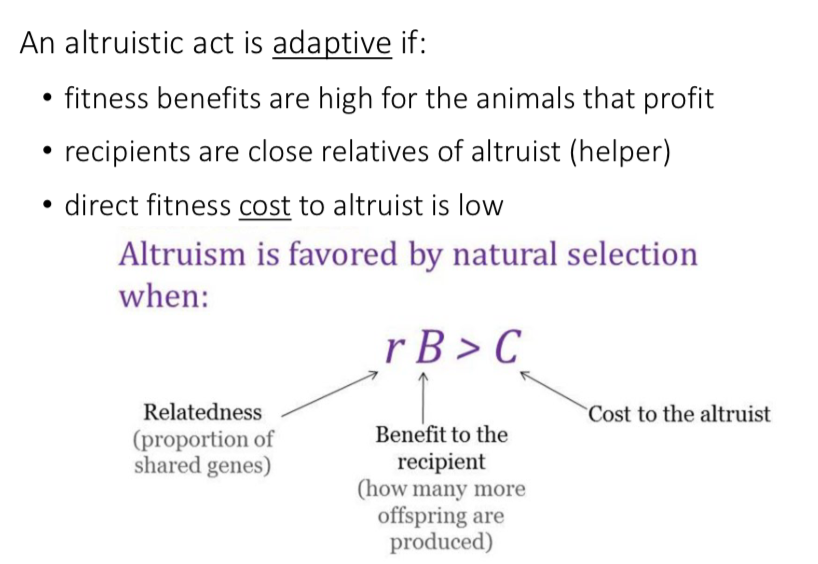
Kin selection favors helping (1) _____ reproduce. It becomes weaker as genetic (2) _____ decreases.
1) relatives; 2) relatedness
