Normative influence slides
 Call Kai
 Learn
 Practice Test
 Spaced Repetition
 Match
 Flashcards
 Knowt Play
1/36

There's no tags or description
Looks like no tags are added yet.
37 Terms
People enjoy feeling “__ - ____” to others around
them
“in-sync”
3 Parts of Social Influence
• Obedience – The submission to a more
powerful person
• Compliance – Adhering to the wishes of
another person (regardless of their power)
• Conformity – Matching behavior to others due
to real or perceived pressure
According to the Milgram study, anyone can:
obey a horrible order
In the Miligram study, most people:
objected, but were pressured to
continue – ineffective disobedience
In the Milligram study, people did not start with supposedly lethal shocks:
they were brought there slowly
In the Miligram study Participants were made to not feel ___________
for their behavior
responsible
In the Miligram study Participant has a public choice –
resist the
authority and benefits of science, or follow
request of victim
Reactance states that people do not like:
being told what to do.
It is easier to resist authority if you have
_________ doing so and if you have _____ and _______.
practiced doing so; allies; friends.
In the Asch Conformity Study 7 guys were shown the same line and asked to determine which line matched that one and it was obviously “B” but the confederates all said “A” which resulted in the person who didn’t know they were all in on it to:
also say “A” because that is what everyone else said.
Asch conformity:
People knowingly and willingly said what they
knew to be false because others did the same
If even one other person stated the truth, they
were far more likely to _______ from the group and this is early experimental evidence of ________ ____________ _________.
deviate; normative social influence.
Social Norms are:
societally held expectations
for the behavior of individuals
“Expectations” has multiple components:
descriptive and injunctive
Descriptive norms are:
What people do / What is the
common behavior?
Injunctive Norms are:
The approved behavior of a group / “Norms of ought” / Expectation in the sense of your social obligations
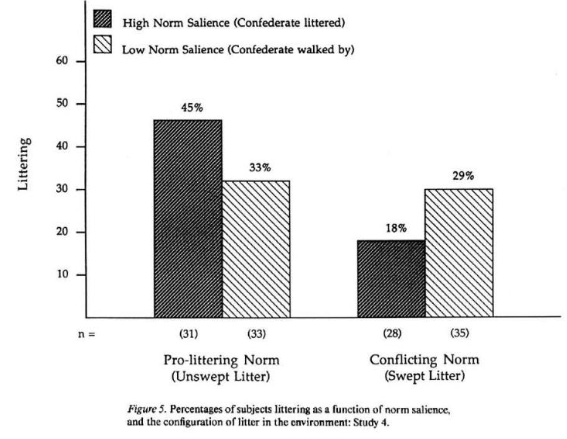
We ______ our behavior to adhere to norms. We will follow whichever norm is more _______ in that moment
adjust; salient.
Effect of descriptive norms ex:
More people litter in an
environment that is already
littered.

Effect of injunctive norms ex:
More people litter in an
environment that signals
others do not care about
littering
Norms can be communicated through _____
messages
short
In norms messages short messages can
remind people of the desired behavior.

Social Norms Messages ___________ norms
communicate

Here is an
example of a
_________
norms message
descriptive
Norms are dynamic. Dynamic norms can be very effective at _________ _________.
changing behavior.

There is a debate as to whether _____ norms are truly “norms”.
moral
Social norms are enforced by ______ _________.
Include both ______ and ___ - ______ responses
to violations of social norms
social sanctions (Gossiping).
verbal; non - verbal
Who will sanction?:
• Those who are affected by the norm
transgression
• Extraverted individuals
• Those with a strong sense of responsibility
• Those in power
• Those who believe others can change their
behavior (think theory of planned behavior)
• Those in “tight cultures”
Tight culture:
Loose culture:
Neither is good or bad, just different ________ expectations for
behavior
Tight = strict norms with little room for deviation.
Loose = more permissive for deviating from norms.
cultural
However, Sanctioning can have a cost because people tend to _______ those who administer sanctions to others
dislike
_______ affect norms. Think of the example on the slide and describe it.
Leaders.

Pluralistic Ignorance:
A misperception between the perceived norm (our belief) and the actual norm (what is actually going on). Ex: We believe republicans don’t care as much as democrats about climate change but then it is proven that they both kind of care at the equal amount.
Mini- Summary
• People are highly motivated to ______ to
others
• People like being part of groups and will match
their behavior to their ____.
• People will administer sanctions to enforce
_____.
connect;
peers;
norms.
However, people have a desire for _______________.
distinctiveness
Optimal Distinctiveness Theory:
People want to maintain a balance between fitting in and standing out from a group
Foot in the Door :
Door in the Face :
Foot: commitment to consistency
Door: Norm of reciprocity
Everyone can influence norms, but influence occurs in ________. So in other words, everyone can influence norms but it is not always _____ (give example).
networks; equal; Ex: When the teacher tells everyone to raise their hand we do but if I were to just raise my hand to ask a question my peers probably aren’t going to follow this behavior.
Wrap- up
• Social Norms have a powerful effect on
________.
• They are critical to the formation of ______.
• Everything we do from here on out (and much
of what we have done) is affected by ______
_____.
behavior.
groups.
social norms.