Gregmat Formulas
 Call Kai
 Learn
 Practice Test
 Spaced Repetition
 Match
 Flashcards
 Knowt Play
1/52

There's no tags or description
Looks like no tags are added yet.
53 Terms
Calculate # of integers in an Interval
Last number - First number + 1
30 60 90 Triangle sides

Finding the even number of factors of a number using prime factorization

Calculating # of shared factors using prime factorization

Number of positive factors in a number using Prime factor
Multiply 1 plus each exponent in the prime factor
To find the total number multiply the solution by 2 to include the negative factors
To find the odd factors, multiply only the exponents of the odd primes +1
Maximizing the area of a polygon with the same perimeter
The highest area will be that of a regular polygon with the same length size
Area of an equilateral triangle

Solving probability and combination problems
Find the probability of a successful event then multiply it by number of combinations of the successful event
Exterior angle of a regular polygon
360/N, where N is the number of sides of the polygon
Speed formula
If they are going in opposite directions and towards each other add the speeds together but if they are going away from each other/the same direction subtract the speed
Skewness of a distribution graph

Normal distribution
1 SD up and down of the mean is 68% of the data

Adding and subtracting to the mean on a Normal distribution

Calculating sum of integers in an interval

Probability of independent events gal pending
Permutations vs combinations
Number of permutations > number of combinations . (Greater than or equal to)
Permutation formula
N is the total number of elements and r is the number of choices

Permutation with repeats

Permutations in a circle
(N-1)!
Combinations formula

Calculating the at least or at most probability’s of cases
1 - the sum of the probabilities of the not events times the combinations
Adding and subtracting to the SD on a Normal distribution

Completing the square for gre questions

Reflections in a coordinate plane

Distance formula between two coordinate points

Parallel and perpendicular line slopes
Parallel lines have the same slope
Perpendicular lines have negative reciprocals
Inclusion - exclusion principle for sets

Discrimant and relationship to solution
B² - 4AC

Supplementary angles
Add up to 180

Angles relationship when one line bisects 2 parallel lines

Sum of interior angles of a polygon
(N - 2) x 180• where n is number of sides
In a regular polygon where the angles are equal, divide total angles by N to find one side
Sum of exterior angles of a polygon
360
Even and Odd number operations

Calculating # of Multiples in an interval

Calculating sum of Multiples in an interval
(Sum of first and last multiple) x (# of multiples/2)

Standard deviation Spacing
The higher the range of the dataset the larger the standard deviation
Standard deviation of a 1 # data set
0
Calculating standard deviation of a 2 # dataset
Calculate the average of the 2#s then subtract it by the lower number
Population Standard deviation formula

Sample standard deviation formula
Sample standard is always higher than population SD because it’s further from population mean
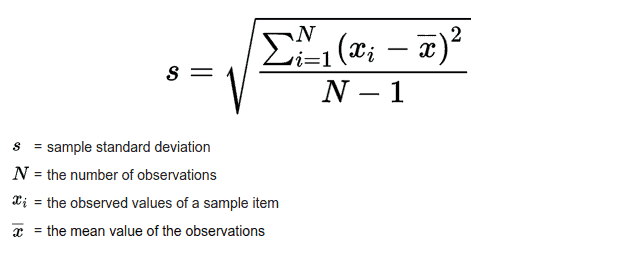
Changes to SD
Stays the same when the same number is added or subtracted to every element
Multiply/divide SD by absolute value of the number when all elements are multiplied/divided by that number
Set vs List
Set
In {}, # are in no order, no repeat counts, and can be finite or infinite
List
Written within brackets or with square brackets, are always in order, allows repeats, and is finite
Graphing Circles on a coordinate Plain

Rotating 90 degrees on a coordinate plane
Flip x and y value, then determine positive or negatives based on quadrant of the rotation

Set intersection
A new set comprised of all elements of the 2 sets share in common

Set Union
A set composed of all the elements of both sets with no repeats
Mutually exclusive sets
No overlap in elements and so thier union is a null set
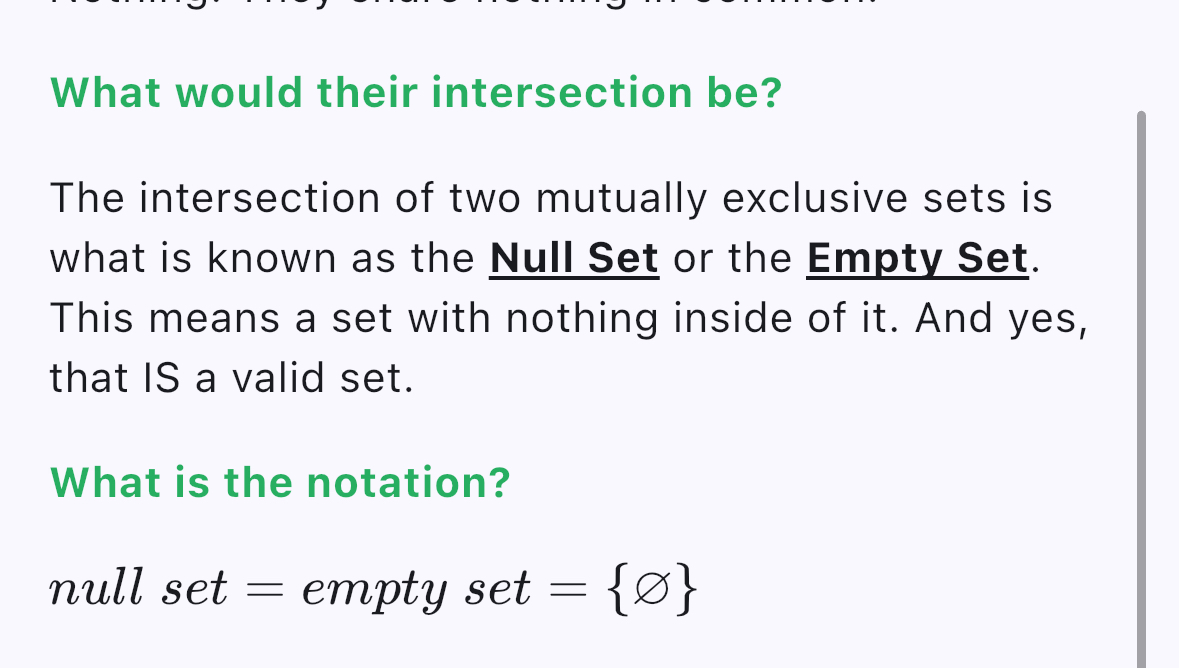
Measures of central tendency
Mean → sum of all éléments / number of elements
Median → number in the middle of a data set when lined in order
Mode → data element that appears the most times
Mean and median are the same when …
By mere accident
The dataset is evenly distributed
The dataset is sysmetrical
Weighted mean
Sum of (element x frequency)
Number of elements
Measures of dispersion
Range → Max - min
Interquartile range → Q3 - Q1