Microeconomics Test 2
 Call Kai
 Learn
Learn Practice Test
 Spaced Repetition
 Match
Match Flashcards
 Knowt Play
1/24

There's no tags or description
Looks like no tags are added yet.
Name | Mastery | Learn | Test | Matching | Spaced | Call with Kai | Chat |
|---|
No analytics yet
Send a link to your students to track their progress
25 Terms
Elasicity
measure of the responsiveness of quantity demanded or supplied to changes in one of its determinants (how buyers and sellers change their behavior when the price changes)
Price of Elasticity of Demand
the measure of how much the quanitity demanded responds to a change in price
-Availability of close substitutes
-Whether a good is a luxury/ nessecity
-How broadly the market is defined
-Time horizon under consideration
Elastic Demand > 1
Quantity demanded resonds substantily to price changes
-Good with close substitute
-Luxury
-Narrowly defines markets
-Longer time horizons (plan to keep money invested for a while, 10+ yrs)
Inelastic Demand <1
Quantity demanded responds slightly to price changes
-Good with not close substitutes
-Nessecities
-Broadly defines markets
-Shorter time horizons (plan to keep money in for at least 3 yrs)
Unit Elasticity
=0 (when price changes, total revenue remains constant)
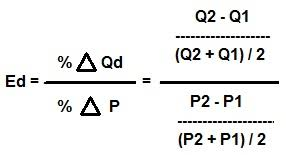
Price Elasticity of Demand (Midpoint Formula)
Demand= Perfectly Inelastic
-Price elasticity of demand= 0
VERTICAL
Demand= Perfectly Elastic
-Price elasticity of demand= ∞
HORIZONTAL
Total Revenue
-Amount paid by buyers and received by sellers of a good
-P times Q
Total Revenue & Elastic Demand
-Price and total revenue move in opposite directions (a change in price causes a larger percentage change in the quantity demanded)
-LINEAR: points with high price and low quantity
Total Revenue & Inelastic Demand
-Price and total revenue move in the same direction (the percentage change in price is larger than the resulting percentage change in quantity demanded)
-LINEAR= points with low price and high quantity
Income Elasticity of Demand
measures how much the quantity demanded of a good responds to a
change in consumers’ income
Positive Income Elasticity
Normal good
Negative Income Elasticity
Inferior good
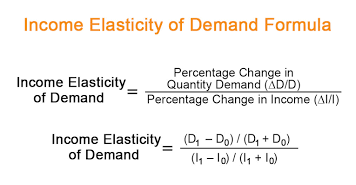
Income Elasticity of Demand Formula
Cross Price Elasticity of Demand
measures how much the quantity demanded of one good responds to a
change in the price of another good
Positive Cross Price Elasticity
Subsitutes
Negative Cross Price Elasticity
Complements
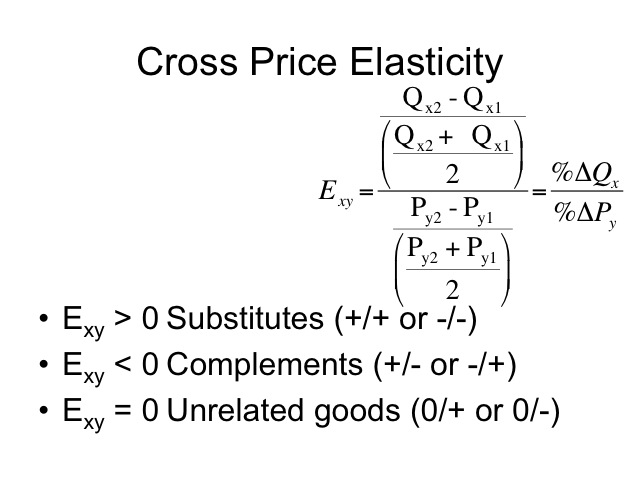
Cross-Price Elasticity of Demand
Price Elasticity of Supply
Measures how much the quantity supplied of a good responds to a change
in the price of that good
Elastic Supply > 1
Quantity supplied responds substantially to price changes
-Long run (all markets are in equilibrium, and all prices and quantities have fully adjusted and are in equilibrium)
Inelastic Supply <1
Quantity supplied repsonds only slightly to price changes
-Short run (a period where at least one factor of production is fixed, while others can be adjusted)
Supply= Perfectly Inelastic
Price elasticity of supply= 0
VERTICAL
Supply= Perfectly Elastic
Price elasticity of supply= ∞
HORIZONTAL