BIOS 3455 Lab II/III Nerve Physiology & Action Potentials and Sensory Physiology
 Call Kai
 Learn
 Practice Test
 Spaced Repetition
 Match
 Flashcards
 Knowt Play
1/21

There's no tags or description
Looks like no tags are added yet.
Name | Mastery | Learn | Test | Matching | Spaced | Call with Kai | Chat |
|---|
No analytics yet
Send a link to your students to track their progress
22 Terms
Which of the following is/are NOT true about IPSPs?
it brings the membrane potential closer to threshold
In our action potential experiment we had a stimulating electrode on the axon hillock and the recording electrode further down the axon. You were able to cause an action potential using a 1.8 nA stimulus and a 0.8 msec duration. The distance between the stimulating and recording electrodes on the axon was 17.1 cm and it took 12.7 msec for the action potential to travel that distance and the temperature at the time of the experiment was 5°C. What is the conduction velocity? no units required
13.5
Patient's having a heart attack often feel pain in their chest, upper arms, and neck, even though the stimulus originates in the heart. Which of the following sensory laws/concepts is most closely related to this pain (angina pectoris)?
law of projection
Amputees often feel sensations in their missing limbs; even though they are no longer associated with their body. Which of the following sensory laws/concepts is most closely related to these phantom sensations?
law of projection
Which of the following is/are NOT true about the sodium equilibrium potential (ENa)?
in most neurons it is close to -90 mV
Which of the following is/are NOT true about EPSPs?
EPSPs can spead down long axons to cause the release of neurotransmitters

Match numbers and letters on this figure with the terms, descriptions, and/or values that best matches it.
#1: hyperpolarization
#3: Na+ channels become inactivated
#4: Na+ moving into the cell
B: +30 mV
D: -70
K: -90 mV
While there is a typical pattern in patients with diabetic sensory neuropathy (DSN), the presentation of DSN in patients is not one size fits all. If your patient was not able to feel the monofilament at 4 of 5 sites, but was able to feel the vibrating tuning fork at all sites tested, which of the following is/are likely true?
-they do not have large afferent nerve fiber damage
-they likely have small afferent nerve fiber damage
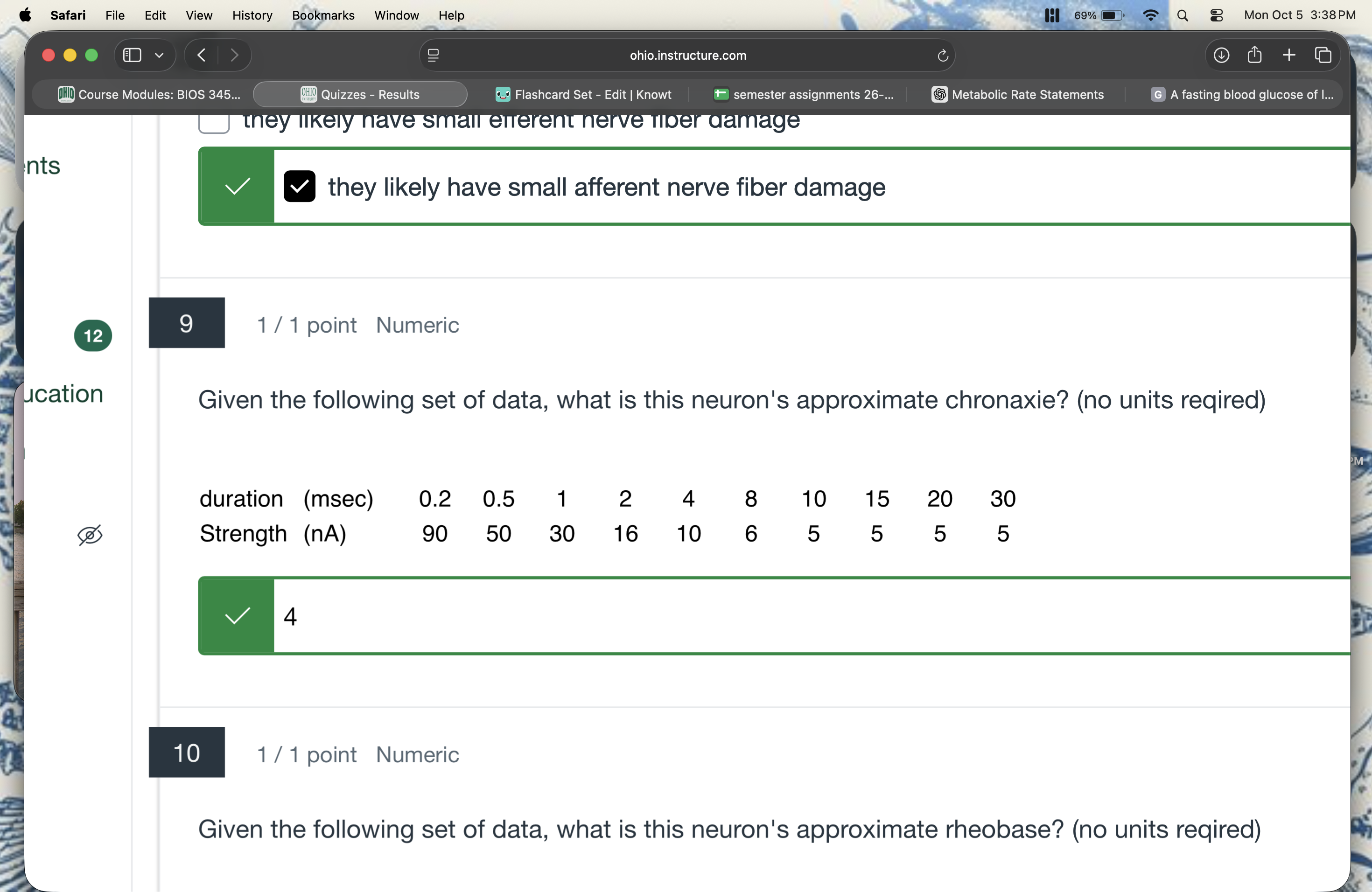
Given the following set of data, what is this neuron's approximate chronaxie?
4
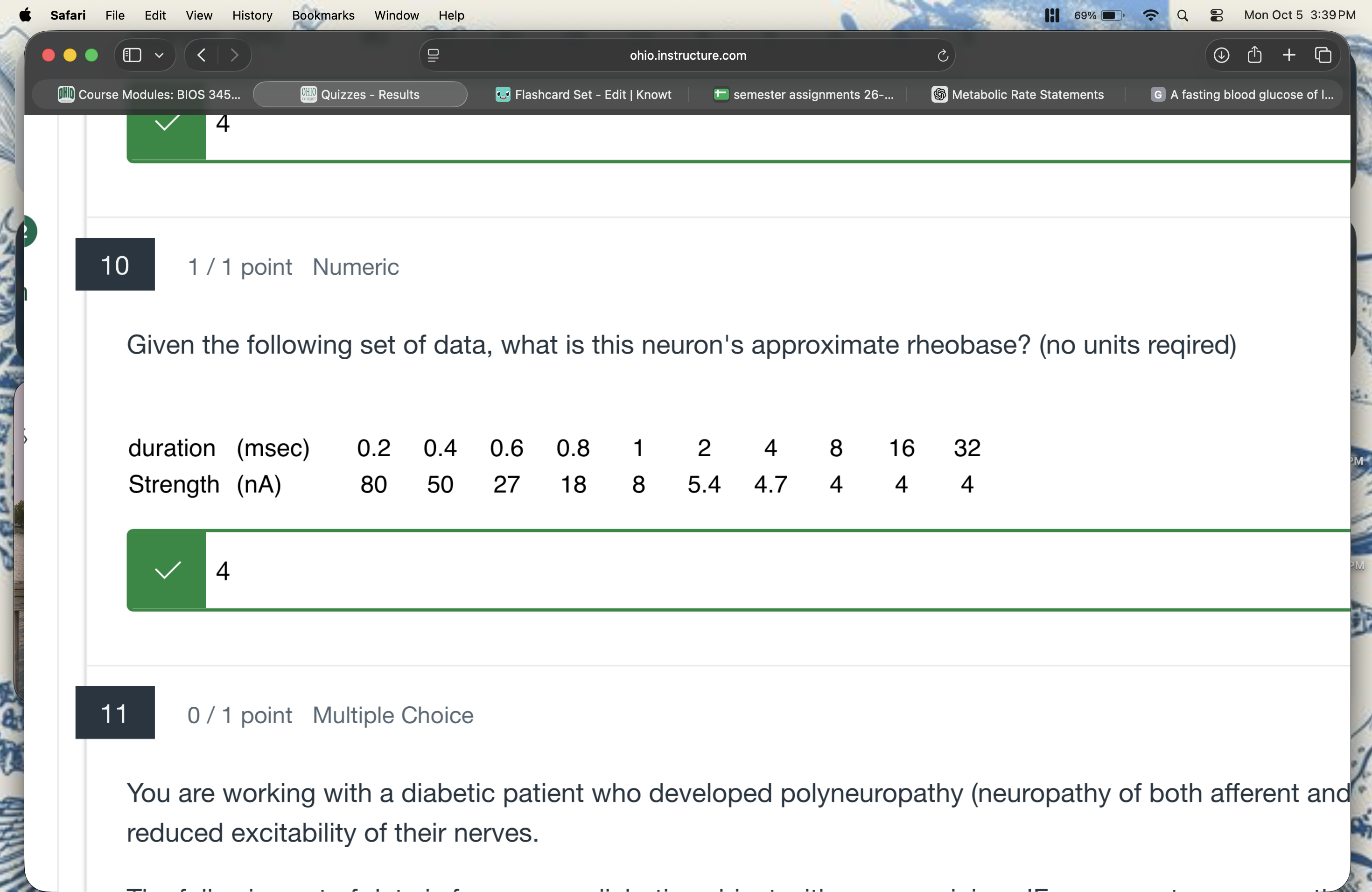
Given the following set of data, what is this neuron's approximate rheobase?
4

You are working with a diabetic patient who developed polyneuropathy (neuropathy of both afferent and efferent nerve fibers) and this resulted in a reduced excitability of their nerves.
The following set of data is from a non-diabetic subject with no nerve injury. IF you were to compare the strength-duration curve below with one from the diabetic patient's curve, which of the following statements would we expect to find on the diabetic patient's strength duration curve?
the diabetic patient's rheobase could be 9mV
The somas (cell bodys) of _______ are outside of the central nervous system
afferent neurons
If your patient had a conductive hearing loss in the left ear, which of the following findings would you observe when performing the Weber and Rinne tests? select all that apply. Assume you performed all tests correctly and in the correct location and that the patient has no other forms of hearing loss.
-During the Weber test the patient would have heard the sound louder in the left ear
-During the Rinne test on the left side the patient would have heard the sound longer by bone conduction than by sound conduction

The following audiogram was taken from your patient, the solid line is the audiogram for the left ear and the dashed line is from the right ear. Which of the following could be true?
-The right ear's hearing loss is likely due to loss of hair cells in some parts of the cochlea
-The right ear appears to have a sensorineural hearing loss
A patient came to see you recently who reported that they were having some trouble hearing lately. You then used a 512 Hz tuning fork to help narrow down the possible types of hearing loss. You first placed the tuning fork on the bridge of the patient's nose and they heard the sound louder in their right ear. You then followed this up by placing the tuning fork on the mastoid process behind the patient's right ear and you observed that they were able to hear the sound longer by sound conduction than by bone conduction. What type of hearing loss does this subject have, and in which ear?
sensorineural hearing loss in the left ear
If we placed a rubber band on our subject's head, which of the following is/are likely true?
-it would be common to feel the sensation of the rubber band briefly after removing it
-they would likely stop feeling the sensation of having a rubber band on their head
If we placed stimulating and recording electrodes 5cm away from each other on each of the following axons, which axon would require the least amount of time to travel those 5cm?
A myelinated axon in a completely healthy subject with a diameter of 20 μm at 37ºC
In our action potential experiment we had a stimulating electrode on the axon hillock and the recording electrode further down the axon. You were able to cause an action potential using a 1.8 nA stimulus and a 0.8 msec duration. The distance between the stimulating and recording electrodes on the axon was 14.6 cm and it took 22.2 msec for the action potential to travel that distance and the temperature at the time of the experiment was 5°C. What is the conduction velocity? no units required
6.6
Which of the following axons is likely to have the slowest conduction velocity?
An unmyelinated axon in a completely healthy subject with a diameter of 20 μm at 30ºC
If we were doing an experiment with a neuron and we determined the following. The absolute refractory period ended 9ms after the start of the first action potential, and the relative refractory period ended 16ms after the start of the first action potential. Under some circumstances we stimulated with a stimulus that was just strong enough to cause an action potential (normal strength) and in some cases we doubled the strength of the stimulus. Which of the following statements would be true?
-If we stimulated the neuron with a double strength stimulus 12ms after the start of the 1st action potential we would expect to see a second action potential
-If we stimulated the neuron with a normal threshold strength stimulus 17ms after the start of the 1st action potential we would expect to see a second action potential

The following audiogram was taken from your patient, the solid line is the audiogram for the left ear and the dashed line is from the right ear. Which of the following could be true?
-The right ear's hearing loss could be due to damage to the tympanic membrane
-The right ear appears to have a conductive hearing loss

Match numbers and letters on this figure with the terms, descriptions, and/or values that best matches it.
#2: repolarization
#4: Na+ influx
F: end of the absolute refractory period
H: Threshold
J: K+ equilibrium potential