Sun and Stars
 Call Kai
 Learn
Learn Practice Test
 Spaced Repetition
 Match
Match Flashcards
 Knowt Play
1/74

Earn XP
Description and Tags
Astronomy Test
Name | Mastery | Learn | Test | Matching | Spaced | Call with Kai | Chat |
|---|
No analytics yet
Send a link to your students to track their progress
75 Terms
The Sun is very hot plasma. Why doesn't the plasma just expand into space and the Sun fly apart?
the Sun has a lot of mass, so the gravity holds it together
The Sun has a lot of mass. Why doesn't it all collapse to a single point at the center?
the plasma of the Sun is hot and wants to expand, and this pressure balances gravity
The energy to heat the Sun comes from the core, where
small atoms are fused into larger ones in nuclear fusion
Fusion converts hydrogen in the core to helium. What happens to the helium generated in the core?
it stays in the core
What is the surface of the Sun like?
it’s not solid, it’s just where the plasma is thin enough that light can escape into space
The process where small nuclei are merged to form a heavier element, which can release energy
fusion
The part of the star where the plasma keeps thinning above the photosphere
atomosphere
The surface of a star, where the plasma is thin enough that light can escape freely into space
photosphere
The interior part of a star where fusion doesn’t occur and where the composition stays the same since the star was formed
envelope
The part of the star where energy is generated
core
The overall electric charge of the Sun
neutral
Two students are discussing the Sun. Which student is correct?
Student 6: Nuclear fusion powers the Sun, so activity like sunspots and flares must be caused by a change in the fusion rate or the type of fusion.
Student 7: Fusion is constant, keeping the Sun a nice temperature; changes on the surface are caused by the Sun's magnetic field.
student 7
Describe the balance of forces in the Sun that keeps it from either flying apart or collapsing in on itself.
pressure build up generated by the core's fusion pushes outward, while the gravitational pull from the Sun's mass pushes inward.
How do we study the interior of the Sun? How do we build models of what the inside of the Sun looks like?
With helioseismology, which allows you to study the interior of the Sun using the vibrations of the Sun. We build models using basic laws of physics and go off of what it should look like.
The Sun sends a powerful CME toward the Earth. Which of these could be side-effects of the resulting geomagnetic storm?
more people would see aurora (northern and southern lights) at night
satellite orbits might degrade
some areas would lose power and some satellites might short circuit
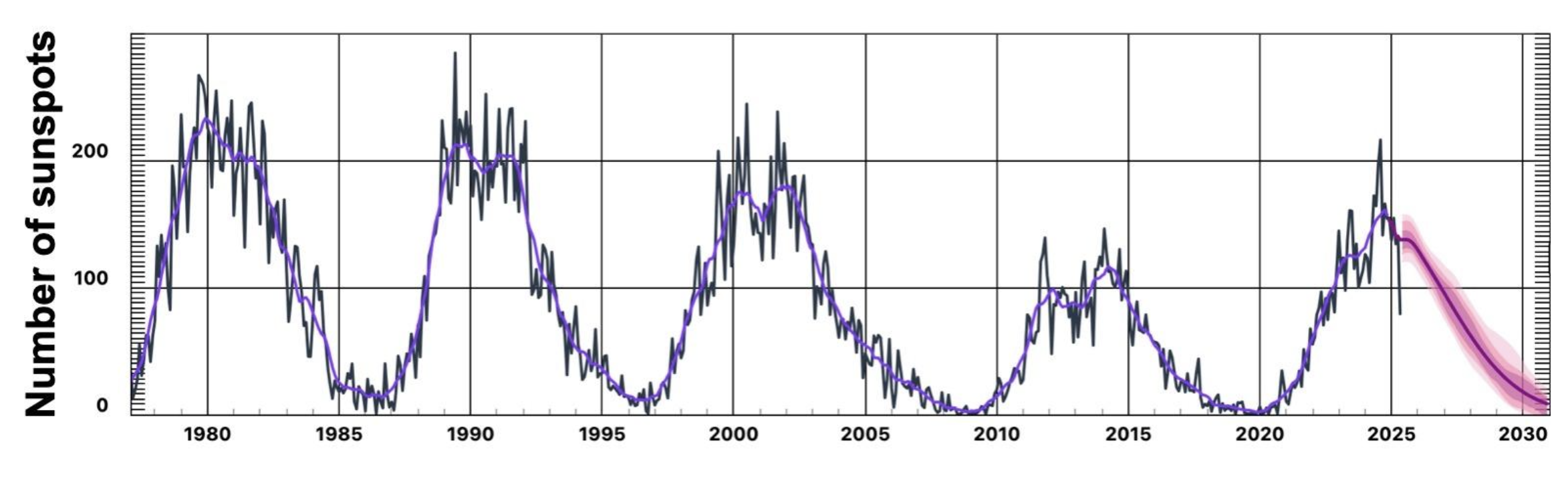
Consider the following graph of sunspot activity from the Space Weather Prediction Center. The year 1990 was probably a solar ___________, which is in the ___________ of a sunspot cycle.
maximum, middle
Let's say a solar flare generates a CME. What order would we detect them on Earth and why?
Light from the flare first, then particles from the CME afterward because light travels faster than sound.
When in the sunspot cycle do we have the best chance of seeing the aurora as far south as Toledo?
middle
On Earth we are used to solid land, liquid water, and gaseous atmosphere. We saw jovian planets had gas atmospheres and liquid interiors. The hydrogen and helium in the Sun exist in what state?
plasma, since they are so hot that their electrons are ripped off
neutron star
high mass star
white dwarf
low mass star
a pulsar is a
neutron star that is spinning very quickly and emitting radiation
Neutron stars and black holes can have a few times the mass of the Sun and are about the size of
a city like Toledo
Think about what kinds of stars create which stellar corpses and how common those stars are. If you look at a really old collection of stars, where there has been enough time for a star of any mass to die, what kind of corpse would you expect to see more of?
white dwarfs
high mass star
supergiant
low mass star
red giant
what are stars mostly made of
hydrogen and helium
These objects are too low mass to initiate stable hydrogen fusion and cool as they age
brown dwarf
This represent the longest phase of a star's life, when it is stable and burning hydrogen
main sequence
These extremely luminous stars are among the largest ever observed and represent the very short-lived old age phase of high mass stars.
supergiants
These luminous stars represent the short-lived old age phase of low mass stars. When our Sun hits this phase, it could become large enough to engulf the Earth.
red giants
A high mass star has a lot more hydrogen as fuel than a low mass star; why does a high mass star have a much shorter lifespan?
a high mass star's core is hotter, so it goes through its fuel much faster than a low mass star
Which generates more energy in old age, low or high mass stars?
high mass stars, fusion is running faster and there are more types of fusion
In old age why can a more massive star fuse heavier elements (like carbon, oxygen, and silicon), while a low mass star might only be able to fuse hydrogen and helium?In old age why can a more massive star fuse heavier elements (like carbon, oxygen, and silicon), while a low mass star might only be able to fuse hydrogen and helium?
it has more mass, which crushes the core to higher pressure and temperature
Why do stars get larger in old age?
different types of fusion generate more energy which makes the star expand
Three stars are born at the same time
Star #1 has 10% Msun (10% the mass of the Sun)
Star #2 has 1 Msun (the same mass as the Sun)
Star #3 has 10 Msun (10 times the mass of the Sun)
Which one has the longest life span?
Star 1
Three stars are born at the same time
Star #1 has 10% Msun (10% the mass of the Sun)
Star #2 has 1 Msun (the same mass as the Sun)
Star #3 has 10 Msun (10 times the mass of the Sun)
Which one has the shortest life span?
Star 3
Three stars are born at the same time
Star #1 has 10% Msun (10% the mass of the Sun)
Star #2 has 1 Msun (the same mass as the Sun)
Star #3 has 10 Msun (10 times the mass of the Sun)
Which one has the middle life span?
Star 2
Why does generating too much iron in a star's core trigger a supernova?
It absorbs energy instead of releasing it, causing the core to lose its outward thermal pressure and collapse under gravity.
How will our Sun die?
It will run out of the ability to create fusion and the Sun will violently expand and form a planetary nebula.
What is a planetary nebula?
the gas cloud thrown off a low mass star when it dies
If I could change the mass of a star, which of these would also change?
Everything, the mass of a star affected everything
Why can't brown dwarfs fuse hydrogen and be called stars?
They have really low mass which means, they can't make the extreme core temperatures and pressure to fuse hydrogen.
Consider a star with the same mass as the Sun. Why will the star be much larger in the red giant phase than during the main sequence phase?
in the red giant phase fusion reactions are generating more energy than on the main sequence, which inflates the envelope more
Why is the surface of a giant star redder than when it was a main sequence star?
the surface is farther from the core and is therefore cooler
original gas clump from which solar system formed
nebula
disk-shaped cloud from which our sun and the planets would eventually form
protoplanetary disk
process by which planets move around in the disk
planetary migration
thing that would eventually ignite fusion and become our Sun
protostar
What happened to the molecules of the "ices" (water, methane, ammonia) present inside the frost line?
they existed as a gas
Jovian planets grew larger and faster than terrestrials because Jovians formed _____, where there were solid particles of ice, rock, and metal --- rather than just rock & metal
farther from the Sun than the frost line
What event cleared out the gas from the protoplanetary disk?
the Sun became a star and its solar wind blew away the gas
What is a star?
A massive luminous celestial object held together by its own gravity
What is the composition of the Sun? What are the “metals? (just the most abundant ones)
Hydrogen, Helium, and Metals (oxygen, carbon, neon, iron)
What makes the core of the Sun so hot?
Gravity pushes pushes inward and the pressure heats the inner layers
What force balances the gravitational pressure and keeps the Sun from collapsing?
gravity
What is plasma?
A gas that is super heated so the electrons are stripped from the atoms and it becomes ionized
How does the core of the Sun generate energy?
Nuclear fusion occurs when hydrogen nuclei combine to form helium, releasing immense energy.
How do we study the interior of the Sun?
Helioseismology
What is the core of a star? What is happening in the core?
The core of a star is its central region where nuclear fusion occurs, generating energy by fusing hydrogen into helium. This process sustains the star's energy output and counteracts gravitational collapse.
What is the envelope of a star? What is true about the composition of the envelope?
The envelope of a star is the outer region surrounding the core, which includes layers where energy transport occurs. It is typically composed of hydrogen and helium.
What is the “surface” of a star called? Does a star have a hard surface like Earth?
The surface of a star is called the photosphere. Unlike Earth, stars do not have a hard surface; they transition from gas to plasma.
The plasma of a star keeps thinning above the photosphere. What do we call this? How is it heated?
The sun’s atmosphere,including the chromosphere and corona, is called the star's atmosphere. It is heated by processes such as magnetic reconnection and wave heating.
What is the Solar wind?
The solar wind is a stream of charged particles, primarily electrons and protons, ejected from the sun's outer layers, extending throughout the solar system.
The Sun is made of rapidly rotating plasma that generates what? How far out from the Sun does it extend?
A magnetic field that extends past the Kuiper Belt and our entire solar system.
What causes sunspots? How does their temperature compare to the surrounding parts of the Sun?