BI 423: Dissolved Oxygen Aquatic Ecology Test 1
 Call Kai
 Learn
Learn Practice Test
 Spaced Repetition
 Match
Match Flashcards
 Knowt Play
1/49

There's no tags or description
Looks like no tags are added yet.
Name | Mastery | Learn | Test | Matching | Spaced | Call with Kai | Chat |
|---|
No analytics yet
Send a link to your students to track their progress
50 Terms
Why do ponds, i.e., water hazards, on golf courses almost always have clinograde DO2 profiles?
They are hypereutrophic due to fertilizer runoff
How much DO is in the atmosphere? How much in water?
21%, 1%
What do DO concentrations depend on?
Temperature, Photosynthesis, Barometric pressure, Respiration, Salinity
What increases solubility greatly?
Cold temperatures
DO is _____ in water
Sparingly soluble
When is DO highest
during the day
Where do DO2 Gains (sources) come from
Diffusion from atmosphere, mixing from wave action and wind (etc.), photosynthetic organisms
What are sources of DO2 loss
Organism respiration (i.e. fish, mollusks, insects, etc.), decomposition (utilization by bacteria and fungi)
What greatly effects the vertical profile of DO2 lakes
Thermal stratification, photosynthetic production of O2, Respiration and Decomposition of O2
When is the DO2 profile largely uniform
Fall and Spring Turnover
What percentage of saturation (DO2) are lakes during spring and fall turnover
Near 100% saturation top to bottom
What oxygenates the epilimnion
Diffusion, wave action, photosynthesis
What makes the DO2 rather uniform, throughout the epilimnion
Wave action + convective currents mix throughout epilimnion
What could contribute to high, localized DO2 levels
May have spots high in phytoplankton concentration contribute to high, localized DO2 levels
Orthograde
refers to a vertical dissolved oxygen (DO) profile in a stratified lake where oxygen concentrations remain relatively uniform from the surface down to the bottom
Clinograde
dissolved oxygen levels are high at the surface but decrease rapidly—often to near zero—at greater depths
Heterograde
a vertical distribution of dissolved oxygen (DO) in a stratified lake or reservoir where oxygen levels peak or drop significantly at an intermediate depth
What happens to the hypolimnion during summer stratification
Hypolimnion is isolated from surface epilimnion due to H2O density differences (i.e., no mixing between
hypolimnion + epilimnion)
And hypolimnion is often below _____ zone and contains the _____ zone (i.e., no net O2 production)
euphotic or trophogenic, tropholytic
Oligotrophic lakes hyoplimnion remain
relatively high in DO 2 from spring/fall turnover
during stratification
Not much organic matter produced or settling to bottom, No or little O 2 used or needed for decomposition for _____ lakes
oligotrophic
However, in summer, epilimnion DO2 levels will _____ relative to spring turnover in oligotrophic lakes
fall slightly
Warmer liquids hold ________ gas
less
In summer, epilimnion DO2 levels generally remain unchanged in ____ Lakes
eutrophic
in eutrophic lakes _____ level will decline to 0 or ~0 as _____ occurs
DO2, stratification
DO2 level will decline to 0 or ~0 as _____ occurs in eutrophic lakes
stratification
In _____, epilimnion DO 2 levels generally remain relatively unchanged or
slightly higher due to PS in eutrophic lakes
summer
Oligotrophic lakes have a ____ DO profile curve
orthograde
eutrophic lakes have a ____ DO profile curve
clinograde
DO2 in High nutrient lakes Can have a _____ Due to settling of phytoplankton to metalimnion
metalimnetic maxima
Oxidation is a _____
loss
Reduction is a ___
gain
where most of decomposing OM is located, where most of O2 is being
consumed
the redox gradient
what is the redox gradient
At the very bottom of a lake, there is a sharp transition zone where the water goes from having oxygen (oxidation) to having no oxygen (reduction). This transition is called a redox gradient.
After lake stratifies, O2 is used from
_____, Redox front progresses upward
bottom upward
Global Example- extreme eutrophication
Gulf of Mexico
What causes dead zones
excess nutrients
What is a leading cause of dead zones
Nitrogen
What about fertilizer causes dead zones
Causes algae bloom -- algae eventually die -- bacteria
decompose & use up O2; no oxygen creates an Anoxic dead zone
What are solutions to dead zones
cover crops, no-till farming, buffer strips, fence animals
from streams, timing & amount of fertilizer,
extended rotations, nitrogen management
Regarding DO and water temperature, there is generally more DO in water during the ____ and during which time of year
day time, winter

During which time of year would the uniform DO profile most likely occur? (temp profile shown is for entire lake depth, not just epilimnion)
fall

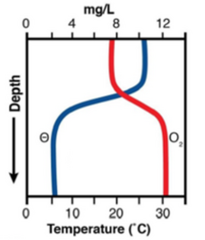
Based on the figure below, this type of temperature/oxygen profile would be found in a _____ lake during summer stratification, and is considered to be a _____ DO profile curve.
oligotrophic, orthograde
Regarding the redox boundary during summer stratification in May vs. July. Between the 2 DO profile lines in the 1st graph below, the GRAY line best represents the likely DO profile in which of those months?
july

A dead zone- or _____ zone- is an area of low oxygen that can harm fish and marine life near the bottom of the sea.
hypoxic
Dead Zones appear to be concentrated in coastal regions primarily in North America and South America (T/F)
false
how big can a dead zone get (size of this state)
NJ
In which layer of Crooked Lake is the DO level the highest?
metalimnion

is Eutrophication a natural process?
yes
Which type of Eutrophication tends to occur much more rapidly?
cultural