Chapter 12 Med Term
 Call Kai
 Learn
 Practice Test
 Spaced Repetition
 Match
 Flashcards
 Knowt Play
1/111

Earn XP
Description and Tags
Nervous System
112 Terms
Basic functions
coordinates and controls body functions
receives sensory input, makes decisions based on input, and orders appropriate body responses
primary structures of NS are the brain, spinal cord, and nerves.

Alges/o
sense of pain
astr/o
star
centr/o
center
cerebell/o
cerebellum
cerebr/o
cerebrum
clon/o
rapid contracting and relaxing
concuss/o
to shake violently
dur/o
dura mater
encephal/o
brain
esthesi/o
sensation, feeling
gli/o
glue
medull/o
medulla oblongata
mening/o or meningi/o
meninges
ment/o
mind
myel/o
spinal cord
neur/o
nerve
peripher/o
away from center
poli/o
gray matter
pont/o
pons
radicul/o
nerve root
thalam/o
thalamus
thec/o
sheath, meninges
tom/o
to cut
ton/o
tone
ventricul/o
ventricle
-paresis
weakness
-phasia
speech
-taxia
muscle coordination
Nervous system coordination
receives info from external and internal sensory receptors
uses receptor info to adjust activity of muscles and glands to math body’s needs
CNS
consist of brain and spinal cord
motor messages exit the CNS with commands for muscles and glands
Made up of gray and white matter
bundles of interconnecting nerve fivers form tracts
3 meninges encase and protect CNS
Gray matter
Unsheathed cell bodies and dendrites
white matter
Myelinated nerve fibers
PNS
consists of cranial nerves
sensory nerves carry messages into the CNS
Motor nerves carry commands away from CNS
12 pairs of cranial nerves and 31 pairs of spinal nerves
What are the two types of nervous cells
neurons and neuroglia
Neurons Basic Parts
Dendrites - receive impulses
nerve cell body - contains nucleus and other organelles of the cell
Axon - the projection from the cell body that conducts the impulse toward its destination
Synaptic cleft - a gap that exists between two neurons
Elec. impulses - cannot directly pass the synaptic cleft; a chemical neurotransmitter released by the axon carries them across

Neuroglial cells
support different neuron function
some produce fatty substance myelin
DO NOT conduct elec. impulses.
Myelin functions
myelin is the insulation for the axon
allows the axon to conduct faster impulses
Brain
One of the largest organs in body
coordinates most of body activities
each part is responsible for diff body func
divided into 4 sections - Cerebrum, cerebellum, diencephalon, and the brainstem

Cerebrum
largest section and the upper portion of the brain
Processes thought, judgement, memory, problem solving, and language
Cerebrum is subdivided into Right and Left cerebral hemispheres; each hemisphere has 4 lobes
Cerebral hemispheres
Frontal lobe - anterior and control motor function, personality, and speech.
Parietal lobes - superior and interpret nerve impulses and language
Occipital lobes- posterior and control vision
temporal lobes - lateral and control hearing and smell

Diencephalon pieces
Thalamus and hypothalamus
Thalamus
Made of gray matter
relays impulses from the eyes, ears, and skin to the cerebrum
Controls pain reception
Hypothalamus
below thalamus
controls temp, appetite, sleep sexual desire, and emotion
controls the autonomic NS, the Cardiovascular sys., the digestive sys., and the pituitary gland
Cerebellum
Second largest portion of the brain
located beneath the posterior part of the cerebrum
Aids in coordination voluntary body movements and maintaining balance and equilibrium
Refines muscular movements initiated in the cerebrum
Brainstem components
Midbrain - pathway for impulses between the brain and psinal cord
Pons - connects the cerebellum ot the rest of the brain
Medulla oblongata - connects the brain to the spinal cord
Medulla oblongata
control center for respiration, heart rate, temp, and blood pressure
Site where nerve tracts cross from one side of the brain to the other side of the body
4 ventricles in the brain
One ventricle in each hemisphere - one in thalamus and one in front of the cerebellum
Contain clear fluid called cerebrospinal fluid (CSF)
CSF - provides shock and motion protection to the brain and spinal cord
Spinal Cord
Pathway for impulses traveling to and from the brain
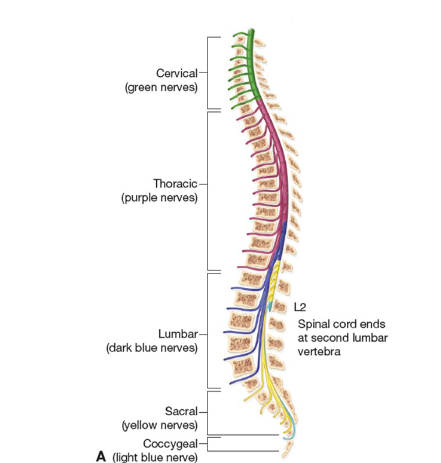
column of nervous tissue extending from the medulla oblongata to the second lumbar vertebra
CSF flows down the center of spinal cord within central canal
Inner portion of SC
Made of cell bodies and dendrites and is gray matter
Outer portion of SC
Myelinated white matter
Ascending tracts carry sensory info up to the brain
Descending tracts - carry motor commands down from the brain to a peripheral nerve
Meninges
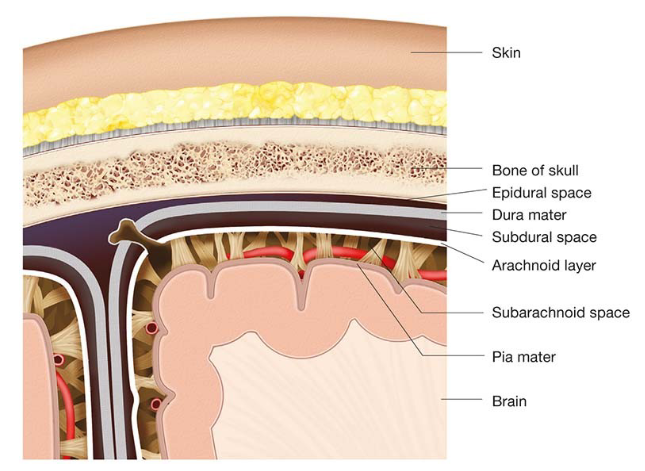
Three layers of connective tissue membranes surrounding the brain and spinal cord
Meninges Tissue layer Spaces
dura mater - tough mother; tough, fibrous outermost sac
Subdural space - between dura mater and arachnoid layer
Arachnoid - spider like; delicate and attached to the pia mater by filaments
Subarachnoid space - space between the arachnoid layer and pia mater
Pia mater - Soft mother; applied directly to the brain and spinal cord surface
Spinal nerves (PNS)
cranial nerves - arise from the brain, typically the medulla oblongata
spinal nerves - split off of the spinal cord, with one pair of nerves between each pair of vertebrae.
Nerve root - where a nerve is attached to the CNS
Olfactory
sense of smell
optic
Sense of sight
Oculomotor
controls eye muscles and the pupil of the eye
Trochlear
controls superior oblique muscles of the eye
Trigeminal
facial impulses and control of chewing muscles
abducens
Controls the eyeball muslce that turns the eye to the side
facial
controls facial muscles for expression, salivation, and taste on the front 2/3 of the tongue
vestibulocochlear
responsible for equilibrium and hearing
Glossopharyngeal
Carries sensory impulses from the pharynx and taste on posterior third of the tongue
Vagus
supplies abdominal and thoracic organs
accessory
controls neck and shoulder muscles
Hypoglossal
controls tongue muscles
Autonomic NS
PNS subdivision/ along w somatic nerves
controls involuntary or unconscious body functions
Affects smooth muscle function in the viscera and vessles
increases and decreases activity of cardiac muscle in the heart
influences activity of the glands
divided into sympathetic and Parasympathetic branches
Sympathetic Branch
controls “fight or flight” reactions
Active in times of stress and crisis
increases heartrate, dilates airways, increaes blood pressure, inhibits digestion, and stimulates production of adrenaline
Parasympathetic Branch
is a counterbalance to the sympathetic branch
causes the heartrate to slow, lowers the blood pressure, and stimulates the return of digestion
Somatic Nerves
serve skin and skeletal muscles
mostly involved with conscious and voluntary activities of the body
Sensory receptors of the dermis use somatic nerves to send info about touch, temp, pressure and pain to the brain.
Carry motor commands to skeletal muscles
absence seizure
epileptic seizure characterized by loss of awareness and absence of activity.
analgesia
absence of pain
anesthesia
lack of feeling or sensation
aphasia
inability to communicate verbally or in wirting due to damage to the language centers of the brain
ataxia
lack of muscle coordination
aura
sensations occurring prior to epileptic seizure or migraine; seeing colors or smelling odors
causalgia
burning pain along the path of a nerve
cephalalgia
a headache
coma
state of profound unconsciousness
comatose
being in a coma
conscious
condition of being awake and aware of surroundings
convulsion
severe involuntary muscle contractions and relaxations
delirium
abnormal mental state of confusion, disorientation, and agitation
dementia
progressive impairment of intellectual function that interferes with activities of daily living
dysphasia
difficulty communicating verbally or in writing
focal seizure
seizure in only one limb or body part
hemiparesis
weakness on one side of body
hemiplegia
paralysis on one side of the body
hyperesthesia
abnormally heightened sense of feeling, sense of pain, or sensitivity to touch
monoparesis
muscle weakness in one limbmonoplegia
monoplegia
paralysis of one limb
neuralgia
nerve pain
palsy
temporary or permanent loss of ability to control movements
paralysis
permanent loss of voluntary movement
paraplegia
paralysis of the lower portion of the body
parasthesia
abnormal sensations such as burning or tingling
quadriplegia
paralysis of all four limbs
seizure
sudden uncontrollable onset of symptoms, such as in epeileptic seizure
semiconscious
state of being aware of surrounding and responding to stimuli only part of the time
spasticity
having above normal muscle tone and hyperactive deep tendon reflexes