Chp 18 Modulation of Movement by Basal Ganglia
 Call Kai
 Learn
 Practice Test
 Spaced Repetition
 Match
 Flashcards
 Knowt Play
1/6

There's no tags or description
Looks like no tags are added yet.
7 Terms
Medium spiny neurons in caudate and putamen receive inputs from which two brain regions?
Cerebral cortex & substantia nigra pars compacta (Snc)
main sources of output from the basal ganglia to upper motor neurons in motor cortex or superior colliculus
Globus pallidus & substantia nigra pars reticulata are the 2 main output sources from the basal ganglia & send inhibitory GABAergic projections to thalamus/motor cortex
The sequence of events that occur during functioning of the basal ganglia circuit
- When the basal ganglia circuit is at rest, neurons in the globus pallidus send tonic inhibition to the thalamus to prevent unwanted movement
- When medium spiny neurons receive signals from sensory cortex to command movement, the pallidal neurons are inhibited by activation of the medium spiny neurons, resulting disinhibition (free from inhibition) of the thalamic neurons & excitation of UMNs to initiate intended movement
- Excitation of medium spiny neurons in corpus striatum → inhibition of globus pallidus neurons → disinhibition of thalamic neurons → excitation of UMNs
- How disinhibitory basal ganglia circuit control eye movement: Excitation of medium spiny neurons in corpus striatum → inhibition of neurons in substantia nigra pars reticulata → disinhibition (free from inhibition/excitation) of UMNs in superior colliculus → initiation of saccades
Cause of Parkinson’s disease
hypokinetic movement disorder caused by the loss of dopaminergic neurons in substantia nigra pars compacta
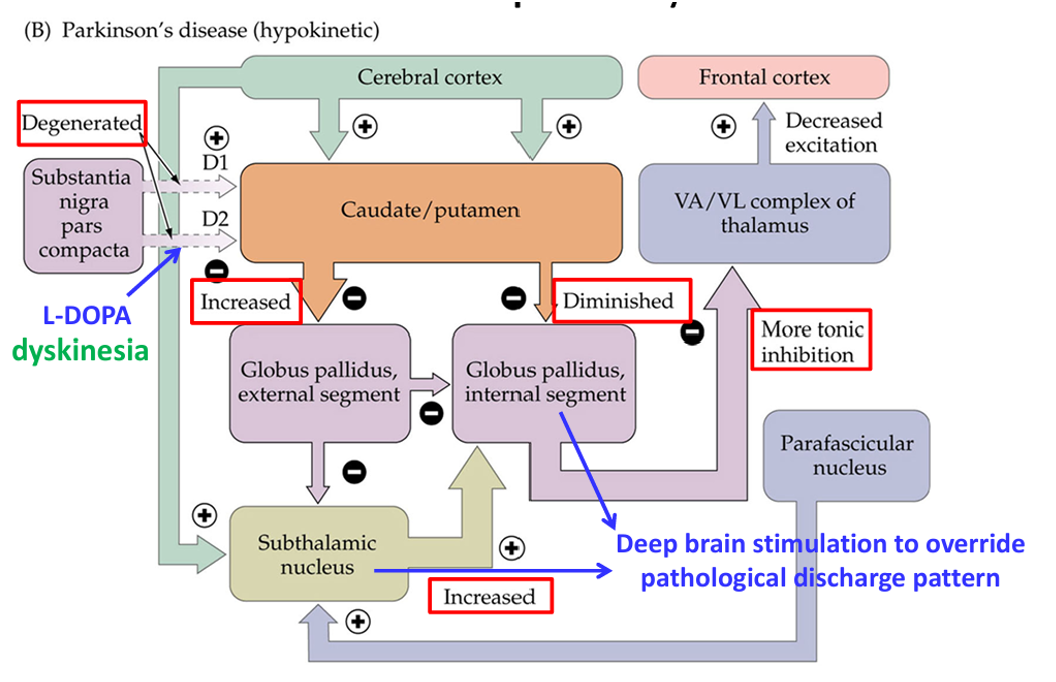
How does loss of dopaminergic inputs to striatum (caudate/putamen) cause hypokinetic symptoms in Parkinson’s disease? What are the effects of hypokinetic disorders on movement control pathways
Loss of dopaminergic input from substantia nigra pars compacta → increased indirect pathway (overactivity of indirect pathway) and diminished direct pathway (underactivity of direct pathway) → more tonic inhibition of thalamus → decreased excitation of motor cortex UMNs → reduced voluntary movement
Huntington’s disease is caused by degeneration of medium spiny neurons used which type of the dopamine receptor?
hyperkinetic movement disorder caused by the loss of medium spiny neurons that project to the globus pallidus external (loss of medium spiny neurons used inhibitory D2 dopamine receptors [the D2R-type MSNs])

How does degeneration of the basal ganglia circuits cause hyperkinetic symptoms in Huntington’s disease? What are the effects of hyperkinetic disorders on movement control pathways
Loss of D2R-type MSNs (loss of indirect pathway) from caudate/putamen → abnormally activation of globus pallidus external → diminished excitatory subthalamic output to globus pallidus internal → less tonic inhibition of thalamus → increased excitation of motor cortex neurons → undesired choreiform (“dancelike”) movement in HD