Radiation Production and Characteristics: Particle Interactions with Matter
 Call Kai
 Learn
 Practice Test
 Spaced Repetition
 Match
 Flashcards
 Knowt Play
1/44

There's no tags or description
Looks like no tags are added yet.
45 Terms
EXCITATION
It is the transfer of some of the incident particle’s energy to electrons in the absorbing material, promoting them to electron orbitals farther from the nucleus
Approximately 70%
______________ of charged particle energy deposition leads to nonionizing excitation
interacting with orbital electrons
Excitation occurs when charged particles lose energy by
Ionization
It is the process of removing an orbital electron from an atom
Occurs when charged particles lose energy by interacting with orbital electrons
Coulombic Repulsion/Attraction
The force pulling between the opposite charges that removes the electron
DE-EXCITATION
The electron will return to a lower energy level, with the emission of the excitation energy in the form of low-energy electromagnetic radiation
Ejected Electrons
Positively Charged Atom (Cation)
What results an ion pair?
DELTA RAYS
Sometimes the ejected electron ____________ possess sufficient energy
SECONDARY IONIZATIONS
produce further ionizations
SPECIFIC IONIZATION
It is the number of primary and secondary ion pairs produced per unit length of the charged particle’s path
IP/mm
What is the unit of Specific Ionization?
Linear Energy Transfer
LET
keV/um
The rate at which energy is locally transferred or deposited into a medium as a charged particle travels through it
DIRECTLY PROPORTIONAL
Linear Energy Transfer is a _____________ to specific ionizations, linked by the average energy expended per ionization event
Xrays
Gamma rays
Alpha particles have a higher LET than photons
Low Penetrability
HIGH LET
High dose from a single track
High Penetrability
LOW LET
Very low dose from a single track
COULOMBIC DEFLECTIONS
Are electrons follow tortuous paths in matter as the result of multiple scattering events caused by?
TRUE
Bremsstrahlung Interactions and Characteristic Interactions both produce xray photons?
ANODE
1?

ROTOR (+)
2?
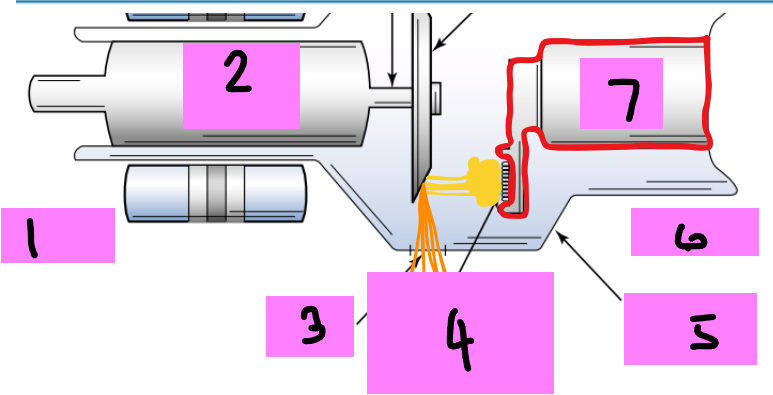
PORT
3?

FILAMENT IN FOCUSING CUP
4?

GLASS ENVELOPE
5?

CATHODE
6?
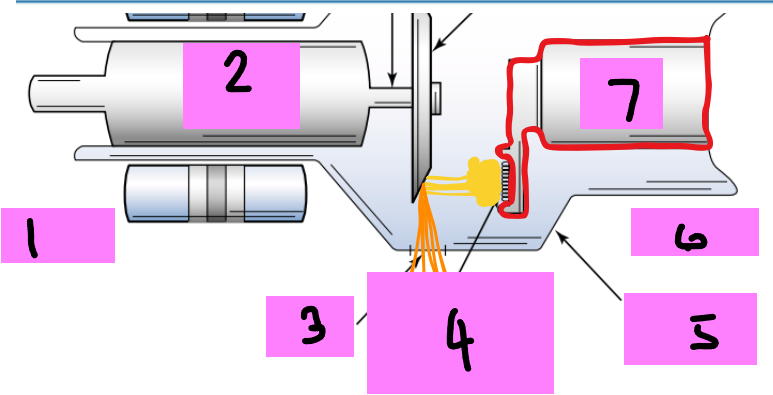
NEGATIVE (-)
7?

BREMSSTRAHLUNG INTERACTION
A projectile electron that completely avoids the orbital electrons as it passes through may come sufficiently close to the nucleus
Slowed-down Radiation
A German word meaning?
Bremsstrahlung x-rays
can be produced at any cathode electron energy
are produced when a projectile electron is slowed by the nuclear field of a target atom nucleus
TRUE
Most xrays interactions in the diagnostic energy range are bremsstrahlung
HIGH ENERGY BREMSSTRAHLUNG XRAYS

LOW ENERGY BREMSSTRAHLUNG XRAYS

CHARACTERISTIC INTERACTION
Occurs when the interaction results in ionization of the target atom with the removal of an inner-shell electron
Characteristic x-rays
When the electron interacts with an inner-shell electron, ____________ are produced
K-Characteristic
Only the _____________ xrays of tungsten are useful for imaging
CHARACTERISTIC XRAYS
70 keV
69.5 keV
_______________ can produced in tungsten target only when the kvp is set at _____ or greater because the binding energy of K-shell electron is _______
PRODUCTION OF CHARACTERISTIC XRAYS
AUGER ELECTRONS
During characteristic interactions, two possible outcomes can occur:
AUGER ELECTRONS
are secondary electrons ejected from an atom, releasing energy through a radiationless transition
It means there is no electromagnetic radiation like xrays, is emitted instead of the transition energy is transferred directly to the ejected Auger Electron
Define Radiationless transition?
K = 57.4
L-Shell

K = 66.7
L = 9.3
M-Shell

K = 68.9
L = 11.5
M = 2.2
N-Shell
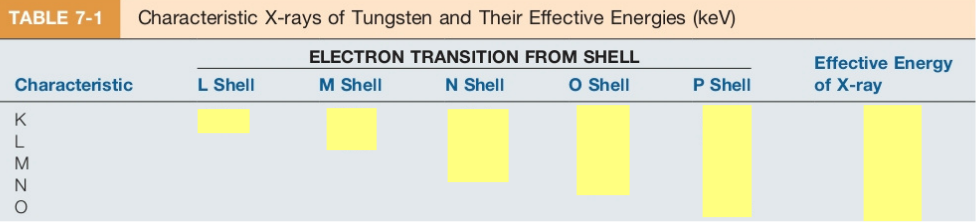
K = 69.4
L = 12.0
M = 2.7
N = 0.52
O-Shell

K = 69.5
L = 12.1
M = 2.8
N = 0.6
O = 0.08
P-Shell
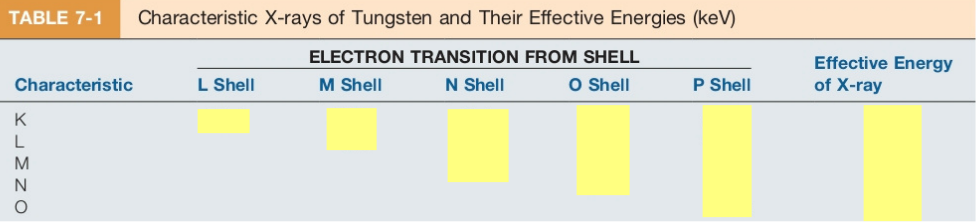
K = 69.5
L = 12
M = 3
N = 0.6
P = 0.1
Effective Energy of Xrays
