Product Decisions
 Call Kai
 Learn
 Practice Test
 Spaced Repetition
 Match
 Flashcards
 Knowt Play
1/27

Earn XP
Description and Tags
Reviewer for MGT 151
28 Terms
Product
Anything that can be offered to a market to satisfy a want or need; includes physical goods, services, events, persons, places, organizations, ideas.
Core Benefit
Fundamental service or benefit that the customer is really buying (e.g., a hotel guest is buying “rest and sleep”).
Basic Product
The marketer has to turn the benefit into a ________ (e.g., a hotel room includes a bed, bathroom, towels, desk, dresser and closet).
Expected Product
A set of attributes and conditions buyers normally expect when they purchase this product.
Augmented Product
This exceeds customer expectations; it includes what companies add to their factory output in the form of packaging, services, advertising, customer advice, financing, delivery arrangements, etc..
Potential Product
Encompasses all the possible augmentations and transformations the product might undergo in the future.
Delighting
Exceeding expectations.
Durable Goods
DURABILITY AND TANGIBILITY
Tangible goods that normally survive many uses (refrigerators, clothing); require more personal selling and service, command a higher margin and require more seller guarantees.
Nondurable Goods
DURABILITY AND TANGIBILITY
Tangible goods normally consumed in one or a few uses (beer, soap); strategy is to make them available in many locations, charge only a small markup and advertise heavily.
Services
DURABILITY AND TANGIBILITY
Intangible, inseparable, variable and perishable products (massage, haircut); they require more quality control, supplier credibility and adaptability.
Convenience Products
CONSUMER GOODS CLASSIFICATION
Buy frequently & immediately; low priced; many purchase locations; includes staple, impulse, and emergency goods.
Shopping Products
CONSUMER GOODS CLASSIFICATION
Buy less frequently; gather product information; fewer purchase locations; compare for suitability & quality, price & style.
Specialty Products
CONSUMER GOODS CLASSIFICATION
Special purchase efforts; unique characteristics; brand identification; few purchase locations.
Unsought Products
CONSUMER GOODS CLASSIFICATION
New innovations; products consumers don't want to think about; require much advertising & personal selling.
Width
PRODUCT MIX
Number of different product lines.
Length
PRODUCT MIX
Total number of items within the lines.
Depth
PRODUCT MIX
Number of versions of each product.
Product Mix
All the product lines offered.
Line Pruning
Deadwoods are products that do not sell well and are depressing profits. It can be done also when the company is short of production capacity.
Product Life Cycle (PLC)
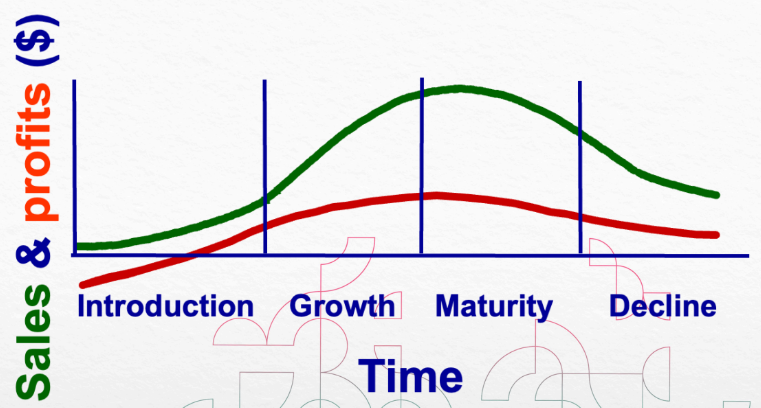
Concept stating products have a limited life and sales pass-through distinct stages (Introduction, Growth, Maturity, Decline), each posing different challenges and requiring different strategies.
Introduction Stage
PRODUCT LIFE CYCLE
Characterized by low sales, high cost per customer, negative or low profits; objective is to create product awareness and trial.
Growth Stage
PRODUCT LIFE CYCLE
Characterized by rapidly rising sales, average cost per customer, and rising profits; objective is to maximize market share.
Maturity Stage
PRODUCT LIFE CYCLE
Characterized by peak sales, low cost per customer, and high profits (then lower profits); objective is to maximize profits while defending market share.
Decline Stage
PRODUCT LIFE CYCLE
Characterized by declining sales, low cost per customer, and declining profits; objective is to reduce expenditure and maintain, reposition, harvest or drop the product.
Rapid-Skimming Strategy
INTRODUCTORY MARKETING STRATEGIES
Launching a new product at a high price and a high promotion level to convince the market of the product’s merits.
Slow-Skimming Strategy
INTRODUCTORY MARKETING STRATEGIES
Launching a new product at a high price and low promotion; high price helps recover profit per unit while low promotion keeps expenses down.
Rapid-Penetration Strategy
INTRODUCTORY MARKETING STRATEGIES
Launching a new product at a low price and spending heavily on promotion to bring about the fastest market penetration.
Slow-Penetration Strategy
INTRODUCTORY MARKETING STRATEGIES
Launching a new product at a low price and low level of promotion; low price encourages rapid acceptance while low promotion costs bring profits up.