Roundworms
 Call Kai
 Learn
 Practice Test
 Spaced Repetition
 Match
 Flashcards
 Knowt Play
1/78

There's no tags or description
Looks like no tags are added yet.
79 Terms
___ refer to roundworms, tapeworms, and flukes.
___ is another name for Roundworms.
Helminths; nematodes
Helminths may infect humans by direct ingestion of ____.
Or by ingesting larvae contained in an ____ host.
Some helminth larvae infect humans by direct penetration of the ____.
eggs; intermediate; skin
Roundworms have ___ distinct sexes. Tapeworms and Flukes are hermaphroditic, meaning that there are both male and female structures ___ in one organism.
2; combined
There are 3 transmission routes for helminth infections:
1) direct ___ of eggs (ova)
2) Ingestion of ___ contained in an intermediate host (if infected meat that is not cooked properly is ingested)
3) Direct ___ of the skin by larvae
ingestion; larvae; penetration
Filariform larvae, the ___ form, of hookworms enter by penetrating the ____.
infective; skin
More infections are asymptomatic. Severity of the infection depends on ___ ___ means the number of adult worms infecting a host.
Adult forms do not multiply in human host--severity depends on # of eggs or ___ ingested
worm burden; larvae

An Ascaris egg with a rough outer coat is ____.
corticated

An Ascaris egg lacking that coat is ____.
decorticated
The feeding-stage larva of Strongyloides is ____.
___-infective, eats soil bacteria
forms within 1-2 days
rhabditiform; non
The infective larva of hookworms and Strongyloides is ____.
develops within ___ week
infects via ___ skin penetration
filariform; 1; direct
Humans acquire Enterobius by ingesting ____ eggs.
Embryonated
Enterobius larvae hatch in the intestine and mature into adults in the ____ intestine.
large
Enterobius vermicularis is also known as ___, the most ___ worm infection in the U.S.
common in children
___ route contamination
pinworm; common; fecal-oral
Enterobius eggs are best recovered with a perianal ____/paddle test.
tape
Pinworm infection often causes nighttime anal ____. (___ of female worm to perianal area to lay her eggs)
pruritus; migration
Enterobius eggs become infective within several ____ after deposition.
hours
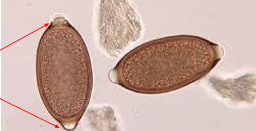
Trichuris egg looks like a barrel with two ____ plugs.
polar
Trichuris eggs are passed in stool as ____ eggs.
Humans acquire Trichuris by ingesting ____ eggs from soil.
Trichuris eggs require about ____ days in warm, moist soil to embryonate
eggs remaining viable in soil for 3-5 years
unembryonated; embryonated; 14
Trichuris trichiura larva are released in ___ intestine and undergoes several molts before maturing into ___ worm in the large intestine, ___.
small; adult; cecum
Ascaris infects humans after ingestion of ____ eggs.
not ___ eggs are fertilized! But the ones that are fertilized and deposited in warm, moist
soil will mature to an embryonated
(contains larva) egg after ~___ weeks and
become infective
viable in soil for up to 10 years
embryonated; all; 2
Ascaris eggs passed in stool must mature in warm, moist ____ before becoming infective.
soil
After ingestion of embryonated egg, Ascaris larvae hatch in the ____ intestine.
penetrate the intestine wall and enter the ___ portal circulation (blood circulation).
Ascaris larvae migrate to the ____, ascend the respiratory tree, and are swallowed.
small; hepatic; lungs
Ascaris larvae migrate through the ____ before returning to intestine after being ___. (Process very common w/ ground worm life cycles)
maturation completes in the ___
~___ days from ingestion of fertilized egg
to maturation
lungs; swallowed; intestines; 50
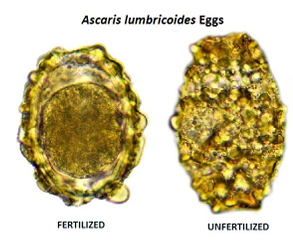
Ascaris eggs may be corticated or ____.
As well as fertilized, featuring a one-cell stage ___ (clear internalized structure).
Or unfertilized, elongated than ovoid containing a mass of highly refractile ___.
decorticated; embryo; granules

Ascaris lumbricoides
State if its fertilized/or not AND if it is corticated.
Unfertilized, corticated

Ascaris lumbricoides
State if its fertilized/or not AND if it is corticated.
Unfertilized, decorticated

Ascaris lumbricoides
State if its fertilized/or not AND if it is corticated.
Fertilized, corticated

Ascaris lumbricoides
State if its fertilized/or not AND if it is corticated.
Fertilized, decorticated
Hookworms are the ___ most commonly reported helminth infection in U.S. - pinworm is first.
Two species: Necator ___ (New World Hookworm) and Ancylostoma ___ (Old World Hookworm)
2nd; americanus; duodenale
Hookworm worm burden tends to ___ with age!
Most other helminth infections more
prevalent in children
increase
Hookworm eggs hatch in soil into ____ larvae, ineffective.
develop into infective ____ larvae.
Rhabditiform; filariform
Hookworms live in the ___ intestine, attaching to the mucosal surface with teeth (___) or cutting plates (___).
ingests blood as food source
Secrete substances that interfere with host digestive enzymes/absorption of ___
small; A. duodenale; N. americanus; nutrients
Hookworm causes anemia from intestinal ____ loss.
Also known for ___ ___, leaving a small, itchy, red papule on the skin at the site of larval penetration.
blood; ground itch
The usual hookworm forms passed in stool are ____.
eggs

Hookworm eggs in stool have thin shells and segmented ____.
eggs and rhabditiform larvae of N.
americanus and A. duodenale are
___--report as “hookworm”
embryos; indistinguishable
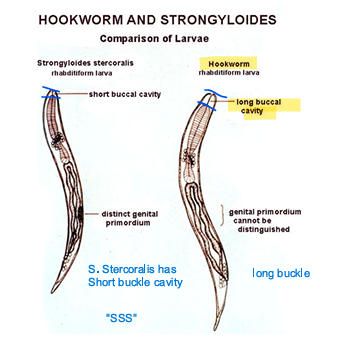
Hookworm Rhabditiform larvae must be distinguished from that of S. stercoralis - due to different treatment.
Hook worms have a ___ buccal capsule!
long
Strongyloides sterocoralis is also known as the ___.
inhabits ___ intestine but can also be a ___-living worm.
threadworm; small; free
Immunocompromised persons infected with Strongyloides stercoralis are at risk for ___ (auto reinfection phase) that may be potentially fatal.
hyperinfection

Strongyloides stercoralis is usually diagnosed by ____ larvae in stool because eggs are ___ seen in stool (Deposited in intestinal ___ rather than passed)
features ___ buccal capsule. (“SSS”)
rhabditiform; rarely; mucosa; short
Unlike hookworm, there is no ___ at site of skin penetration with Strongyloides stercoralis.
papule

Strongyloides stercoralis life cycle can occur in 3 forms
1) Direct route: similar to hookworms; eggs originate from ___ (penetration of filariform larvae, enter circulation and break out of lung capillaries, migrate bronical/tracheal tube and are swallowed)
2) Indirect route: Rhabditiform larvae in soil develop into ___-living males/females -- produce eggs
eggs originate in ___ rather than stool
Free-living cycle can revert to produce
infective ___ larvae at any point
Follows direct route of infection from here
3) Autoinfection: Rhabditiform larvae develop into ___ larvae rather than ___ in stool
follows direct route of infection from here
causes persistent infection and is source for hyperinfection
stool; free; soil; filariform; filariform; pass
Strongyloides eggs resemble ____ eggs when seen, though eggs are rarely seen in stool.
Hookworm
Trichinella spiralis is the causative agent of ___, the infection of ___ tissue with the larval form of T. spiralis.
Trichinosis; muscle
Humans are ___/dead end hosts with Trichinella spiralis due to ingestion of undercooked meat (___, wild game).
accidental; pork

Process of Trichinella spiralis infection:
1) ingested larvae are released from tissue capsule (after digestion of undercooked pork) in the intestine, maturing into ___.
2) Adults live in the intestines
either die or are expelled with feces
3) Female adults produce liveborn ___
who penetrate intestinal wall, enter circulation, and exit into ___ throughout the body
4) Once larvae enter tissue, they begin a maturation cycle that takes ~1 ___
Coil, become ___, and may remain
viable for years
Eventually calcify and die
adults; larvae; tissues; month; encapsulated
Trichinella spiralis is typically diagnosed via ___ immunoassay and tissue ___ for definitive diagnosis.
enzyme; biopsy
Larva migrans is the condition where migration of larva in human tissue goes where it's ___ supposed to (human accidental host) such as in human Trichinella spiralis infections.
Two forms exist: Cutaneous and visceral.
not

Cutaneous (creeping eruption) larva migrans is migration of larvae through the ____.
creates long, winding ___ underneath the skin
severe itch and allergic reaction
resolves within a few weeks when larva dies
caused by filariform larvae of dog/cat
___ (Ancylostoma braziliense &
caninum
skin; tunnels; hookworm

Visceral larva migrans is migration into internal ____/tissues.
Accidental ingestion of dog/cat roundworm (___ canis/cati) eggs
Toxocara - specific Ag. test, clinical symptoms for diagnosis
organs; Toxocara
Microfilariae are the larval forms of ____ worms.
filarial
Filarial worms (such as Wuchereria bancrofti) causes lymphatic ____.
filariasis
Onchocerca volvulus is transmitted by ____ flies (simulium).
black
Loa loa is transmitted by ____ flies.
Chrysops
Onchocerca microfilariae are ____ (sheathed or unsheathed?) and ___ nuclei extend to the tail.
unsheathed; no

For blood filariae, tail ____ arrangement and presence/absence of ____ helps species identification.
nuclei; sheath

Identify the organism
key microscopic feature: flattened coffee-bean egg
Enterobius vermicularis (pinworm)

Identify the organism
key microscopic feature: barrel egg with polar plugs
Trichuris trichiura (Whipworm)

Identify the organism
key microscopic feature: corticated (bile-stained outer coating mamillated/ covering in bumps) vs decorticated (lack mammillation)
Ascaris lumbricoides (large intestinal roundworm)

Identify the organism
key microscopic feature: segmented thin-shelled egg
Hookworm

Identify the organism
key microscopic feature: rhabditiform larva, short buccal
Strongyloides stercoralis (Threadworm)
The buccal canal is the ____ cavity of a nematode larva used as a morphologic ID feature.
oral
Strongyloides rhabditiform larvae have a ____ buccal canal and ____ genital primordium.
Short; prominent
Hookworm rhabditiform larvae have a ____ buccal canal and ____/inconspicuous genital primordium.
Long; small
Wuchereria bancrofti is transmitted by ____ vectors.
Mosquito
Wuchereria adults live mainly in the ____ and lymph nodes.
lymphatics
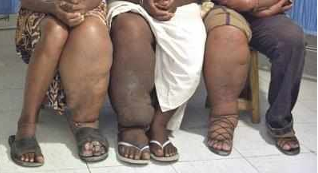
Wuchereria can cause severe lymphatic obstruction known as ____.
Elephantiasis
Wuchereria bancrofti, Brugia malayi, Onchocerca volvulus, and Loa loa are ___ filarial worms.
___ spp. are less pathogenic filarial worms..
pathogenic; Mansonella
Blood for Wuchereria is best collected between ____ PM and 2 AM due to ___ behavior.
This is the same for ____ malayi.
10; nocturnal; Brugia
In Wuchereria, nuclei do ____ extend to the tip of the tail and are ___ (sheathed/unsheathed).
not; sheathed

Brugia malayi causes disease ___ to Wuchereria bancrofti.
similar
Brugia microfilariae are ____ (sheathed or unsheathed?) and ___ nuclei extend to the tail.
sheathed; two

There is only ___ exception that does not have a sheath - that is Onchocerca volvulus.
All mansonella spp. (less pathogenic filarial worm) are ___.
one; unsheathed
Loa loa adults migrate through ____ tissue.
The characteristic Loa loa inflammatory swellings are called ____ swellings.
subcutaneous; Calabar

In Loa loa, nuclei extend to the ____ of the tail and are ___ (sheathed/unsheathed).
tip; sheathed
Blood for Loa loa is best collected around ____.
noon
Onchocerca causes onchocerciasis (___ ___).
river blindness
Adult Onchocerca worms are found in fibrotic ____ in subcutaneous tissue.
Why Microfilariae are ___ found in blood or lymphatics.
tumours; rarely
The diagnostic specimen for Onchocerca is a ____ snip.
skin
Filarial worm, Mansonella spp., is not associated with ___ human disease, but may be isolated from clinical samples.
M. streptocerca is found in the ____ and has nuclei extending through the shepherd’s-crook tail.
M. perstans is found in ____ and has nuclei extending to the tail tip.
M. ozzardi is found in ____ and its nuclei do not reach the tail tip.
serious; skin; blood; blood