Language Change
 Call Kai
 Learn
 Practice Test
 Spaced Repetition
 Match
 Flashcards
 Knowt Play
1/91

There's no tags or description
Looks like no tags are added yet.
92 Terms
what is standardisation
the process of establishing and maintaining a dominant, authoritative version of the language which includes regulating its spelling, grammar and vocabulary
what is the standard version of English
British Standard English (BSE)
What is the British standard English
Received Pronunciation - RP
What is the attitude that there is a standard variety of English which has rules that should be followed
prescriptivism
examples where BSE is more likely used
journalism, legal documents, job interview
examples where BSE is less likely used
text messages, social media posts, conversation in English between non-native English speakers
In a geographical area i which lots of speakers use slightly different varieties how might the standard variety be decided
the version that the most powerful or important people use
who or what decides what the version that the most powerful or important people use
the dictionary writers, print n press writers
how are the rules of the standard be established at maintained
SECA
Selection
Elaboration
Codification
Acceptance
what is selection (seca)
the step that involves choosing which varities and forms the standard will be based on
what is elaboration (seca)
expanding the language to be appropriate for use in all necessary contexts or filling any gaps that exist in the variety that was selected
what is codification (seca)
the process that ultimately establishes what is correct and what isnt in the standard
what is acceptance (seca)
the recognition and acceptance of the standard by all its users
benefits of standard english for education
sets students up for success
ensures fairness in exams giving every student the same reference point and standard to mark against
benefits of standard english for the law
consistency across cases and documents
international cooperation
everything done in the same way so is fair
benefits of standard english for occupational contexts
shared language helps colleges from different backgrounds communicate smoothly
global communication
benefits of standard english for ordinary people
clear communication in daily conversation - makes public situation easier
social mobility
avoiding misunderstandings
what’s the problem with linguistic subordination (deficit approach)
people are judged quite harshly by the way that they speak
suppression of linguistic diversity (problems with standardisation)
standardising a language minimises its variations which can lead to the suppression of authentic regional and social differences
social and psychological harm (problems with standardisation)
speakers of non-standard varieties may develop feelings of inferiority, questioning the value of their own language while the standardised form is seen of superior
practical and ideological problems (problems with standardisation)
remove or complicate functional parts of the language that are well understood and usual for users
consequences for language vitality (problems with standardisation)
a rigid focus of consistency can hinder innovation and the natural evolution of language preventing it form adapting to new needs and expectations
snell and cushing (research)
2023 - how attitudes to non - standard english manifest in school ofsted reports
criticised teachers who didnt ‘correct’ pupils use of non standard english
‘we done’ and ‘we was’
the school was in an area of high economic depravation serving largely black african black and black Caribbean pupils
concluded that these ideologies unfairly disadvantage students from lower social classes and from minority ethnic backgrounds
should we abolish the apostrophe - yes
complicates things for new english speakers
doesnt add anything to the language
we cant hear them
people miss them out anyway
used to judge people
speed/ease
should we abolish the apostrophe - no
‘were’ and ‘we’re’ - can completely change the meaning of a word
indicated omitted letters
demonstrates a certain level of education
used for a long time
provides clarity
who’s the organisation who wants to protect the apostrophe
Apostrophe Protection Society: Defending the Apostrophe
what do people view the misuse or omittion of the apostrophe as
a decline in standards
other non-standard usage that is often viewed as a decline in standards besides the apostrophe
common misspellings - their there and they’re
lack of capital letters
lack of full stops
lack of comma usage
double negation
pronunciation features - uptalk, th fronting etc
slang increase
the use of like as a filler
declinism/the crumbling castle
negative attitudes towards language change - declinism
Jean Atkinson - crumbling castle analogy
a once perfect structure - english is like a beautiful castle that was gradually and perfectly constructed at some point in the past
decline and decay - language is now slowly crumbling and falling into ruin due to changes and innovations that are seen as degradation
Jean Aitchison’s views on the crumbling castle
implies the castle of english was gradually and loving assembled until it reached a point of maximum splendour yet no year can be found when language achieved some peak of perfection nor have those who claim that english is ever declining ever suggested what this date might have been
examples of random things that were changed for political correctness
hertfordhsire recruitment agency boss could not use words like reliable in order to not offend unreliable people
the ‘mean witch’ in rapunzel was renamed a ‘kindness impaired person’ inn a modern adaptation
what is political correctness
creating rules about language in order to not offend
what is political correctness also known as
benign prescriptivism - kind or harmless prescriptivism
example of political correct terms
eskimos now know as inuits because
pinkers euphemism treadmill
making language politically correct results in a ‘euphemism treadmill’ (words/phrases are constantly changed') and actually fails to change attitudes
FOR EXAMPLE special needs - special educational needs - learning needs - individual needs
Arguments in favour of politically correct language
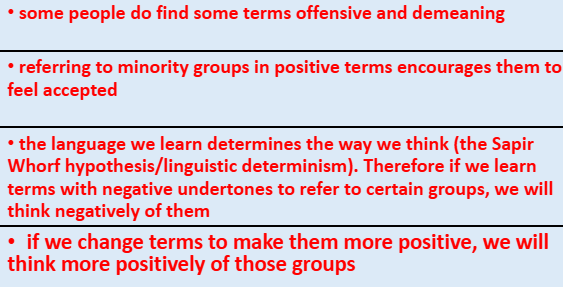
Arguments against politically correct language

what is functional theory - halliday
language changes in response to the needs of its users
language adapts to express new concepts and social realities
what is a neologism (functional theory in action)
new words are needed to name things that are new or to alter meaning
what is a neologism
a new word
what is regularisation (functional theory in action)
an irregular word changes to follow regular rules so its more logical and easy eg spelt is now spelled
what is blending (neologism)
parts of words are blended to create a new one eg pleather
what is compounding (neologisms)
whole words are stuck together eg breakfast
what is borrowing (neologisms)
words are taken from other languages eg sushi
what are acronyms (neologisms)
initial letters of phrases create a new word eg NATO
what are abbreviations (neologisms)
words are shortened eg telly
what is affixing (neologisms)
prefixes/suffixes are added to root words eg sexism
what is lib-fixing (neologisms)
parts of words are ‘liberated’ to create a suffix or prefix eg -zine
what is narrowing (neologisms)
a word becomes narrower in it meaning eg meat used to just mean all food
what is broadening (neologisms)
a word become broader in its meaning eg dog used to mean only one breed
what is amelioration (neologisms)
words become more positive eg sick
what is pejoration (neologisms)
words become more negative eg attitude
what is Americanisation (functional theory)
british english is evolving to become more similar to american english eg film becoming film or recognise to recognize
how does Americanisation meet the needs of british english
utilise british tech without having to buy british version/change the settings
the british comsume alot of american media
examples of textspeak
emojis, acronyms, initialisms, non standard spelling, flooding
aitchison and the damp spoon metaphor
she characterised the view that textspeak is lazy with a damp spoon metaphor taken from a newspaper writer who stated the distaste felt towards textspeak is the as when you see a damp spoon dipped in the sugar bowl
(JEAN DOES NOT FEEL THIS WAY BTW SHE JUST SAYING IT)
why is textspeak viewed as lazy or sloppy
involves shortening words, disregarding standard rules, emojis are the lazy option
what is beign prescriptivism
controlling langauge for a moral reason
what was the plain english campaign (benign prescriptivism)
fight against gobbledygook and misleading public information
aims to redefine power imbalances between mainstream and minority groups
what is change from above
a conscious, top-down process where new linguistic forms are adopted and promoted by individuals or institutions in positions of authority or prestige
conscious and deliberate - change from above feature
purposeful attempt to influence or reform language rather than a sudden linguistic shift
authority and influence - change from above feature
driven by influential figures or institutions such as grammarians, schools or language authorities
standardisation - change from above feature
the process is closely linked with the historical rise of standard language ideologies and the deliberate implementation of a single prestigious variety
top-down diffusion - change from above feature
he change typically starts in higher social classes and spreads to lower classes
social prestige - change from above feature
the new linguistic feature is associated with a higher social status, power or education
what is a fantabulous example of change from above
them apostrophe protection society peeps or silly Gillian Shepard telling teachers to stop kids using EE
what makes a change successful - change from above
becomes standard english
all speakers/writers use it
previous version no longer used
what makes a change unsuccessful - change from above
doesnt become standard english
speakers/writers dont use it
previous version still used
whats a way to determine is a change is successful
the s-curve model
what is the s curve model
a graph developed by matthew chen which determines the success of a change
what is the steepest part of the s curve model
when the spread has become more rapid and more speakers/writers are using it
what does the s curve model levelling off represent
when most people have adopted the new change
what is functional theory
language changes in response to the needs of its users
who came up with functional theory
halliday
neologisms as a functional theory example
sometimes language needs a new term to label something new
sometimes they are completely new words or they are existing words that are altered
regularisation as a functional theory example
an irregular word changing to follow regular rules for example the past tense version of the verb to sneak going from snuck to sneaked
what is blending (making a neologism)
2 parts a word blended to make a new word (spork, smog, pleather)
what is compounding (making a neologism)
whole words are stuck together (laptop, breakfast, waistband)
what is borrowing (making a neologism)
words that are taken from other languages (baguette, sushi, balcony)
what is affixing (making a neologism)
prefixes/suffixes are added to words (sexism, pre-drinks, unalive)
what is lib-fixing (making a neologism)
parts of words are ‘liberated’ to create a suffix/prefix (-zine, -gate, -tastic)
what is narrowing (making a neologism)
a word becomes narrower in it scope (meat used to mean all food now its just dead animals)
what is broadening (making a neologism)
a word becomes broader in scope (cool used to only refer to jazz music)
what is pejoration (making a neologism)
a word becomes more negative in its meaning (attitude, sick, discreet)
what is amelioration (making a neologism)
a word becomes more positive in its meaning
ways to make neologisms
blending, compounding, borrowing, acronyms, abbreviations, affixing, lib-fixing, metaphor, narrowing, broadening, pejoration, amelioration, euphemism
americanisation as an example of functional theory
british english is evolving to become more similar to american english for example spelling of recognise to recognize and movie replacing film
how does americanisation meet the needs of british english
it can utilise american produced tech without having to buy a specific british version/change the settings
british english users consume so much american media
technology has made communication between countries in different parts of the world easier and more common
what are affordances (when it comes to technology)
the opportunities and functionality afforded by a particular technology
what are constraints (when it comes to technology)
the limitations and lack of functionality afforded by a particular technology
what is a synchronous discourse
discourse (conversation) that is reliant on everyone being present at the same time
what is a asynchronous discourse
discourse (conversation) that is not reliant on everyone being present at the same time