chapter 4 pt.1 - Epithelial tissues
 Call Kai
 Learn
 Practice Test
 Spaced Repetition
 Match
 Flashcards
 Knowt Play
1/31

There's no tags or description
Looks like no tags are added yet.
32 Terms
histology
study of tissues
biopsy
tissue sample used to investigate disease or disorders
what are the four major tissue types in the human body?
Epithelial, Connective, Muscle, and Nervous
main functions of epithelial tissue?
Protection, absorption, secretion, filtration, excretion, and sensation. It covers organs, lines cavities, and forms glands.
What does avascular mean, and how does epithelial tissue obtain nutrients?
Avascular means no blood vessels. Nutrients diffuse from the underlying connective tissue.
Apical Surface
the exposed or free surface
Where is the basement membrane located?
Between epithelial tissue and the underlying connective tissue. It supports and anchors the epithelium.
What is the difference between simple and stratified epithelium?
Simple has one layer of cells; stratified has two or more layers.
What are the three basic epithelial cell shapes?
Squamous = flat; cuboidal = cube-shaped; columnar = tall.
What are the Eight Epithelial tissue types?
Simple squamous
Simple cuboidal
simple columnar
stratified squamous
stratified cuboidal
stratified columnar
pseudostratified ciliated columnar
transitional

Where is simple squamous epithelium found, and what is its function?
Found in alveoli and blood-vessel linings. Allows rapid diffusion and filtration.

What is endothelium?
Simple squamous epithelium lining the inside of blood and lymphatic vessels.

Where is simple cuboidal epithelium found?
Kidney tubules and certain gland ducts; important in secretion and absorption.

Which epithelium lines most of the digestive tract and absorbs nutrients?
Simple columnar epithelium. Often has microvilli and goblet cells.

What is the identification and location of the stratified squamous epithelium found?
Epidermis, mouth, esophagus, and v@g1na. Primarily protects against abrasion. (Pap smears)

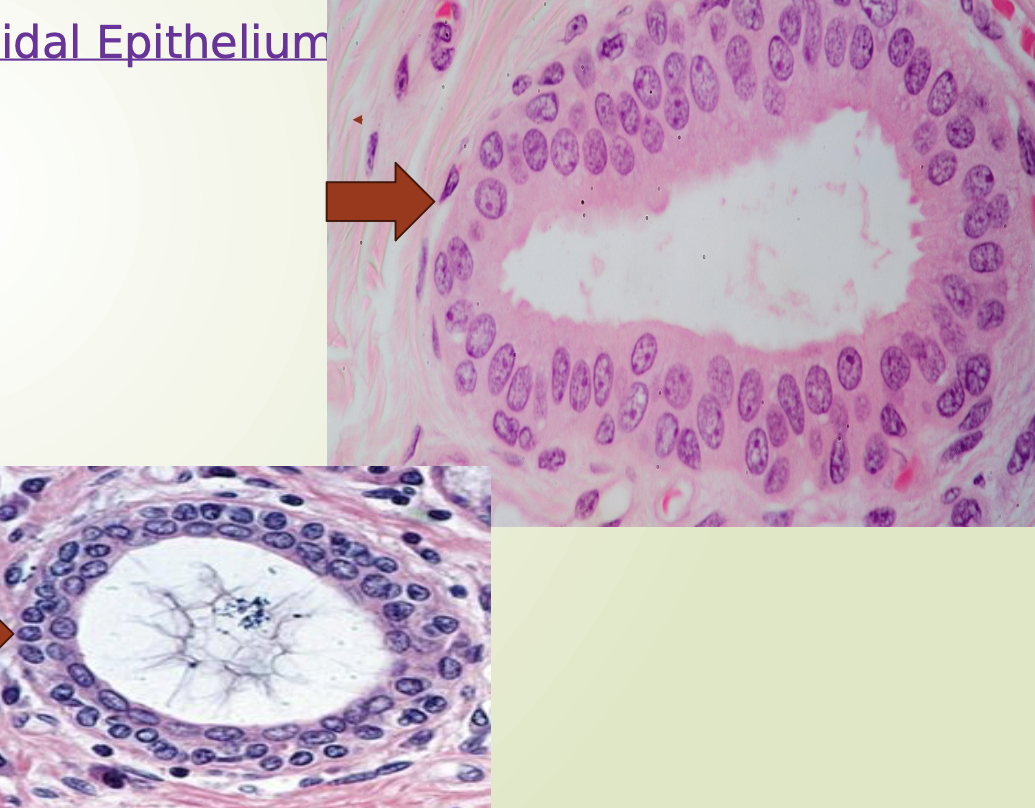
What is the identification and location of the stratified cuboidal?
has multiple layers of cuboidal cells. located in sweat gland ducts

what is the identification and location of the Stratified Columnar?
has multiple layers and tall surface cells. located in large gland ducts and the urethra.

What distinguishes pseudostratified ciliated columnar epithelium?
Nuclei at different heights, cilia, and often goblet cells. All cells contact the basement membrane.

Where is transitional epithelium found?
Urinary bladder and ureters. It stretches as these organs fill.
What do goblet cells produce?
Mucus, which traps particles and protects or lubricates epithelial surfaces.
What is the difference between cilia and microvilli?
Cilia move material across a surface; microvilli increase surface area for absorption.
What are the three major epithelial membranes?
Cutaneous, mucous, and serous membranes.
What is the difference between visceral and parietal serous membranes?
Visceral covers the organ; parietal lines the cavity wall.
What is the difference between pleura, pericardium, and peritoneum?
Pleura = lungs; pericardium = heart; peritoneum = abdominopelvic cavity.
What distinguishes endocrine and exocrine glands?
Endocrine glands are ductless and release hormones into body fluids; exocrine glands release products through ducts.
How do merocrine, apocrine, and holocrine secretion differ?
Merocrine = exocytosis; apocrine = apical cell portion released; holocrine = entire cell breaks down.

what’s the name of this tissue?
Simple cuboidal epithelium. One layer of cube-shaped cells with centrally placed nuclei.

what’s the name of this tissue?
Stratified squamous epithelium. Multiple layers with flattened surface cells.

what’s the name of this tissue?
Stratified columnar epithelium. Multiple layers with columnar cells at the exposed surface.

what’s the name of this tissue?
Transitional epithelium. Multiple layers with rounded or dome-shaped surface cells; stretches in urinary organs.

what’s the name of this tissue?
Pseudostratified ciliated columnar
all cells touch the basement membrane
Multicellular exocrine glands
simple = unbranched duct
compound = branched duct