lecture 6 translation
 Call Kai
 Learn
 Practice Test
 Spaced Repetition
 Match
 Flashcards
 Knowt Play
1/23

There's no tags or description
Looks like no tags are added yet.
24 Terms
how do polycistronic mRNAs from prokaryotic operons differ from typical eukaryotic monocistronic mRNAs?
polycistronic: one mRNA contains multiple coding regions and can produce more than one polypeptide.
monocistronic: one mRNA contains a single coding region and produces one type of polypeptide.

the ribosome has a channel for mRNA and three tRNA binding sites. what does each site hold?
A site (aminoacyl) — holds the incoming tRNA carrying an amino acid.
P site (peptidyl) — holds the tRNA carrying the growing polypeptide.
E site (exit) — holds the empty tRNA just before it leaves.
during prokaryotic translation initiation, how does the small ribosomal subunit position the mRNA start codon?
IF1, IF2, and IF3 bind the 30S subunit. then 16S rRNA base-pairs with the Shine–Dalgarno sequence on the mRNA, positioning the start codon in the P site.

once the start codon is in the P site, how does prokaryotic translation initiation finish?
IF2–GTP helps the initiator fMet-tRNA pair with the start codon. the 50S subunit joins, triggering IF2 to hydrolyze GTP. the initiation factors dissociate, leaving a complete 70S ribosome ready for elongation.

during bacterial translation initiation, what modified amino acid does the initiator tRNA carry?
formylmethionine (fMet), which is methionine with a formyl group attached to its amino group. the initiator tRNA delivers fMet as the first amino acid of the new polypeptide.

in eukaryotic translation initiation, what makes up the 43S preinitiation complex?
the 40S small ribosomal subunit, the initiator Met-tRNA bound to eIF2–GTP, and the initiation factors eIF1, eIF1A, eIF3, and eIF5.
once the 43S complex forms, how is it recruited to the mRNA, and which direction does it scan?
eIF4E binds the mRNA’s 5′ cap with help from eIF4A, eIF4B, and eIF4G. the 43S complex is recruited to the 5′ end and scans 5′ → 3′ for the start codon.
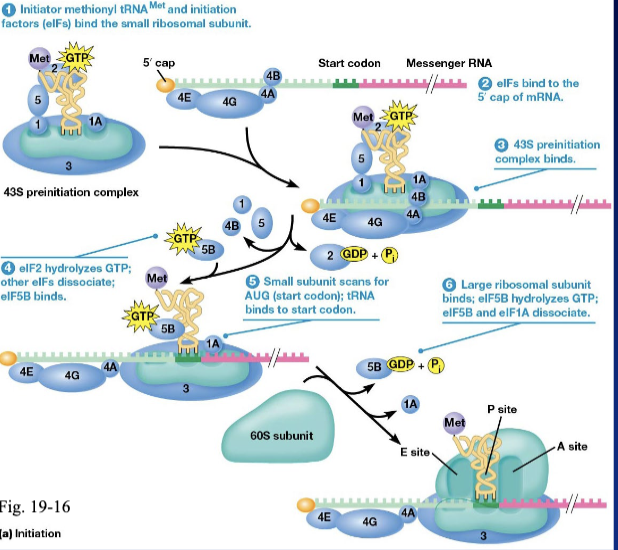
as the 43S complex scans, how does it recognize the start codon and prepare for the large subunit to join?
the initiator Met-tRNA pairs with AUG in the Kozak consensus sequence (example shown: 5′-CCACC[AUG]G-3′). eIF2 hydrolyzes GTP, and most initiation factors detach, making room for the large subunit.

after start codon recognition, how does the complete 80S ribosome form?
eIF5B–GTP helps the 60S large subunit join the 40S subunit. once they join, eIF5B hydrolyzes GTP, and eIF5B–GDP and the remaining initiation factors detach. the 80S ribosome is ready for elongation, with the initiator Met-tRNA in the P site.

what are the three steps of eukaryotic translation elongation?
tRNA binding — an incoming aminoacyl-tRNA pairs with the mRNA codon in the A site.
peptide bond formation — the growing polypeptide transfers from the P-site tRNA to the amino acid on the A-site tRNA.
translocation — the ribosome moves one codon along the mRNA. the tRNA carrying the chain shifts A → P, and the empty tRNA shifts P → E and exits.
at the start of translation elongation, which ribosomal sites are occupied, and what brings the next aminoacyl-tRNA to the ribosome?
the initiator tRNA is in the P site, and the A and E sites are empty. eEF1A–GTP in eukaryotes (called eEF-1α on the slide) or EF-Tu–GTP in bacteria delivers the next aminoacyl-tRNA to the A site.

once an aminoacyl-tRNA is delivered to the A site, what happens when its anticodon correctly matches the mRNA codon?
the elongation factor hydrolyzes GTP and detaches, leaving the aminoacyl-tRNA in the A site. the initiator tRNA is still in the P site, and the E site is empty in this first cycle. in bacteria, EF-Ts helps recycle EF-Tu by promoting GDP release so it can bind GTP again.
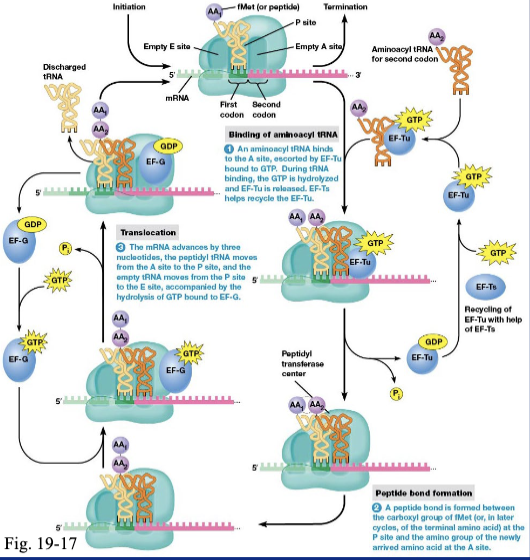
once both the A and P sites are occupied, how does the peptide bond form, and which rRNA catalyzes it?
a peptide bond forms between the carboxyl end of the chain in the P site and the amino group of the new amino acid in the A site. this transfers the growing chain to the A-site tRNA, leaving the P-site tRNA empty. the large-subunit rRNA acts as a ribozyme with peptidyl transferase activity (28S in eukaryotes, 23S in bacteria).
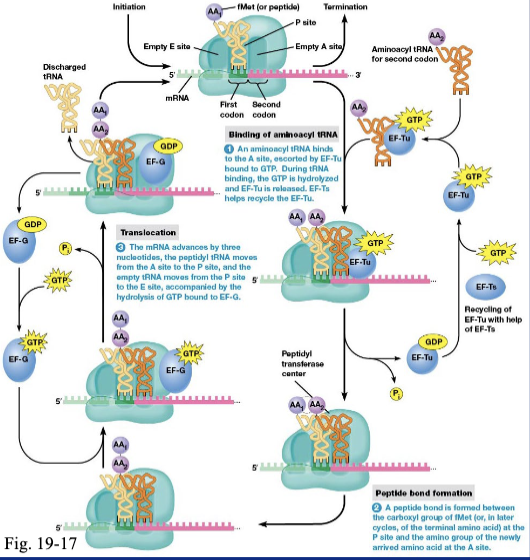
after the peptide bond forms, what drives ribosome translocation, and how far does the ribosome move?
eEF2–GTP in eukaryotes or EF-G–GTP in bacteria binds the ribosome. the ribosome changes shape, loosening its contacts with the tRNAs and allowing it to advance one codon (three bases) toward the 3′ end of the mRNA. the factor hydrolyzes GTP and detaches, and the ribosome returns to its original conformation.

after translocation, where are the two tRNAs, and what makes the ribosome ready for another round?
the peptidyl-tRNA moves A → P, and the empty tRNA moves P → E before exiting. the A site is now empty, so the next aminoacyl-tRNA can bind.

translation termination begins when a stop codon enters the A site. what binds there?
a release factor recognizes the stop codon (UAA, UAG, or UGA). no tRNA has a matching anticodon. in eukaryotes, eRF1 recognizes the stop codon, and eRF3–GTP accompanies it.
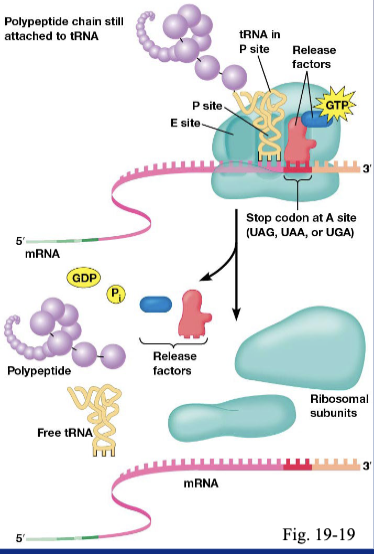
after the stop codon is recognized, how is the polypeptide released?
eRF3 hydrolyzes GTP, and eRF1 promotes hydrolysis of the bond linking the polypeptide to the P-site tRNA. the completed polypeptide is released. the release factors and ribosomal subunits then dissociate from the mRNA.

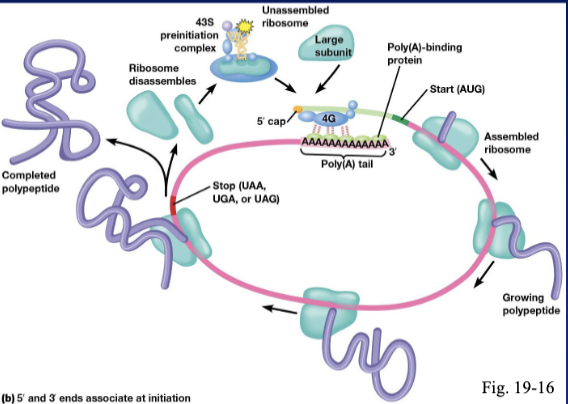
what is a polyribosome, and why are the polypeptides longer near the 3′ end of the mRNA?
a polyribosome (polysome) is a group of ribosomes translating the same mRNA at the same time. each ribosome moves 5′ → 3′, so ribosomes farther along have added more amino acids to their polypeptides.

how does bringing the 5′ and 3′ ends of a eukaryotic mRNA together help translation start again?
the poly(A)-binding protein at the 3′ tail binds eIF4G in the 5′ cap complex, looping the mRNA. when translation ends, the released ribosomal subunits are already near the 5′ end, where they can be reused to initiate translation.
which antibiotics target the bacterial 30S subunit, and what does each block?
streptomycin inhibits translation initiation and causes misreading of mRNA.
tetracycline blocks aminoacyl-tRNA from binding to the A site.
which antibiotics target the bacterial 50S subunit, and which step of elongation does each inhibit?
erythromycin inhibits translocation, the step that moves tRNA from the A site to the P site.
chloramphenicol blocks peptidyl transferase activity, preventing peptide bond formation.

ricin is a toxic protein from castor beans. how does it stop translation?
ricin damages 28S rRNA in the large ribosomal subunit. this prevents the ribosome from working with elongation factors, so protein synthesis stops.

how does the chaperone HSP70 help a newly forming polypeptide fold?
HSP70 binds exposed hydrophobic regions to keep them from clumping while the rest of the protein folds. ATP hydrolysis makes HSP70 grip the polypeptide more tightly, and binding a new ATP causes it to release the polypeptide.

how does the HSP60 chaperonin help an unfolded or partially folded protein fold?
the polypeptide enters a protected chamber. in the bacterial example, GroEL forms the chamber and GroES caps it. ATP-driven shape changes create a hydrophilic environment where the protein can fold before it’s released.
