Brain stem and cerebellum
 Call Kai
 Learn
 Practice Test
 Spaced Repetition
 Match
 Flashcards
 Knowt Play
1/21

Earn XP
Description and Tags
Chapter 17
22 Terms
Brainstem
Consists of the midbrain, pons, and medulla oblongata

Midbrain
Involved in vision, hearing, motor control and more
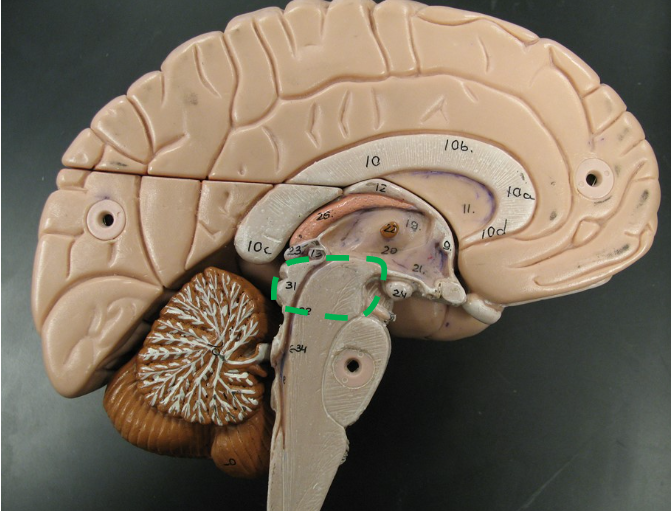
Cerebral aqueduct
Runs through the midbrain and allows for CSF to flow from the third ventricle to the fourth ventricle
Tectum
Involved in auditory and visual reflexes

What are the bulging structures on the tectum?
Corpora quadrigemina
Superior colliculus
Involved in visual reflexes and eye and hand movement

Inferior colliculus
Involved in auditory reflexes
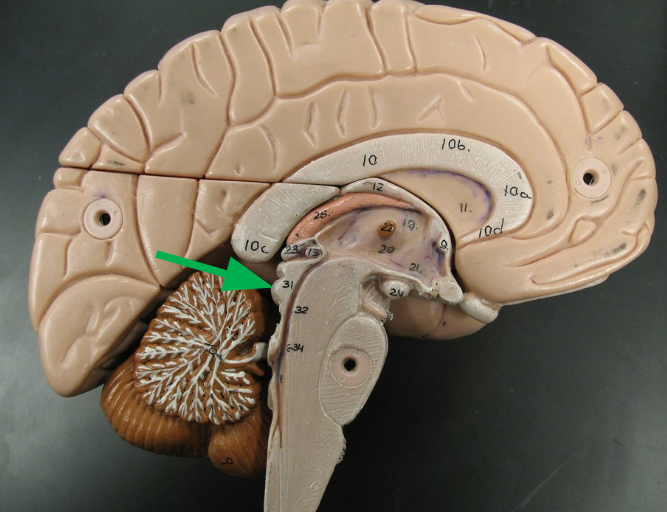
Pineal gland
Produces melatonin

Oculomotor nerve
Controls muscles involved in eye movements and the constriction and dilation of the pupil

Pons
Contain tracts that connect the diencephalon and cerebrum to the cerebellum and medulla oblongata
Controls chewing, swallowing, breathing, etc.

Medulla oblongata
Contains motor tracts ventrally
Contains sensory tracts dorsally
Contain nuclei involved in heart rate, blood pressure, breathing, vomiting, sneezing, etc.

Cerebral hemisphere
Located in red. Involved in coordination of motor activity

Folia
Located in green. The small folds of the cerebellum

Arbor vitae
Collection of white matter in the cerebellum

Fourth ventricle
Receives CSF from the 3rd ventricle from the cerebral aqueduct
Allows CSF to move to the central canal of the spinal cord inferiorly
Allows CSF to move into the subarachnoid space laterally and posteriorly
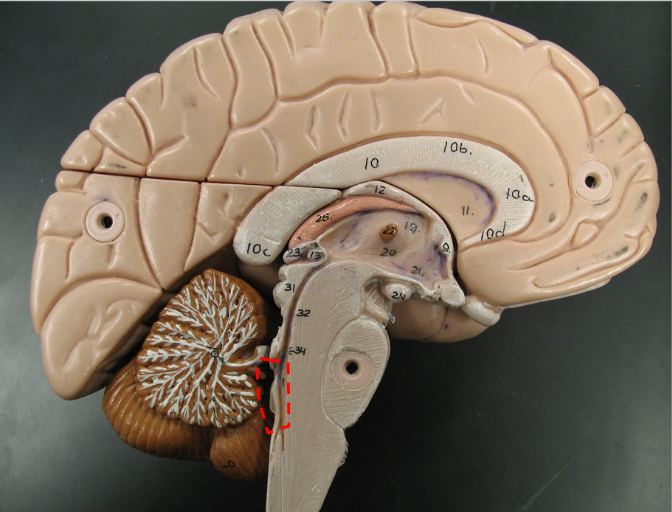
Transverse fissure
Separates the cerebellum and the occipital lobe of the cerebrum
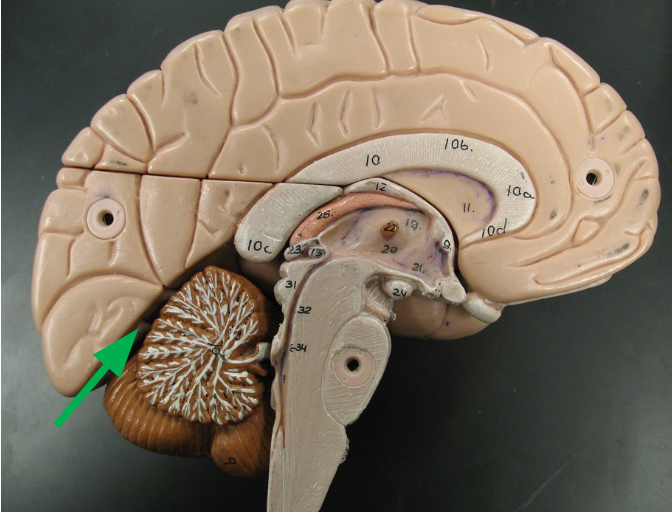
Vermis
Segmented narrow band of nervous tissue

Olfactory bulb
Receives input from the olfactory neurons coming from the nasal cavity
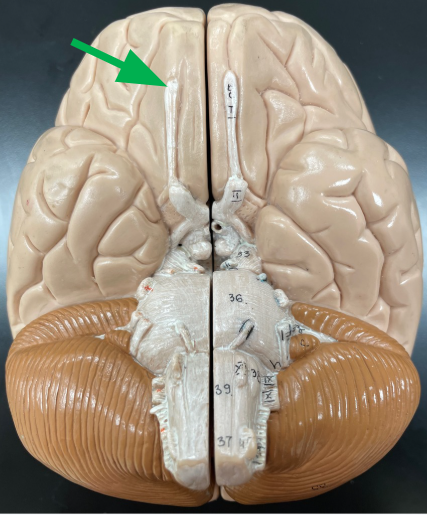
Olfactory tract
Carries olfactory information from the olfactory bulb to the cerebrum

Optic nerve
Carries information from the retina of the eye

Optic chiasm
The site at which some axons in each optic nerve cross over to the other side
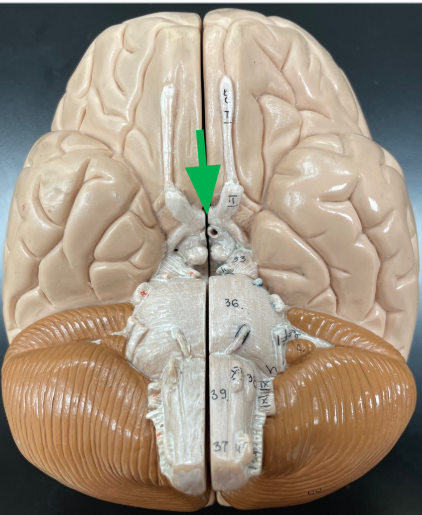
Optic tract
Carries information from the optic nerves to the thalamus
