synthesis reactions
 Call Kai
 Learn
 Practice Test
 Spaced Repetition
 Match
 Flashcards
 Knowt Play
1/11

There's no tags or description
Looks like no tags are added yet.
12 Terms

Hydro halogenation
Reagents: HX
Description: gives Markovnikov addition of H and X across the alkene
Hydrobromination
Reagents: HBr , ROOR
Gives an anti-Markovnikov addition of H and Br across the alkene
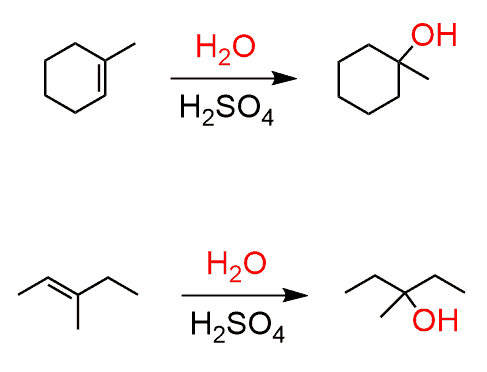
Acid catalyzed hydration
Reagents: H3O+
Description: gives Markovnikov addition of H and OH across the alkene
Oxymercuration Demercuration
Reagents: 1) Hg(OAc)2, H2O 2)NaBH4
Description: gives a Markovnikov addition of H and OH across the alkene without carbocation rearrangements
Hydroboroation-oxidation
Reagents: 1)BH3, THF 2) H2O2, NaOH
Description: gives an anti-Markovnikov addition of H and OH across the alkene via exclusive syn addition
Hydrogenation
Reagents: H2 , Pt
Description: gives a syn addition of H and H across the alkene

Bromination
Reagents: Br2
Description: gives an anti-addition of Br and Br across the alkene
Halhydrin formation
Reagents: Br2 H2O
Description: gives an anti addition of Br and OH across the alkene. The OH group installs at the more substituted position
Anti Dihydroxylation
Reagents: 1) RCO3H 2) H3O+
Description: converts the alkene into an epoxide, which is open by an aqueous acid to yield a trans-diol
Syn Dihydroxylation (Permagenate)
Reagents: KMnO4, NaOH, cold
Description: gives a syn addition of OH and OH across an alkene to yield a cis-diol
Syn Dihydroxylation (Osmonium)
Reagents: 1)OsO4 2)NaHSO3, H2O
Description: gives a syn addition of OH and OH across an alkene to yield a cis-diol
Ozonolysis
Reagents: 1) O3 2) DMS
Description: cleaves the C=C bond, producing two separate compounds containing C=O bond