L7 -Genetics of Leukaemia

0.0(0)
Studied by 0 people
call kaiCall Kai
learnLearn
examPractice Test
spaced repetitionSpaced Repetition
heart puzzleMatch
flashcardsFlashcards
GameKnowt Play
Card Sorting

1/30

encourage image

There's no tags or description

Looks like no tags are added yet.

Last updated 2:34 PM on 10/4/26
Name
Mastery
Learn
Test
Matching
Spaced
Call with Kai
Chat

No analytics yet

Send a link to your students to track their progress

31 Terms

1
New cards

what are the types of adult leukaemia

  • plus chronic myeloid leukaemia (CML) and T cell leukaemia
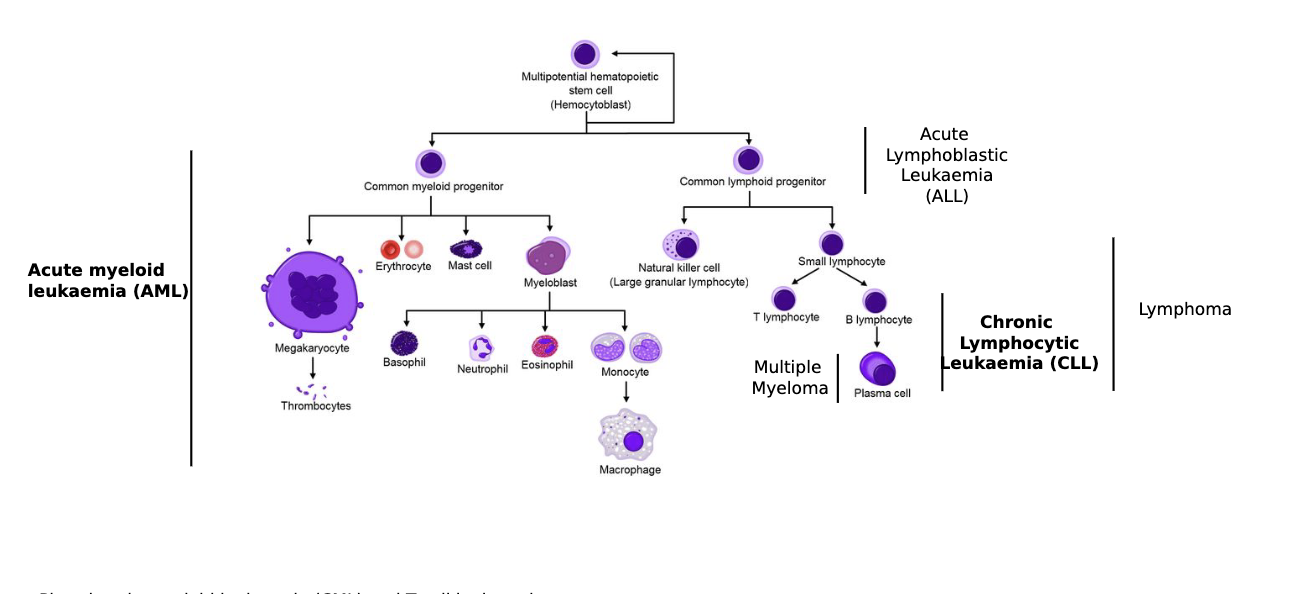

<ul><li><p>plus chronic myeloid leukaemia (CML) and T cell leukaemia </p></li></ul><p></p>
2
New cards

At which stages of B-cell development can cancers arise, and what cancers are associated with them?

Cancers can arise at different stages of B-cell development: acute lymphoblastic/leukaemia from B-cell precursors,

  • Hodgkin lymphoma from germinal-centre B cells, multiple myeloma from plasma cells, and chronic lymphocytic leukaemia (CLL) from mature/memory B cells.


<p>Cancers can arise at different stages of B-cell development: <strong>acute lymphoblastic/leukaemia</strong> from B-cell precursors,</p><ul><li><p><strong>Hodgkin lymphoma</strong> from germinal-centre B cells, <strong>multiple myeloma</strong> from plasma cells, and <strong>chronic lymphocytic leukaemia (CLL)</strong> from mature/memory B cells.</p></li></ul><p></p>
3
New cards

when are adult leukaemiad diagnosed

knowt flashcard image
4
New cards

How do constitutional and somatic genetic changes contribute to cancer risk?

The human genome contains >100 million polymorphisms, and DNA replication errors/mutations are an inevitable consequence of cell division.

  • These mutations accumulate differently in each cell, meaning each cell evolves differently and somatic mutations can contribute to cancer development.


<p>The human genome contains <strong>&gt;100 million polymorphisms</strong>, and <strong>DNA replication errors/mutations are an inevitable consequence of cell division</strong>. </p><ul><li><p>These mutations accumulate differently in each cell, meaning <strong>each cell evolves differently</strong> and somatic mutations can contribute to cancer development.</p></li></ul><p></p>
5
New cards

what is the natural history of chronic lymphocytic leukaemia

  • CLL is characterised by complex somatic genetics

  • clinical course of disease is very heterogeneous (because of genetics?)
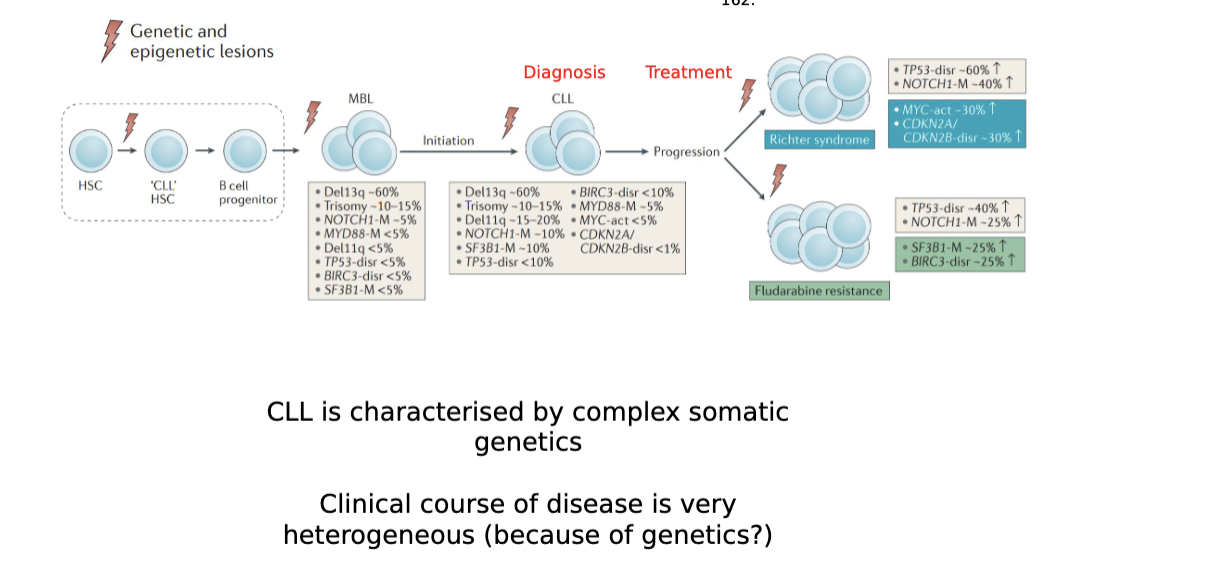

<ul><li><p>CLL is characterised by complex somatic genetics</p></li><li><p>clinical course of disease is very heterogeneous (because of genetics?)</p></li></ul><p></p>
6
New cards

How does the importance of constitutional vs somatic genetic variants change throughout cancer development?

Constitutional variants are present from birth and are more important in disease susceptibility/aetiology,

  • while somatic mutations accumulate over time and become increasingly important for disease progression, prognosis, diagnosis and treatment, enabling more tailored treatment.


<p><strong>Constitutional variants</strong> are present from birth and are more important in <strong>disease susceptibility/aetiology</strong>, </p><ul><li><p>while <strong>somatic mutations</strong> accumulate over time and become increasingly important for <strong>disease progression, prognosis, diagnosis and treatment</strong>, enabling more <strong>tailored treatment</strong>.</p></li></ul><p></p>
7
New cards

Why do haematological cancers tend to run in families?

Familial clustering of haematological cancers may result from shared genetic factors and/or shared environmental exposures.

  • Different cancers can arise from different stages of haematopoietic cell development, including lymphoid and myeloid lineages.


<p>Familial clustering of haematological cancers may result from <strong>shared genetic factors and/or shared environmental exposures</strong>. </p><ul><li><p>Different cancers can arise from different stages of <strong>haematopoietic cell development</strong>, including lymphoid and myeloid lineages.</p></li></ul><p></p>
8
New cards

How do risk alleles differ between monogenic and polygenic cancer?

  • Monogenic risk alleles are generally rarer and have higher penetrance

  • polygenic risk alleles are generally more common and have lower penetrance.


<ul><li><p><strong>Monogenic</strong> risk alleles are generally <strong>rarer and have higher penetrance</strong></p></li></ul><ul><li><p><strong>polygenic</strong> risk alleles are generally <strong>more common and have lower penetrance</strong>.</p></li></ul><p></p>
9
New cards

How can AML be a monogenic disease?

Some individuals carry rare, high-penetrance germline variants that greatly increase their lifetime risk of AML

  • compared with ~0.5% risk in people without a high-penetrance variant.
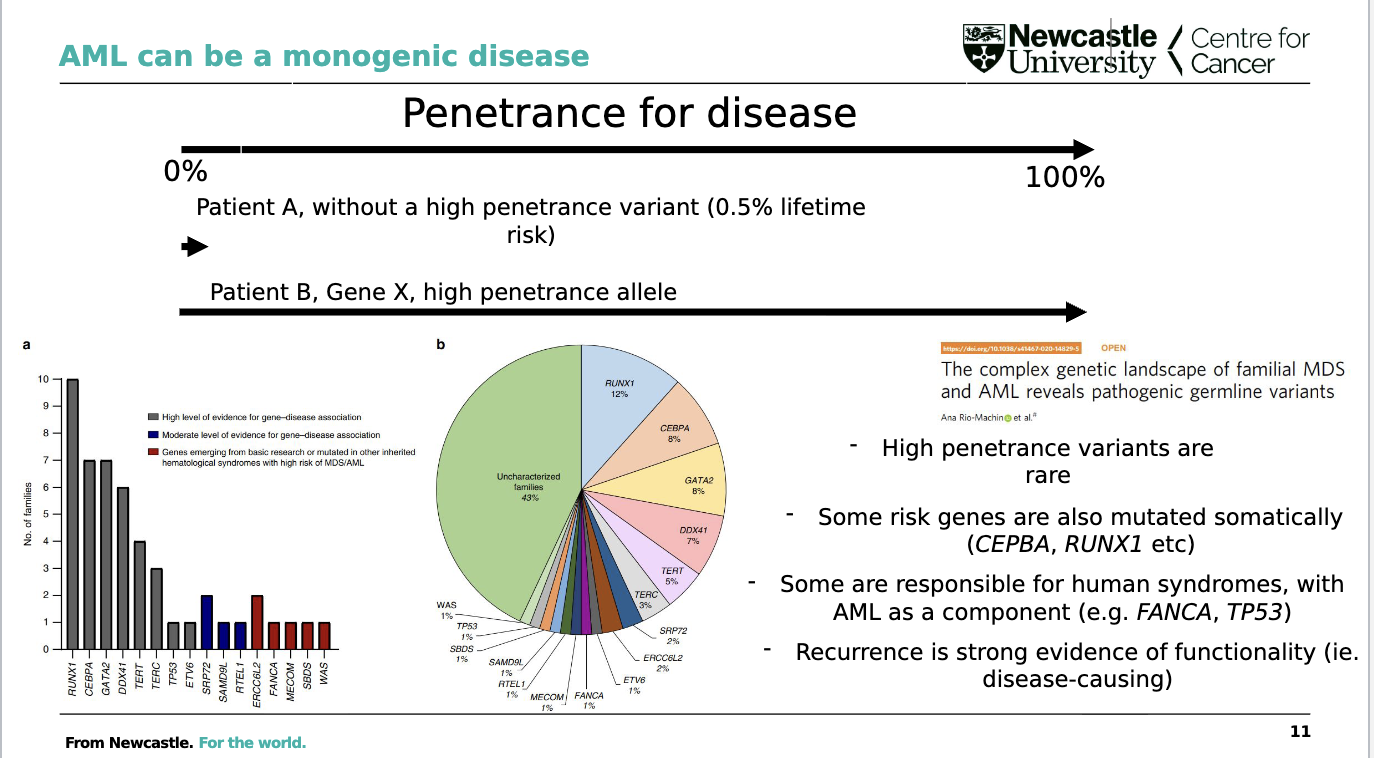

<p>Some individuals carry <strong>rare, high-penetrance germline variants</strong> that greatly increase their lifetime risk of AML</p><ul><li><p>compared with ~0.5% risk in people without a high-penetrance variant.</p></li></ul><p></p>
10
New cards

What evidence supports high-penetrance genetic variants causing AML?

  • High-penetrance variants are rare.

  • Some risk genes are also somatically mutated (e.g. CEBPA, RUNX1).

  • Some cause inherited syndromes where AML is a component (e.g. FANCA, TP53).

  • Strong familial recurrence is evidence that the variant is disease-causing.


<ul><li><p>High-penetrance variants are <strong>rare</strong>.</p></li><li><p>Some risk genes are also <strong>somatically mutated</strong> (e.g. <strong>CEBPA, RUNX1</strong>).</p></li><li><p>Some cause inherited syndromes where AML is a component (e.g. <strong>FANCA, TP53</strong>).</p></li><li><p><strong>Strong familial recurrence</strong> is evidence that the variant is disease-causing.</p></li></ul><p></p>
11
New cards

What does the POT1 example show about genetic predisposition to cancer?

Rare POT1 (Protection of Telomeres 1) germline variants can predispose individuals to lymphoid and myeloid cancers.

  • The example shows a POT1 variant segregating in a family, with affected individuals developing cancers such as CLL and AML, demonstrating a monogenic inherited cancer predisposition.
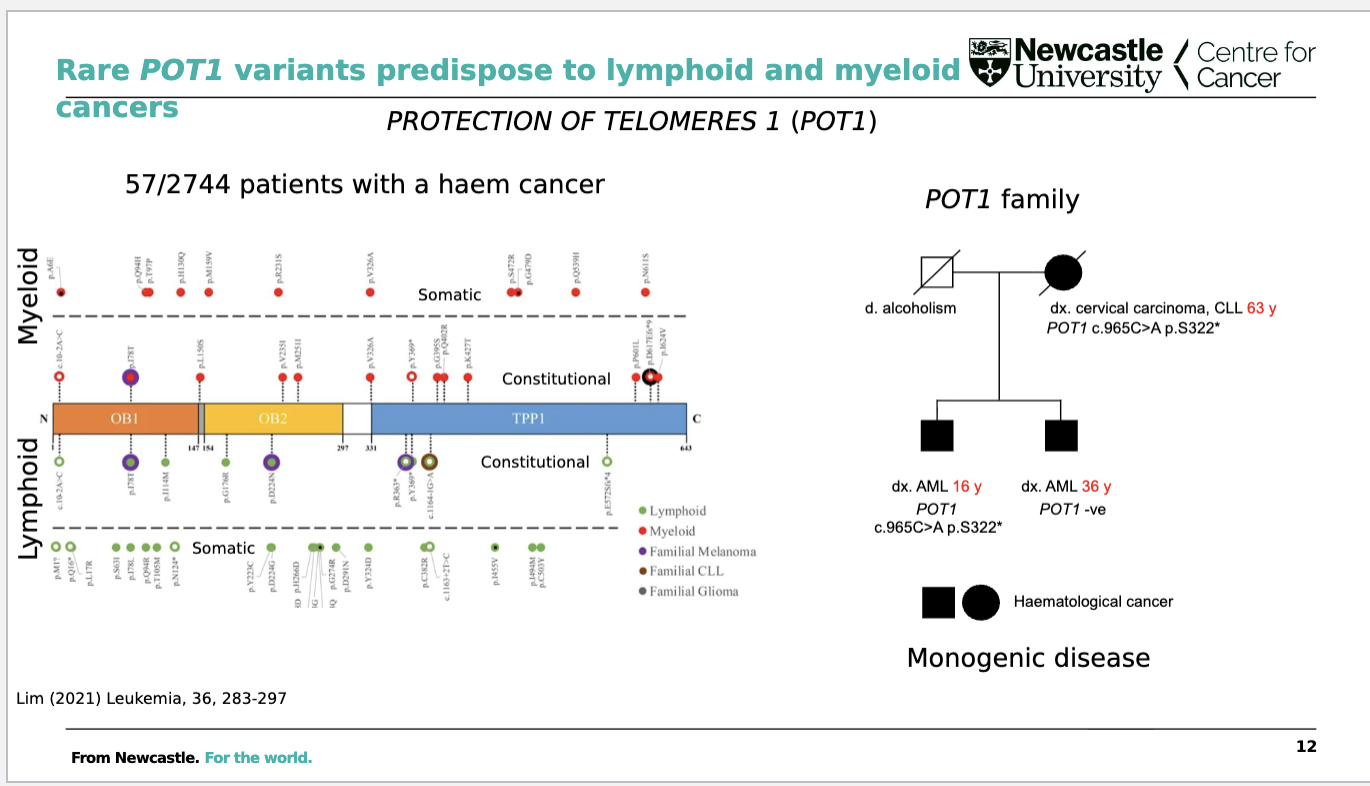

<p>Rare <strong>POT1 (Protection of Telomeres 1) germline variants</strong> can predispose individuals to <strong>lymphoid and myeloid cancers</strong>. </p><ul><li><p>The example shows a <strong>POT1 variant segregating in a family</strong>, with affected individuals developing cancers such as <strong>CLL and AML</strong>, demonstrating a <strong>monogenic inherited cancer predisposition</strong>.</p></li></ul><p></p>
12
New cards

Why is CLL considered a polygenic disease?

CLL risk is influenced by multiple common, low-penetrance alleles across different genes

  • Each allele contributes a small increase in disease risk, with their combined effects producing a higher overall genetic susceptibility.


<p>CLL risk is influenced by <strong>multiple common, low-penetrance alleles</strong> across different genes</p><ul><li><p>Each allele contributes a small increase in disease risk, with their <strong>combined effects</strong> producing a higher overall genetic susceptibility.</p></li></ul><p></p>
13
New cards

What evidence shows that CLL is a polygenic disease?

43 loci carrying common variants account for ~25% of the heritable risk of CLL.

  • Each risk allele has a relatively small effect (e.g. IRF4 OR 1.54, C6orf106/ILRUN OR 1.20)

  • but the effects accumulate: carrying 8+ risk alleles is associated with an OR of 12.0 compared with having none.
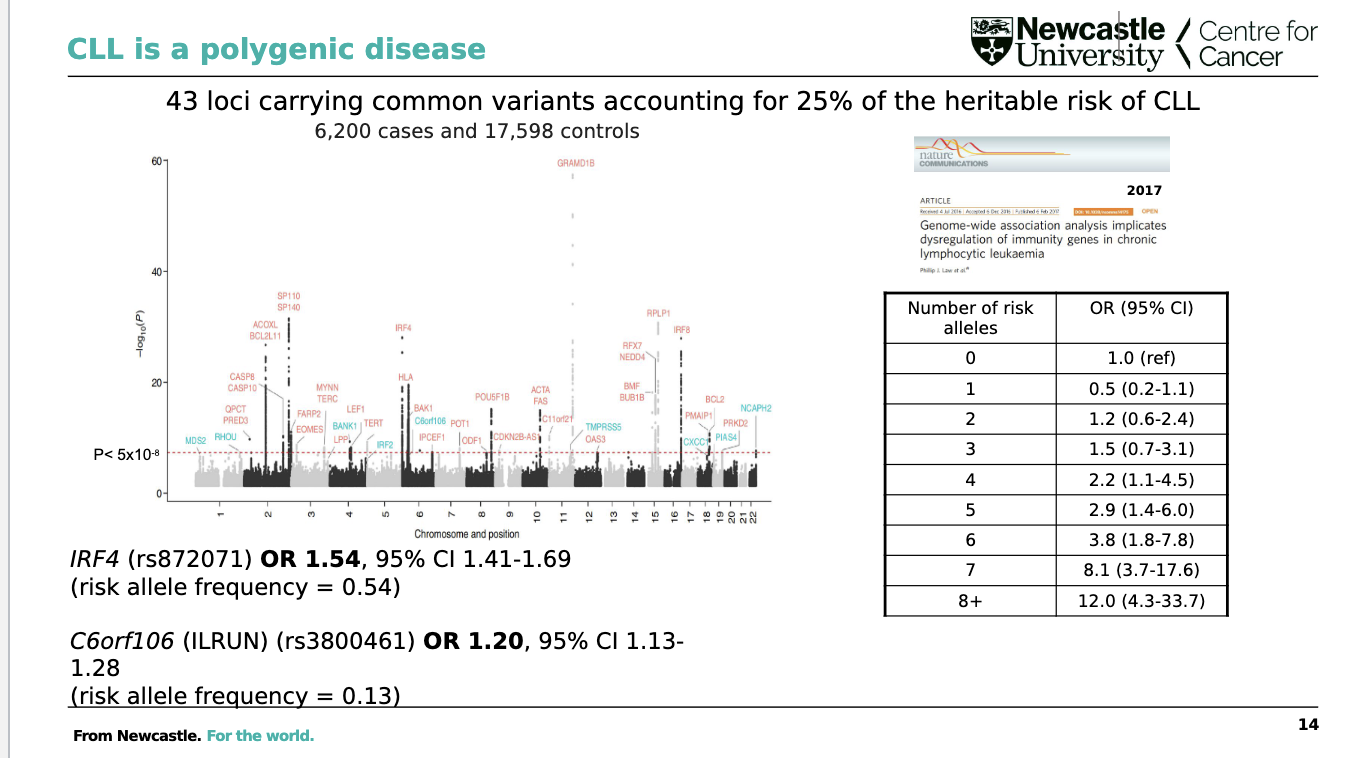

<p><strong>43 loci</strong> carrying common variants account for ~<strong>25% of the heritable risk</strong> of CLL. </p><ul><li><p>Each risk allele has a relatively small effect (e.g. <strong>IRF4 OR 1.54</strong>, <strong>C6orf106/ILRUN OR 1.20</strong>)</p></li><li><p>but the effects <strong>accumulate</strong>: carrying <strong>8+ risk alleles</strong> is associated with an OR of <strong>12.0</strong> compared with having none.</p></li></ul><p></p>
14
New cards

What is the role of IRF4 in CLL and Hodgkin lymphoma risk?

The IRF4 risk allele (rs872071) is associated with increased risk of CLL (OR 1.54) and Hodgkin lymphoma (OR 1.21).

  • IRF4 is important in B-cell development and differentiation, and the risk allele is associated with altered IRF4 mRNA expression in lymphocytes.


<p>The <strong>IRF4 risk allele (rs872071)</strong> is associated with increased risk of <strong>CLL (OR 1.54)</strong> and <strong>Hodgkin lymphoma (OR 1.21)</strong>.</p><ul><li><p>IRF4 is important in <strong>B-cell development and differentiation</strong>, and the risk allele is associated with altered <strong>IRF4 mRNA expression</strong> in lymphocytes.</p></li></ul><p></p>
15
New cards

How do cancer risk loci, particularly in CLL, affect gene regulation?

Most GWAS risk variants map to non-coding regions and affect disease risk by altering gene regulation, including active promoters/enhancers and transcription factor (TF) binding sites such as IRF4, MYC, OCT2 and RUNX3.

  • These TFs regulate B-cell functions including BCR signalling, apoptosis and differentiation.


<p>Most GWAS risk variants map to <strong>non-coding regions</strong> and affect disease risk by altering <strong>gene regulation</strong>, including active <strong>promoters/enhancers</strong> and transcription factor (TF) binding sites such as <strong>IRF4, MYC, OCT2 and RUNX3</strong>. </p><ul><li><p>These TFs regulate B-cell functions including <strong>BCR signalling, apoptosis and differentiation</strong>.</p></li></ul><p></p>
16
New cards

How can low IRF4 levels contribute to CLL cell survival?

Low IRF4 leads to increased BCR activation and CLL cell survival through phosphorylation of IKAROS and SYK.

  • The IRF4 risk allele (rs872071) is associated with increased CLL risk (OR 1.54).


<p><strong>Low IRF4</strong> leads to increased <strong>BCR activation</strong> and CLL cell survival through <strong>phosphorylation of IKAROS and SYK</strong>. </p><ul><li><p>The IRF4 risk allele (<strong>rs872071</strong>) is associated with increased CLL risk (<strong>OR 1.54</strong>).</p></li></ul><p></p>
17
New cards

What is the genetic structure of acute myeloid leukaemia (AML)?

AML is a heterogeneous disease—a collection of diseases with a shared clinical phenotype but numerous different genetic pathways to transformation

  • including different mutations, chromosomal abnormalities and gene fusions.


<p>AML is a <strong>heterogeneous disease</strong>—a collection of diseases with a shared clinical phenotype but <strong>numerous different genetic pathways to transformation</strong></p><ul><li><p>including different mutations, chromosomal abnormalities and gene fusions.</p></li></ul><p></p>
18
New cards

what is DNMTA3 in AML

DNMTA3 is an important gene in AML pathogenesis

  • the most commonly somatically mutated gene in AML


<p>DNMTA3 is an important gene in AML pathogenesis</p><ul><li><p>the most commonly somatically mutated gene in AML</p></li></ul><p></p>
19
New cards

what is the relevance of the HLA locus

  • the HLA locus carries risk alleles for numerous human cancers


HLA (rs3916765) OR 1.72, 95% CI 1.46-2.03 (risk allele frequency = 0.89)

  • Sub-type specific risk alleles


<ul><li><p>the HLA locus carries risk alleles for numerous human cancers </p></li></ul><p></p><p>HLA (rs3916765) OR 1.72, 95% CI 1.46-2.03 (risk allele frequency = 0.89)</p><ul><li><p>Sub-type specific risk alleles</p></li></ul><p></p>
20
New cards

what is HLA and

HLA antigens on specialized immune cells present peptides from foreign substances (e.g. viruses and bacteria) to effector cells of the immune system.

<p>HLA antigens on specialized immune cells present peptides from foreign substances (e.g. viruses and bacteria) to effector cells of the immune system.</p>
21
New cards

why is HLA so important in cancer aetiology

The HLA complex is located within the 6p21.3 region of the short arm of chromosome 6 and contains >240 genes of diverse functions. Many of the genes encode immune system proteins

<p>The HLA complex is located within the 6p21.3 region of the short arm of chromosome 6 and contains &gt;240 genes of diverse functions. Many of the genes encode immune system proteins</p>
22
New cards

what are 1 in 7 cancers caused by

infection
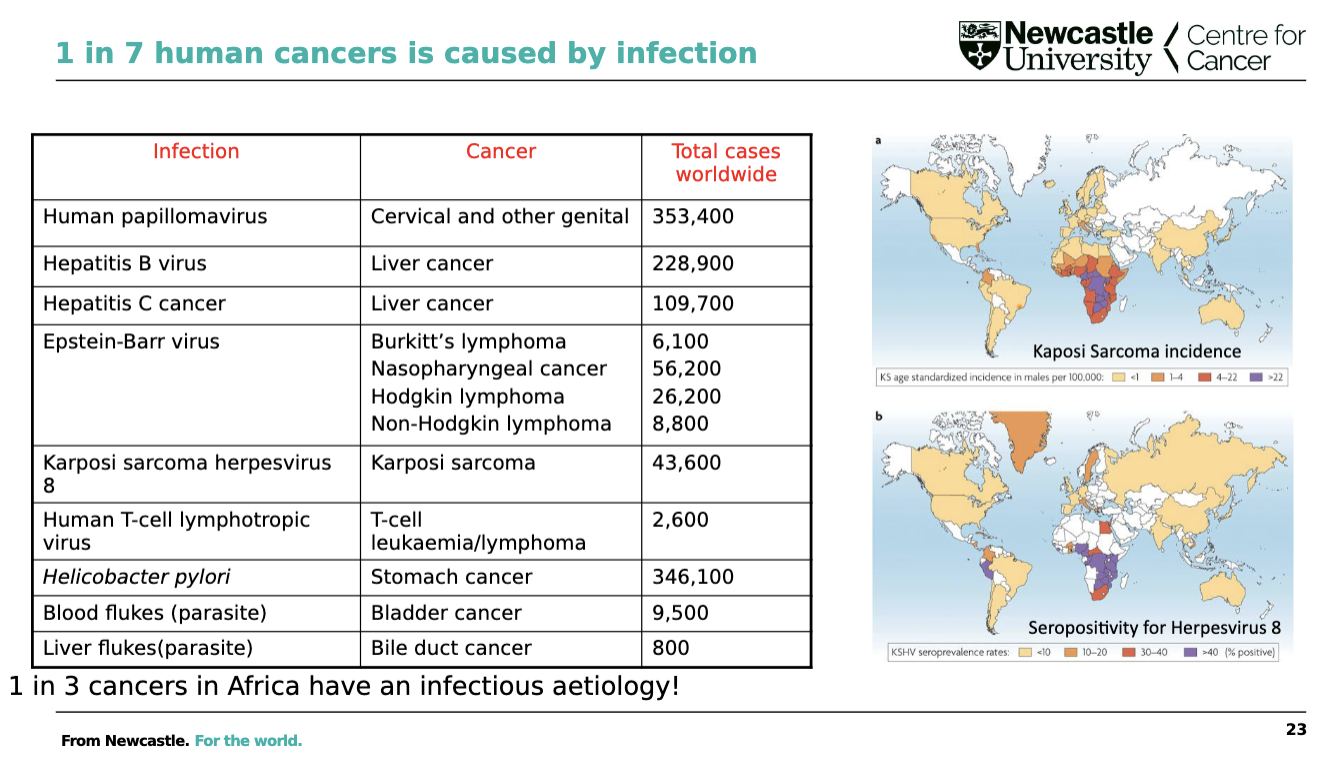
<p>infection</p>
23
New cards

what do mutated cancer proteins function as

neo-antigens for immune recognition

  • HLA (rs3916765) OR 1.72, 95% CI 1.46-2.03
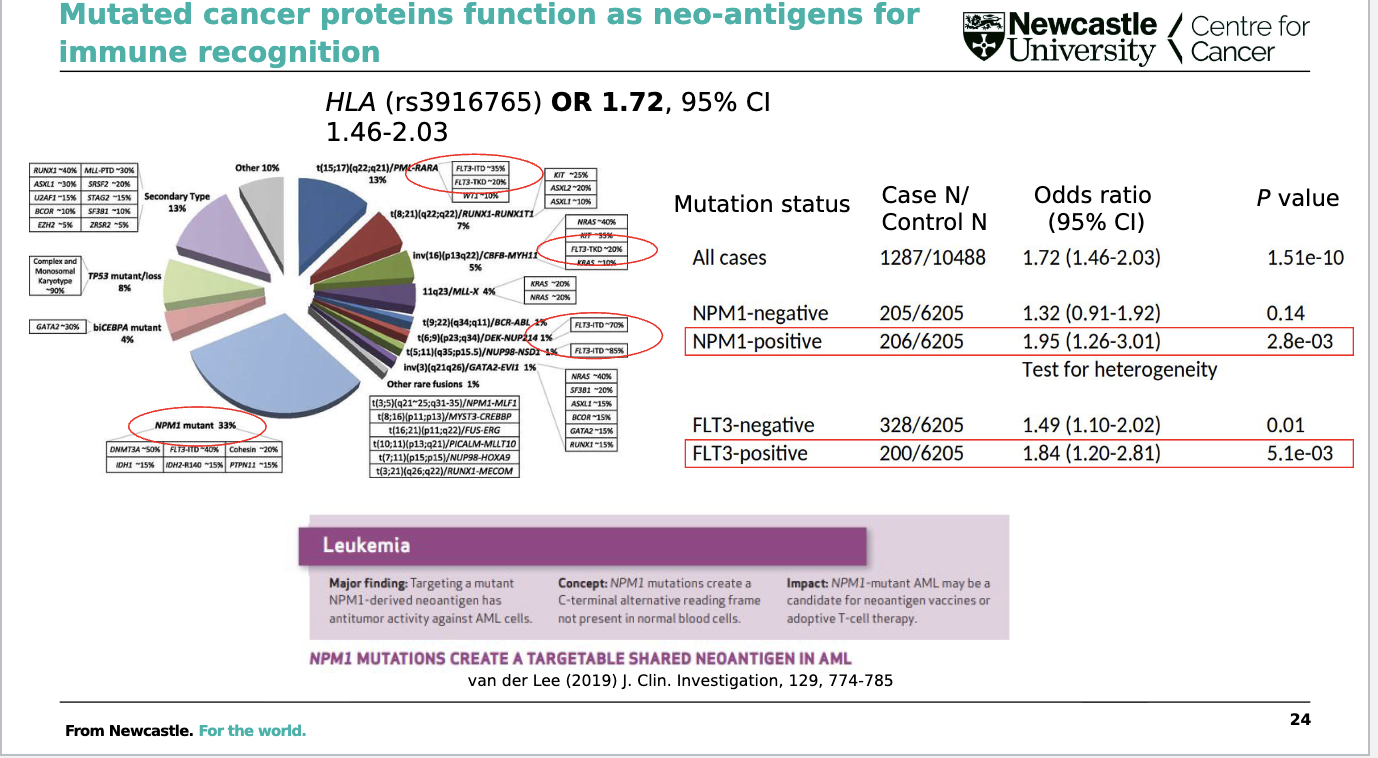

<p>neo-antigens for immune recognition</p><ul><li><p>HLA (rs3916765) OR 1.72, 95% CI 1.46-2.03</p></li></ul><p></p>
24
New cards

what is the role of genetic variants in CLL etiology and progresion

Contribution of constitutional and somatic variants during natural history of disease
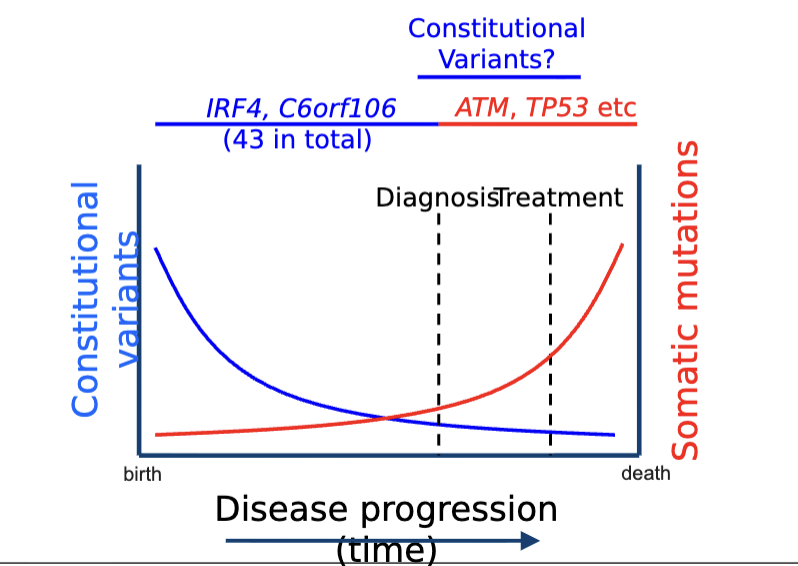
<p>Contribution of constitutional and somatic variants during natural history of disease</p>
25
New cards

what is the natural history of CLL

  • Time from diagnosis to first treatment is highly variable

  • Some patients never need treatment (indolent disease)

  • Other patients progress very quickly (aggressive disease)


<ul><li><p>Time from diagnosis to first treatment is highly variable</p></li><li><p>Some patients never need treatment (indolent disease)</p></li><li><p>Other patients progress very quickly (aggressive disease)</p></li></ul><p></p>
26
New cards

what are the 2 established prognostic markers in CLL

  • IGHV and CD38

  • these are somatic markers

could prognostication models be improved by the addition of constitutional genetic markers

<ul><li><p>IGHV and CD38</p></li><li><p>these are somatic markers</p></li></ul><p>could prognostication models be improved by the addition of constitutional genetic markers </p>
27
New cards

what are the results from prognostic genome wide association studies

755 cases- collated clinical/demographic data (median follow up ~12 years)

  • looked at >5 million constitutional polymorphic variants in human genome

can we identify patients at high risk of disease progression
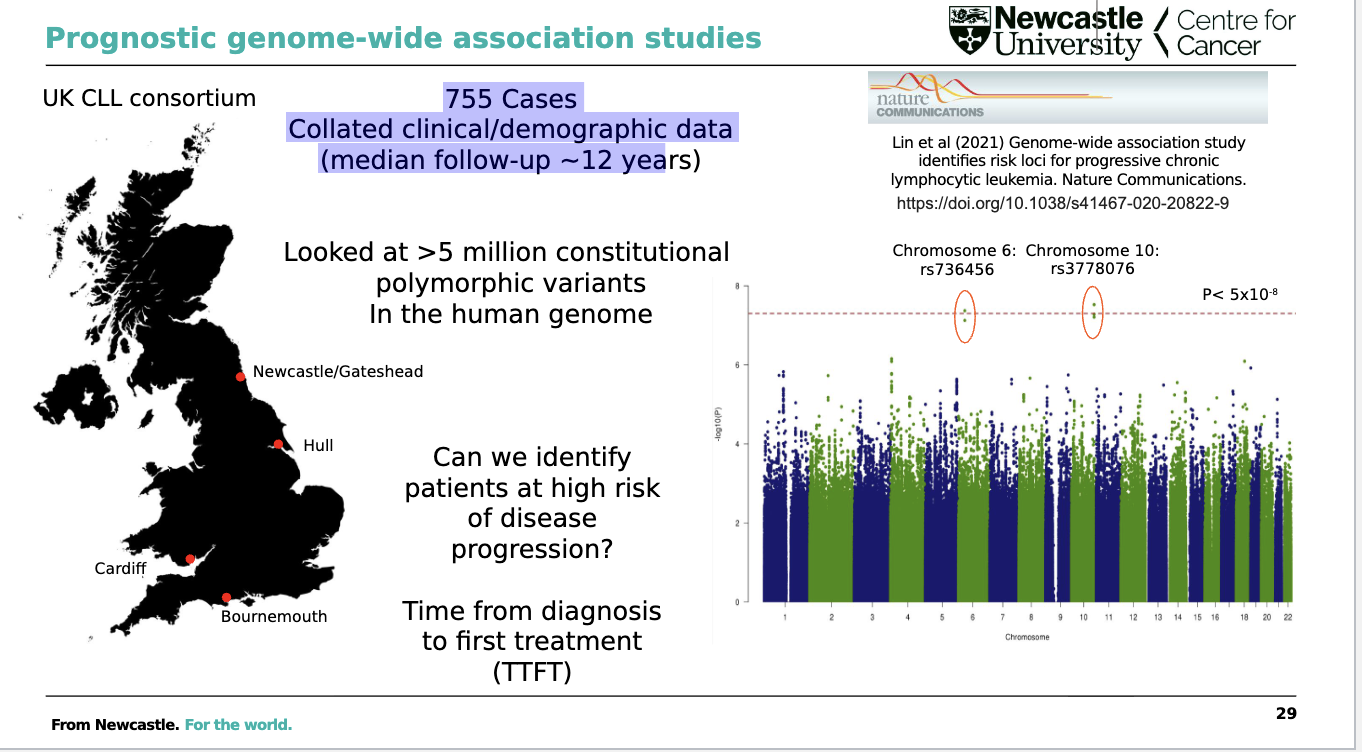

<p>755 cases- collated clinical/demographic data (median follow up ~12 years)</p><ul><li><p>looked at &gt;5 million constitutional polymorphic variants in human genome</p></li></ul><p>can we identify patients at high risk of disease progression</p><p></p>
28
New cards

what 2 chromosome markers are associated with CLL progression

chromosome 6 and 10 markers

<p>chromosome 6 and 10 markers </p>
29
New cards

what is the multivariate model for disease progression in CLL

knowt flashcard image
30
New cards

what is the functional relevance of constitutional and somatic variants during natural history of CLL

knowt flashcard image
31
New cards

what are the main points from the lecture

knowt flashcard image



