Lecture 7: Introduction to Nephrology Urine Formation by the Kidneys
 Call Kai
 Learn
 Practice Test
 Spaced Repetition
 Match
 Flashcards
 Knowt Play
1/76

There's no tags or description
Looks like no tags are added yet.
77 Terms
1. Urine formation.
2. Body fluid and electrolytes composition regulation
3. Blood pH and Acid Base Balance Regulation.
4. Blood pressure regulation: by producing the enzyme renin.
5. Erythropoiesis: erythropoietin
What are the functions of the kidneys? (5)
plasma than in the interstitial fluid.
The Donnan effect, the concentration of cations is slightly greater (~2 %) in the _______ than in the _______

Na+ and K+
The plasma proteins have a net (-) charge and therefore tend to bind cations such as

interstitial fluid compared with the plasma, because the (-) charges of the plasma proteins repel the anions.
Anions tend to have a slightly higher concentration in the ______ compared with the plasma because?

Nephron
What is the kidneys functional unit?

1. Golmerular Filtration
2. Tubular Reabsorption
3. Tubular Secretion
What are the three steps of urine formation?
the movement of material across the filtration membrane into the lumen of Bowman's capsule to from filtrate.
what is Glomerular filtration in the first step of urine formation?

- Solutes are reabsorbed across the wall of the nephron by transport processes such as active transport and cotransport.
- Water is reabsorbed across the wall of the nephron by osmosis.
What is Tubular reabsorption in the second step of urine formation?
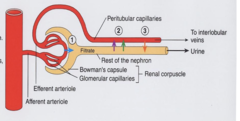
Solutes are secreted across the wall of the nephron into the filtrate.
What is Tubular secretion in the third step of urine formation?
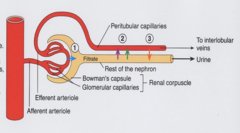
Organs cortex
Where does urine formation take place?
glomerular-capsular membrane.
As blood flows through glomerular capillaries, water and solutes filter out of the blood into Bowman's capsule through the

hydrostatic pressure inside the glomeruli
Fluid filters out of glomeruli into Bowman's capsule because of a pressure gradient resulting from the

afferent arteriole is larger than the efferent one
more volume gets in than out in the time unit"
The hydrostatic pressure inside the glomeruli is high because the

125 ml/min = 180 L/day
The normal glomerular filtration rate (GFR) is

80%
how much of the glomeurlar filtration is reabsorbed by the proximal convoluted tubule?
25 ml/min
how much of the glomerular filtration enters the loop of henle?
permeable
The descending loop of Henle is _________to water

10 ml/min leaving 15ml/min
How much water is reabsorbed in the descending loop of henle?

NOT permeable
but it is to Na+ with energy.
The ascending loop of Henle is _________ to water.

ADH and, usually, approximately 1 ml/min is lost as urine by the nephron.
The collecting duct will absorb water in the presence of
Hydrostatic pressure
What forces fluids and solutes from the glomeruli into the Bowman's capsule?
Filtrate
What is the resulting product of filtration in the Bowman's capsule?
180 mL/day
How much filtrate is produced per day in the kidneys?
Blood cells and large proteins
What substances are excluded from the filtrate in the Bowman's capsule?
1.5 L/day
what is the urine daily volume?
Hypotonic; Hypertonic
Glomerular filtration rate (GFR) can be ______ or ________ according to H20 intake.
By the kidney's intrinsic (auto-regulatory) system
How is the glomerular filtration rate (GFR) regulated?
A constant GFR
What does the kidney's auto-regulatory system maintain despite changes in blood pressure?
Every 45 minutes
How often is the total blood volume filtered by the kidneys?
More than 10 times per day
How many times per day is the extracellular volume (ECV) processed by the kidneys?
99%
What percentage of the glomerular filtration rate (GFR) is reabsorbed?
Na+
Up to 80% of the energy used in active transport is to reabsorb
375 mg/min
Transport maximum (tm): for glucose is
Proximal convoluted tubule (PCT)
All glucose + aminoacids are reabsorbed through the
Proximal convoluted tubule (PCT)
75%-80% of Na+ and H2O are reabsorbed through the
Descending; ascending; ascending
H2O can leave the ________ limb but not the ________limb WHILE Na+ can leave the ________ limb.
hormones and depends on body needs.
No hormones acting = no reabsorption
Reaborption of Na+ and H2O in distal and collecting tubules are regulated by
INCREASES H2O reaborption at DCT + Collecting Duct.
What does ADH do for reabsorption in the nephron?
INCREASES Na+ reaborption at DCT + Cortical Collecting Duct.
What does Aldosterone do for reabsorption in the nephron?
H+, K+, creatinine, ammonia, and drugs
What substances are secreted from peritubular capillaries and tubular cells into the filtrate?
They are secreted back into the filtrate
What happens to substances that were passively reabsorbed but still need to be eliminated?
Urea, uric acid, and excess K+
Name three substances that are passively reabsorbed but later secreted to be eliminated.
control total body H2O and ions.
Concentration-Dilution of urine mechanism works to
Dilution of final urine
What happens to the final urine when more H₂O is present?
Concentration of final urine
What happens to the final urine when there is less H₂O?
Loop of Henle
Which part of the nephron is responsible for urine concentration and dilution?

Juxtamedullary nephrons
Which nephrons are mostly responsible for urine concentration?

They extend their tubule deep into the medulla
How do juxtamedullary nephrons contribute to urine concentration?
The ascending limb is impermeable to H₂O.
What is the permeability of the ascending limb to water (H₂O)?
NaCl (sodium chloride).
What substance moves out of the ascending limb?
It diffuses into the descending limb.
What happens to some of the NaCl that leaves the ascending limb?
To compensate for the NaCl concentration in the interstitial space
Why is water (H₂O) lost in the descending limb?
NaCl and H₂O move into and out of the descending limb.
What substances move in and out of the descending limb?
150 to 180 liters.
How much blood plasma do the kidneys filter in 24 hours through their glomeruli into the tubules?
1.0 to 1.8 liters.
How much urine is produced by the kidneys in 24 hours?
Nitrogenous wastes and unneeded substances.
What components are typically found in urine?
Clear and pale to deep yellow.
What is the color of freshly voided urine?
The action of bacteria on urine solutes when allowed to stand
What causes urine to develop an ammonia odor?
Slightly acidic, around pH 6, but can vary depending on body metabolism and diet.
What is the typical pH of urine?
Na+ and K+ ions, urea, uric acid, creatinine, ammonia, bicarbonate ions, and various other ions.
What solutes are normally found in urine?
It is the process where the osmolarity of the lumen and tissue surrounding the loop increases towards the papilla.
What is countercurrent multiplication?
The collecting duct is highly permeable to water (H2O) under certain circumstances.
What is the permeability of the collecting duct?
It is exposed to the hyperosmolar tissue resulting from countercurrent multiplication.
What happens as filtrate descends through the collecting duct?
Water will leave the collecting duct and be reabsorbed into the blood
What happens to water (H2O) in the collecting duct when exposed to hyperosmolar tissue?
They descend into the outer medulla and divide into specialized capillaries known as vasa recta
What do the peritubular capillaries for the juxtamedullary nephrons do?
he vasa recta extend very deep, running side by side with the loop of Henle, and then return to the cortex, emptying into the cortical veins.
What is the function of the vasa recta?
The vasa recta play an essential role in the formation of urine.
What role do the vasa recta play in the body?
The countercurrent system is turned on, leading to decreased water (H2O) and a hyperosmolar blood.
What happens if urine needs to be concentrated?
The countercurrent system is turned off, leading to increased water (H2O) and a hypo-osmolar blood.
What happens if urine needs to be diluted?
Blood osmolality.
What do cells in the hypothalamus continuously monitor?
Cells in the hypothalamus shrink and signal the posterior pituitary to release ADH.
What happens if blood osmolality increases (H2O decreases)?
ADH turns the countercurrent system on, increasing water reabsorption in the kidneys.
What does ADH do in response to increased blood osmolality?
Blood osmolality decreases, and urine becomes more concentrated.
What is the result of increased water reabsorption due to ADH release?
Cells in the hypothalamus swell, and ADH secretion is inhibited
What happens if blood osmolality decreases (hypo-osmolality)?
The countercurrent system is turned off, and urine becomes diluted.
What occurs when ADH secretion is inhibited?
Urea helps in the osmolarity of the interstitial tissue near the papilla.
How does urea contribute to kidney function?
21% of cardiac output, or 1200 ml/min.
What percentage of cardiac output (CO) is blood flow to both kidneys?