Water
 Call Kai
 Learn
Learn Practice Test
 Spaced Repetition
 Match
Match Flashcards
 Knowt Play
1/25

There's no tags or description
Looks like no tags are added yet.
Name | Mastery | Learn | Test | Matching | Spaced | Call with Kai | Chat |
|---|
No analytics yet
Send a link to your students to track their progress
26 Terms
What is the structure of water
Its fomula is H2O
Made up of one oxygen atom (O) joined to two hydrogen atoms (H)
These atoms are held together by 2 covalent bonds

How is the structure of water covalent?
Oxygen shares 1 electron withe each Hydrogen atom while each hydrogen atom shares its one electron with oxygen
Polarity - How is water a polar molecule
The shared electrons are pulled towards the oxygen atom, giving the oxygen atom a slightly negative charge (δ-). This leaves the hydrogen atoms with a slightly positive charge (δ+).

What makes water a bipolar molecule
Water has both positive and negative poles, making it a dipolar molecule.
How can water molecules bond with one another ?
Each water molecule consists of a partially negative oxygen end and a partially positive hydrogen end. This causes water molecules to interact with one another.
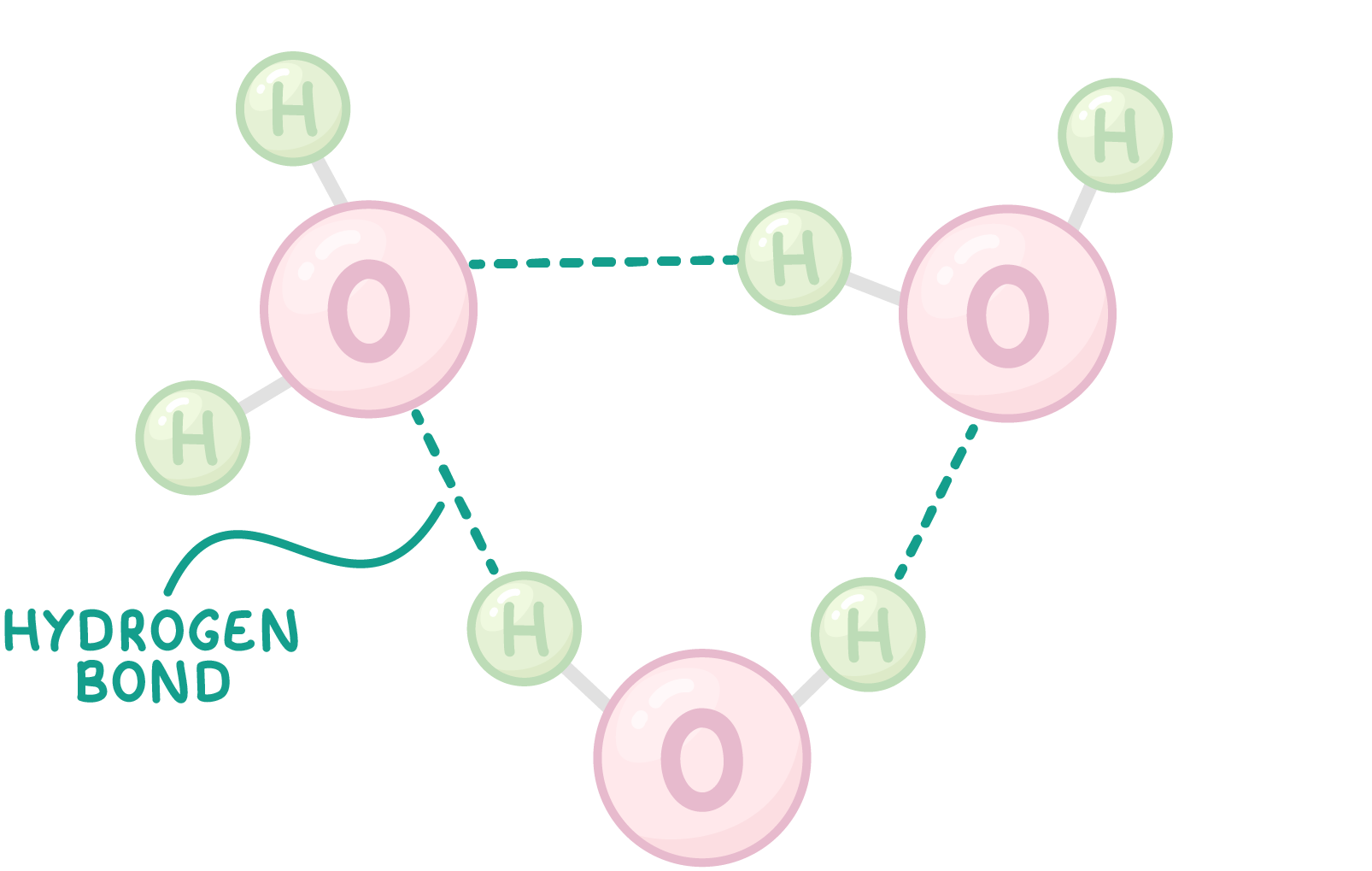
How can a bond formation occur within water molecules and what is it called?
The partially positive hydrogen end of one water molecule attracts towards the partially negative oxygen end of another molecule.
This force of attraction is known as a hydrogen bond.
What is the main thing that enables water to have its properties?
Hydrogen bonds form between many water molecules, causing them to stick together and giving water some of its useful properties.
The 9 roles/ properties of water
1.) Liquid (high boiling point)
2.) Density
3.) Solvent
4.) Cohesion
5.) High Specific heat capacity
6.) High latent heat of evaporation
7.) Reactant/ Metabolite
8.) Not easily compressed
9.) Transparent
Role 1: Liquid (high boiling point)→ How is this the case?
Molecules that are similar to water (eg: H2S) are gases at room temperature. However, the hydrogen bonds in water prevent the molecules from separating and becoming a gas, so it is a liquid.
Role 1: Liquid (high boiling point)→ Why is being liquid useful?
Cells are filled with cytoplasm which is water-based
It allows substances to be transported around organisms
Organisms can use water as a habitat
Role 2: Density → What’s special about water’s density?
Most substances get more dense as they get colder. However, water is most dense at 4°C and then gets less dense as it gets colder.
This means that ice is less dense than water and hence ice floats.
This is due to the way that the hydrogen bonds in ice align, separating the water molecules.
Role 2: Density → Why is water being dense & ice being less dense than water useful?
Ice insulates the rest of the water so it remains a stable habitat
Organisms can use ice as a habitat (they live underneath the ice layer)
Changes in density create currents that circulate nutrients
Role 3: Solvent→ How do substances get dissolved by water?
Polar substances and charged ions are attracted to the polar water molecules allowing then to dissolve. If a solid (eg: salt) is put into water, the water molecules cluster around the ions, separating them.
So, polar attracts polar & causes dissolving
Role 3: Solvent→ Why is water being able to dissolve substances useful?
Chemicals need to be free to move in order to react, eg: in cytoplasm/ in the digestive system
Substances can be transported around the organism, eg: blood/ urine
Role 4: Cohesion (the state of sticking together)→ How is water cohere?
Water molecules are attracted to one another. This is called cohesion. Cohesion creates surface tension. The water molecules at the surface are pulled downwards by the molecules beneath them, creating tension.
Role 4: Cohesion (the state of sticking together)→ Why is cohesion in water useful?
Xylem relies on cohesion to move water through the plant
Some organism use the surface of water as a habitat
Specific heat capacity
amount of thermal energy required to raise the temperature of a given mass of water by 1 °C
Role 5: High specific heat capacity → Why is it high and what is the result of this?
You have to put a lot of energy into water to break the hydrogen bonds and raise its temperature. Therefore, water does not easily heat up or cool down.
Role 5: High specific heat capacity → Why is it being high useful?
Living things are mainly water so they remain at a stable temperature
Habitats remain at the stable temperature
Role 6: High latent heat of evaporation → What does this mean?
When a liquid evaporates into a gas, the bonds between the molecules must be broken. This requires an input of energy. A large amount of energy needs to be put in to break the hydrogen bonds.
Role 6: High latent heat of evaporation → Why is this useful?
Water as a habitat is unlikely to evaporate
Evaporation of sweat or panting removes heat from the body
Plants are cooled by transpiration
Role 7: Metabolite: How is water a reactant?
Water is a reactant in hydrolysis and photosynthesis.
Role 8: Not easily compressed→ How does water do this?
The hydrogen bonds keep the water molecules a certain distance apart so a lot of force is required to compress it.
Role 8: Not easily compressed→ Why is this useful
Large organisms are supported by water
Water can form a hydroskeleton
Turgor pressure supports plants
It can act as a shock absorber, eg: amniotic fluid
Role 9: Transparent
Light can pass through water so aquatic plants can photosynthesise.