Exam 1 - 508: Fertility
 Call Kai
 Learn
Learn Practice Test
 Spaced Repetition
 Match
Match Flashcards
 Knowt Play
1/49

There's no tags or description
Looks like no tags are added yet.
Name | Mastery | Learn | Test | Matching | Spaced | Call with Kai | Chat |
|---|
No analytics yet
Send a link to your students to track their progress
50 Terms
Learning Objectives
Explain the general pathophysiologic principles of female and male infertility
Describe potential medication causes of infertility for men and women
Integrate the pathophysiology of male and female infertility with pharmacologic treatments
Review an in vitro fertilization treatment schedule
What is the definition impaired fecundity?
Physical difficulty getting pregnant or carrying to live birth
What is defined as infertility?
Inability to conceive after 12 months of unprotected intercourse
OR
6 months of unprotected intercourse if age ≥ 35
What are the two types of infertility?
Primary infertility: no previous pregnancies
Secondary infertility: patient has had a previous pregnancy
What are the mechanisms of male fertility?
Spermatogenesis
Sperm function
Sperm motility
Sperm morphology
Semen production/ transport
Blockages
Ejaculation
ED, Retrograde
Any dysfunction in one of these areas can cause male infertility
HPT Axis

Pituitary hormone effect:
LH and FSH stimulate spermatogenesis and testosterone secretion by the testes
Testes hormone effect:
Testosterone and inhibin inhibit the secretion of GnRH by the hypothalamus and LH and FSH by the pituitary
Differentiate primary and secondary causes of impaired spermatogenesis?
Primary → Impairment of the testes
Issues with sertoli cells
Issues with Leydig cells
Secondary → Impairment with the hypothalamus or anterior pituitary
Hypothalamic hypogonadism
Pituitary insufficiency
Hyperprolactinemia
Which medications have a direct toxic effect in causing male infertility?
Alcohol
Illiit medications
Antibiotics (nitrofurantoin, erythromycin)
Antineoplastic agents
Which medications decrease libido? (male infertility)
Antihypertensives
Alpha-adrenergic antagonists
Antipsychotics/ Antidepressants
Alcohol
Which medications have an indirect toxic effect leading to male infertility?
Calcium channel blockers
Which medications affect the HPT axis, leading to male infertility?
Anabolic steroids, testosterone (testosterone gel = AndroGel)
DHEA
Opioids
Antipsychotics
Tricyclic antidepressants
Spironolactone
Cimetidine
Does giving testosterone help to increase spermatogenesis and/or aid in male infertility?
No!
Presence of testosterone negatively feedbacks to the hypothalamus + anterior pituitary to secrete less GnRH and LH + FSH, leading to less sperm production in the testes
How do we treat primary impaired speramtogenesis?
Avoid testosterone
Aromatase inhibitors/SERMs
Assisted reproductive therapy
How do we treat secondary impaired spermatogenesis?
If hypothalamic source → Pulsatile GnRH
If pituitary source → GN replacement therapy
W
What role do aromatase inhibitors/SERMs play in treatment of male infertilty
AIs/SERMs help remove the estrogen feedback → Helps to increase testosterone levels
Aromatase inhibitors → Block conversion of androgens to estrogens
SERMs increase testosterone levels by blocking estrogen receptors in the brain, stimulating more release of GnRH
What are causes/sources of female infertility?
1) Impairment of fallopian tube: absent or blocked
2) Impairment of uterine tube: Fibroids or polyps
3) Impairment of Cervix: Idiopathic or iatrogenic decrease in receptivity
4) Peritoneal: endometriosis, history of PID
What are the WHO groups/classifications of impaired ovulation?
WHO Group 1: Hypothalamic source
WHO Group 2: Normogonadotropic, normoestrogenic anovulation
WHO Group 3: Ovarian source
WHO Group 4: Others (all other sources of ovulation impairment)
What are characteristics/cause of ovulation impairment in WHO Group 1?
Hypothalamic source
Low/normal FSH, low LH, and low estradiol
Causes: anorexia, malnutrition, chronic/severe stress
What are characteristics/cause of ovulation impairment in 2?
Normogonadotropic, normoestrogenic anovulation (lack of ovulation despite normal gonadotropins and estrogen levels)
Normal FSH, Normal/high LH, and Normal estradiol
Causes: PMOS (formerly PCOS)
What are characteristics/cause of ovulation impairment in WHO group 3?
Ovarian source
Low estradiol, High FSH, Normal LH
Causes: Primary ovarian insufficiency
What are characteristics/cause of ovulation impairment in WHO group 4?
“Other” category
Normal/low FSH, Normal LH, and Low estradiol
Causes: Hyperprolactinemia, thyroid abnormality, congenital adrenal hyperplasia
Which medications are known to affect the HPO axis (hypothalamus-pituitary-ovary)?
Antipsychotics
Antiepileptics
Which medications are known to decrease ovulation?
NSAIDs
Which medication is known cause changes to the cervical mucus?
Clomiphene citrate
What is the most common cause of anovulatory infertility?
Polyendocrine Metabolic Ovarian Syndrome (PMOS, aka PCOS)
What are causes/risk factors for PMOS?
Genetics
Epigenetics
Lifestyle
Black/Asian/Hispanic women are under-represented in the PMOS literature
What are symptoms of PMOS?
1) Hyperandrogenism
Acne, facial hair, weight gain, scalp hair loss
Most common
2) Menstrual disturbances
Very infrequent ovulation, in some cases, no ovulation at all
3) Metabolic issues
Increased risk of DM and CV events
What is the pathophysiology of PMOS?
1. Rapid pulsing of GnRH causes hypersecretion of LH
2. LH stimulates release of androgens. FSH would normally promote conversion of androgens to estrogens. In PCOS this process is inactive.
3. Production and release of androgens → increased inhibin → suppressed FSH → increased androgens
4. Insulin resistance exacerbated by increased androgens → compensatory hyperinsulinemia. Hyperinsulinemia increases androgens by decreasing SHBG and increases GnRH pulse frequency → increased LH secretion
5. Hypothalamus becomes desensitized to ovarian steroids → loss of (-) feedback.
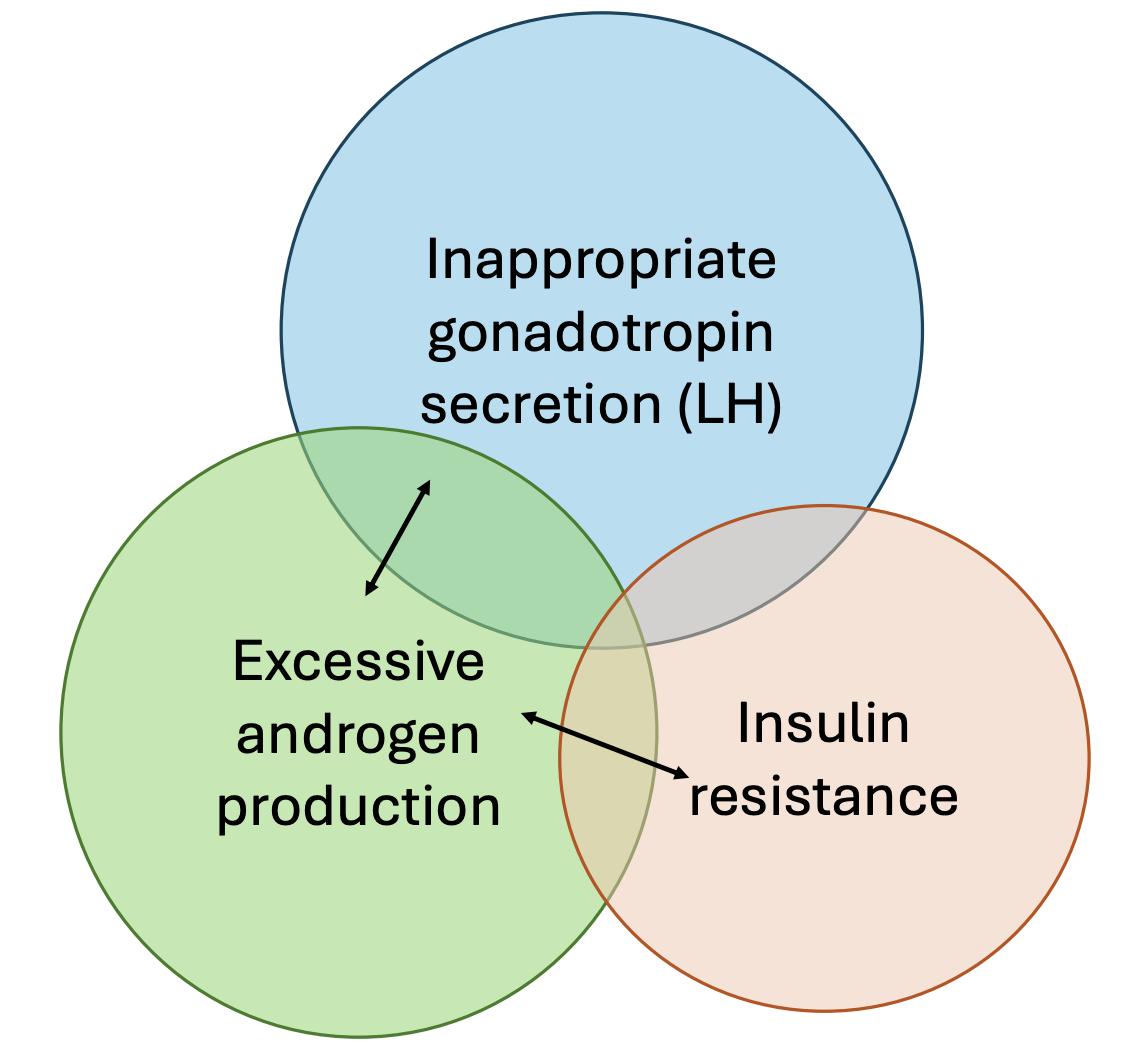
What is the simplified pathophysiology of PMOS?
Inappropriate gonadotropin secretion (LH) leads to →
Excessive androgen production, which leads can to →
Insulin resistance
And these all feedback/impact eachother
What are non-pharmacologic options for treating PMOS?
Diet and exercise
Reduction in CV risk and metabolic complications
Often insufficient to reduce weight, or metabolic or endocrine issues
Weight loss
5-10% loss associated with restoration of menstrual cycles
Reduces testosterone levels
May not provide help with hirsutism and acne
Pharmacologic interventions often required
What are the two pharmacologic treatment options we can employ?
1) “Override the system” by providing exogenous estrogen/progestin
2) Work on/treat the other physiologic areas impacted by PMOS
Such as excessive androgen production or insulin resistance
What agents can we give to treat PMOS by providing exogenous estrogen/progestin?
1) Combined oral contraceptives
Improves acne and hirsutism
Provides menstrual regularity
Choose a product with low estrogen and low androgen progestin
DO NOT GIVE TO PATIENTS WHO DESIRE TO BE PREGNANT
2) Intermittent progestins (medroxyprogesterone)
Given for 10-14 days at least every 3 months
Creates withdrawal bleeding
Reduces risk of endometrial cancer
No effect on androgen excess
Can give to patients who wish to get pregnant if timed correctly
Which medication is used to treat excessive androgen production in PMOS?
Spironolactone
Antiandrogen
Improved acne and hirsutism
No effect on menstrual regularity
DO NOT GIVE TO PATIENTS WHO DESIRE PREGNANCY
What do we give to treat insulin resistance in PMOS?
Metformin (Glucophage/Glumetza)
Improves menstrual regularity/ovulation
Improves acne and hirsutism
May help with weight loss
Recent, GLP-1 RAs have been on the rise, however, there is not enough data to support the safety/use in PMOS
What are the goals of ovulation induction?
Goals:
Monofollicular development (development of one egg)
Start with the least invasive and simplest treatment option (usually oral)
Minimize the risk of ovarian hyperstimulation syndrome (OHSS)
What are our oral agents used for ovulation induction?
Clomiphene citrate
Selective estrogen receptor modulator (SERM)
MOA: Down regulates estrogen receptors
50 mg daily x 5 days
Dose increased by 50 mg per cycle if ineffective
Letrozole
Aromatase inhibitor (AI)
2.5 mg daily x 5 days
Or anastrazole
What are our injectable ovulation induction agents?
Gonadotropins
LH/FSH combination
FSH
Human chorionic gonadotropin (hCG)
Injected in a single dose to simulate LH surge mid-cycle
Finalizes follicular development
Ovulation expected in ~ 24 hrs
Timed with intercourse/intrauterine insemination (IUI)
Most often used with gonadotropins, but can also use with oral OI agents
What role does hCG have as an ovulation inducing agent?
hCG creates the LH surge
What role do gonadotropins have as an ovulation inducing agent?
Stimulate follicle growth
What are potential adverse effects of using ovulation induction agents?
Multiple gestations (multple babies)
Risk of prematurity, LBW, miscarriage, gestational diabetes, preeclampsia
Prevent with step up dosing
Stop OI if >2 mature follicles
Highest risk with gonadotropins (36%)
Serious
Ovarian hyperstimulation syndrome
Risk minimized by monitoring follicle development
Sequential transvaginal ultrasounds
Serum estradiol levels
What is ovarian hyperstimulation syndrome (OHSS)?
An exaggerated, systemic reaction to excess fertility hormones that causes the ovaries to swell and fluid to leak into the abdominal cavity (Most commonly seen with gonadotropins)
Potentially fatal “3rd spacing” of intravascular fluid
Mild: abdominal discomfort, N/V/D
Severe: ascites, pleural effusion, oliguria, hemodynamic instability
Prevention: low doses, step-up therapy, close monitoring and withholding trigger dose
What is assisted reproductive technology (ART)?
Most commonly used is in vitro fertilization
“IVF” commonly used for all ART
Manipulation of oocytes and sperm
Medications are utilized to
Stimulate multiple follicles for oocyte retrieval
Optimize implantation after embryo transfer
Limiting factor → COST (no universal insurance coverage)
When is assisted reproductive technology used?
History of failed ovulation induction with or without intrauterine insemination
Structural factors (i.e. blocked fallopian tubes)
Male factor issues (infertility)
What is controlled ovarian hyperstimulation?
The monitored use of ovulation induction agents to create several follicles for IVF
Which medications do we use in stage 1: Controlled ovarian hyperstimulation (COHS)
1) Oral contraceptives
Control onset of menses and the start of COHS
2) GnRH agonists or antagonists
Prevent premature LH surge or disruption of COHS
3) Gonadotropins (FSH or FSH + LH)
Stimulates development of multiple ovarian follicles for oocyte retrieval
Which medications do we use in stage 2: Oocyte retrieval?
hCG (or GnRH agonists)
Role: They induce folliculat development/maturation for oocyte retrieval
Which medications do we use in stage 3: Luteal phase support?
Progesterone
Role: maintain endometrium for embryo transfer and implantation
What role do GnRH agonists have?
GnRH agonists first stimulate, then down regulate FSH/LH production
What role do GnRH antagonists have?
GnRH antagonists down regulate without having initial stimulation
What AEs are associated with GnRH agonists/antagonists?
Headaches
Hot flashes
Edema
Abdominal pain