Biology Exam #2 (Plants)
 Call Kai
 Learn
 Practice Test
 Spaced Repetition
 Match
 Flashcards
 Knowt Play
1/80

There's no tags or description
Looks like no tags are added yet.
81 Terms
Why should we care about plants?
Plants are important for humans
Plants have proven to be a premier model for the scientific study of diverse aspects of biology
Genes (Mendel); Transposons (McClintock)
Plants solve ecological challenges in really cool ways
Plants are beautiful
Importance of Plants
Food (for us and the animals we eat)
Natural products
Building materials, fibers, paper, dyes, flavoring compounds, drugs, preservatives, perfumes, etc…
Ecosystem services (with other photoautotrophs)
Oxygen, ozone, coal (fossilized plants), oil (algal), gas, limestone
Culture
Ornamentals, folklore, natural spaces (can help you de-stress)
What is the story of angiosperms?
Invasion of land
Began 475 million years ago
Required specific traits to move onto land
Other traits evolved very quickly once plants were on land
What made it difficult to invade land?
Cells may dry out
Less physical support
Sperm will have a hard time fertilizing eggs
Conquest of land
Significant challenges
Maintain water in cells
Support
Sexual reproduction
Huge advantage
Avoids competition for light (no one else was living there)
Deeper water = less light = no photosynthesis
To understand which group invaded land, we can look at groups closely related to land plants (the embryophytes) using a phylogenetic tree
Traits shared by land plants and their relatives five use clues about what traits were important for moving onto land
Green algae share these homologous traits with land plants
Cellulose cell wall
Chlorophyll a & b (same pigments for photosynthesis)
Sperm with two anterior flagella
Exaptations of Charophyte traits
Exaptation = process of a trait that an organism already has being used in a different way
Ex: dinosaur feather originally for something else, then birds later co-opted them for flight
What features allowed for the common ancestor to transition to living on land?
Grew in fresh water
Life cycle that allows dispersal by wind, specifically using spores
Adult algae is haploid, some make eggs, some make sperm via mitosis
Sperm and egg unite in fertilization and form diploid zygote
Zygote undergoes meiosis and creates haploid spores
Spores can grow up and become mature organism
Spores covered in sporopollenin
Most stable biopolymer known
Extremely decay resistant
Dehydration resistant
UV protectant
Sporopollenin is so decay resistant that scientists couldn’t figure out what it is made of
Can associate with mycorrhizal fungi – helps get nutrients (extract nutrients from soil and give them to photosynthetic organism, plants give sugars in response = MUTUALISM)
Before land plants the earth had no soil
Mycorrhizal partners would have been essential for acquiring nutrients
Freshwater charophytes
Often found growing at edges of small ponds
Shoreline of these ponds changes with rainfall
Strong selective pressure to tolerate dry periods
Invasion of land – what did the earliest land plants look like and what were the consequences of their invasion?
First multicellular plants fossils (~475 Ma)
Resemble liverwort thalli
Radically transformed the land surface
Many more fossils of early vascular plants ~425 (tetrapods and insects invaded land around this time)
Adaptation for life on land arose rapidly
How did land plants change the planet?
Made soil by breaking up rocks and dying (ex: organic material)
Compost created soil and breaking of bedrock
Plain rock → soil we see today
Soil created rivers
Soil allowed soil to erode more easily, formed riverbed, allowed rivers to form (instead of just sheeting off shoreline)
Rivers created high nutrient areas in the oceans
Land plant adaptations
arose ~during the invasion of land)
Cuticle
waxy layer on outside of tissue of plant on almost all plants
Also inhibits gas exchange
stomata/ pores needed
Pores or stomata
Only liverworts have pores (cannot control if open or closed)
Stomata = pore that can be adjusted (can open/ close it, ex: during day opens to do photosynthesis, but at night closes so doesn’t lose a lot of water)
Embryo (land plants = embryophytes)
Where does it fit in their lifestyle?
Can make 4 spores during zygotic meiosis for each fertilization event (diploid cell makes 4 spores during meiosis)
Alternation of generations – land plants
Same as before except for next steps
Zygote undergoes mitosis to produce many sporophytes
Sporophyte → meiosis → many spores per fertilization
Then can produce as many spores as it can supply
The two generations
Gametophyte (haploid) = makes gametes by mitosis
Cannot undergo meiosis
Sporophyte (diploid) = makes spores by meiosis
Embryo = a young sporophyte that is nourished by maternal tissue
Occurs after zygote undergoes mitosis, produces an embryo, that embryo undergoes mitosis to produce a mature sporophyte
Liverworts, mosses and hornworts (Bryophytes)
All are very short ~3cm
Tend to live in moist understories of forests
Gametophyte is dominant life stage – sporophyte lives on gametophyte and is dependent on it for nourishment
Gametophyte dominance
Does all the photosynthesis, acquires the nutrients
Liverworts
~9000 species
Do not have stomata – only spores
What the oldest land plants looked like
Mosses
~15000 species
Have stomata (as do all lineages hereafter)
Economically important
Important in florist trade
Holds water well
Peat (largely sphagnum moss) forms bogs and is harvested for fuel and whiskey
Hornworts
~100 species
Sporophyte long-lived (longer than in mosses and liverworts)
In all bryophytes…
gametophyte is dominant and the sporophyte grows in and depends on gametophyte for nourishment.
Ex: If you see a moss, the green moss you see is the gametophyte (haploid) and there sporophytes (diploid) sticking out of it
Gametophyte provides all nutrients
Called gametophyte dominance
Bryophytes do not have a vascular system
Early and basal lineage of land plants were below to the ground
Over time, sporophytes became larger, more complex, and acquired a vascular system
Ex: redwood trees are super tall
Why did plants get taller? Being taller than competitors is important
In order to achieve great heights, plants need…
to transport things within their bodies
Water needs to be transported from roots to their leaves
Sugars made in the leaves need to be transported to all other cells – roots and stems
In the land plants with a vascular system, only the sporophyte generation has one
No vascular tissue in gametophytes
Why sporophyte dominance?
Spores, which are dispersed by wind, are dispersed further from greater heights
Larger, branched sporophytes allow the plant to make more spores per fertilization event
Gametophytes are constrained by the need for water (and lack a vascular system)
Ferns
Seedless vascular plants (no seeds)
12,000 species
Gametophyte phase and sporophyte phase grow independently (also true for lycophyte)
Sporophyte does its own photosynthesis, acquires own nutrients, disperses spores
Gametophyte does its own photosynthesis and acquires own nutrients
Neither gametophyte dominant not sporophyte dominance
Gametophyte very small, sporophyte larger
Gametophyte and sporophyte generation live independently
Gametophyte will die after fertilizing for zygote
Gymnosperms
Have seeds
About 1000 species, but extremely diverse
4 divisions
Ginkgoidae (only 1 extant species)
Cycadidiae (cycads)
Very ancient group
One of the most endangered plant groups
Biggest threats: climate change and poaching (people want them in their gardens)
Gnetidae
Mostly tropical group
Welwitschia (member of Gnetidae)
Pinidae (conifers)
Pine trees
Ex: Sequoia, Douglas Fir, etc…
Angiosperms
The most successful land plant group
~300,000 species
Ecologically dominant
Have flowers
Angiosperms Traits
Flowers
ovules/ seeds enclosed in a sporophyll (carpel)
Sporophyll = leaf that’s been highly modified for reproduction
Spores are no longer dispersed, instead the seed is
Fruit
Pollen tubes and double fertilization
Major trends in land plant evolution
Mosses and other nonvascular plants = gametophyte dominant
Ferns and other seedless vascular plants = sporophyte independent
Seed plants (gymnosperms and angiosperms) = sporophyte dominant
Seeds
Seed is an embryo and its food supply surrounded by a protective coat
Gymnosperm = naked seed
Pollen delivered directly to the ovule
Ovule = structure of sporophyte in which female gametophyte (including the egg) develops
Sporophyll = modified leaf specialized for reproduction
Angiosperm = hidden seed
Ovule encased in a sporophyll called a carpel
Pollen delivered to carpel tissue
Dispersing with seeds provides some evolutionary advantages over spores
Seeds remain dormant for days to years, until specific environmental cues trigger conditions are favorable for germination (most spores have shorter lifespan)
Seeds have a supply of stored food
They may be transported long distances by animals
In angiosperms, the maternal plant only invests in fertilized seeds
Review of Evolution of Traits in Plants
Alternations of generations (life cycles)
All land plants
Stomata
All but liverworts
Long-lived sporophyte
hornworts
Vascular system
Vascular plants
Seeds
Seed plants (gymnosperms and angiosperms)
Flowers
Angiosperms
Seeds vs. fruit
Seeds = fertilized ovules
Fruit = structures derived from ovary
Gymnosperms do not make fruit
Development of female gametophytes in angiosperms
Female gametophytes = made inside the ovule which is in the ovary
Carpel = ovary + style + stigma (contains ovules)
Pistil = 1 or more carpels
Megaspore mother cell (diploid) undergoes meiosis and produces 4 female spores
Only one survives = surviving female spore
Surviving female spores undergoes mitosis and produces 3 cells, 2 nuclei, 1 egg, and 2 neighboring cells (7 cells with 8 nuclei) → all haploid
Sporophyte (diploid) undergoes meiosis and produces one haploid daughter spore. THat daughter cell undergoes mitosis to produce haploid gametophytes, which undergoes mitosis to produce game (egg) which is also haploid. Then it will fuse with sperm in fertilization to produce 2n zygote.
Development of male gametophyte in angiosperms
Male gametophyte = made in anther
Stamen (anther + filament) = sporophyll with pollen sacs containing pollen. Pollen is the male gametophyte
The diploid microspore mother cell undergoes meiosis to produce 4 male spores (haploid) and all survive. Each of the spores undergoes mitosis to form tube cell (male gametophyte) which has a generative cell (haploid), which will then undergo mitosis to form 2 sperm
Sporophyte (diploid) undergoes meiosis and produces four haploid male spore cells. Those spores undergo mitosis to produce haploid gametophytes, which will then undergo mitosis to produce the sperm gamete (haploid), which will fuse with egg in fertilization to form diploid zygote.
Pollination
A diversity of mechanisms that promote transfer of pollen from a stamen to a stigma
On an appropriate stigma (species it can fertilize/ have sex with), the pollen will produce a pollen tube
Pollen tubes grow down the style and find the egg cell
Ovule produces chemical attractants that attract the pollen tube
Double fertilization
When pollen grain lands on stigma, it will grow down because of chemical attractant ovule makes. Grows into a hole in the ovule, delivers sperm to egg in ovule, makes zygote.
One sperm fuse with egg to produce zygote (2n)
Another sperm fuses with polar nuclei to form endosperm nucleus (3n) (2 polar nuclei plus sperm)
Recap:
Egg and sperm = zygote (2n)
Polar nuclei and sperm = endosperm (3n)
Endosperm
Nutritional tissue that feeds growing zygote
Nutritive tissue that supports the embryo
Helps it get out of dirt until it can photosynthesize
In many seeds endosperms disappear
Seedling germination eudicots
Radicle will emerge and begins to grow down, embryonic stem pulls cotyledon up (u shape = eudicots, two cotyledon)
Monocots
Radicle will emerge and so does coleoptile, coleoptile emerges and start photosynthesis (one cotyledon)
Buds - apical and axillary
Distinction is because of their location on the plant (branch tip or node)
Both contain meristem tissue (cells are undifferentiated and can form all tissues – can become anything)
Both produce primary growth
Primary growth elongates shoots and roots (in length = makes longer)
Primary growth also produces leaves and reproductive structures (ex: flowers, pine cones)
Secondary growth makes things fatter (widens)
Recall Exercise
Spore becomes gametophyte through mitosis
Egg becomes zygote through fertilization (fusion with sperm)
Ovule becomes seed through fertilization
ovary/ carpel tissue becomes fruit through fertilization
Differences between plant and animal development
plant growth is indeterminate, human growth is determinate
Apical and axillary buds have meristem tissues which allow them to keep growing forever until something stops them
plant cells’ function is determined by their location
Primary growth
3 zones in primary growth start: constant distance behind growing tip
All zones stay same distance away from root cap as it moves down (they are grow down)
Cells stay where they got made even as zones dragged down
Zone of cell divisions (including apical meristem): where cells are dividing, some are differentiated, some remain undifferentiated, root tip grows down and zone of cell division moves down with root cap (closest to bottom near root cap)
Zone of elongation: water moves into cells via osmosis, pushes root cap farther down (middle)
Zone of differentiation: cells mature, take on functions they will have for the rest of their life (top near surface)
Zones do not get bigger (zone of differentiation may be longer)
Although we’ve been discussing this is roots, the same processes occur in primary growth of shoots, too
Root elongation zone video
Zone of cell division: cells same distance apart
Zone of elongation: cells get farther apart
Zone of differentiation: cells get farther apart, but not as far as zone of elongation
Primary growth first three tissue types
Dermal
Outside of plant body
Ground
Everything else
Any tissue that is not dermal or vascular
Vascular
Xylem = transports water
Phyloem = transports sugar
Helps transport things throughout plant
Primary root
Outside = epidermis (cells on outside = dermal tissue)
Inside epidermis have cortex
Endodermis = surrounds vascular tissue
Middle of endodermis = vascular bundle/ tissue
Primary shoots (stems)
Differences between dicots and monocots
Dicots:
Epidermis
Ground tissue connecting pith to cortex
Cortex (ground tissue)
Pith (ground tissue)
Vascular bundle in circle around outside (boundary that separates pith from cortex)
Monocots
Epidermis
Vascular bundles are scattered (outside and middle) → no boundary between ground tissue and vascular bundle
Just ground tissue (no cortex/ pith)
Leaf
Bundle sheath cell = ground tissue

Secondary growth
Does not occur in monocots
Making the plant thicker
Done by meristems (can differentiate into any plants cells )
Takes place in vascular cambium and cork cambium
Wood is secondary xylem
Vascular cambium produces wood (largely)
Cork cambium produces cork that is harvested and put into wine bottles
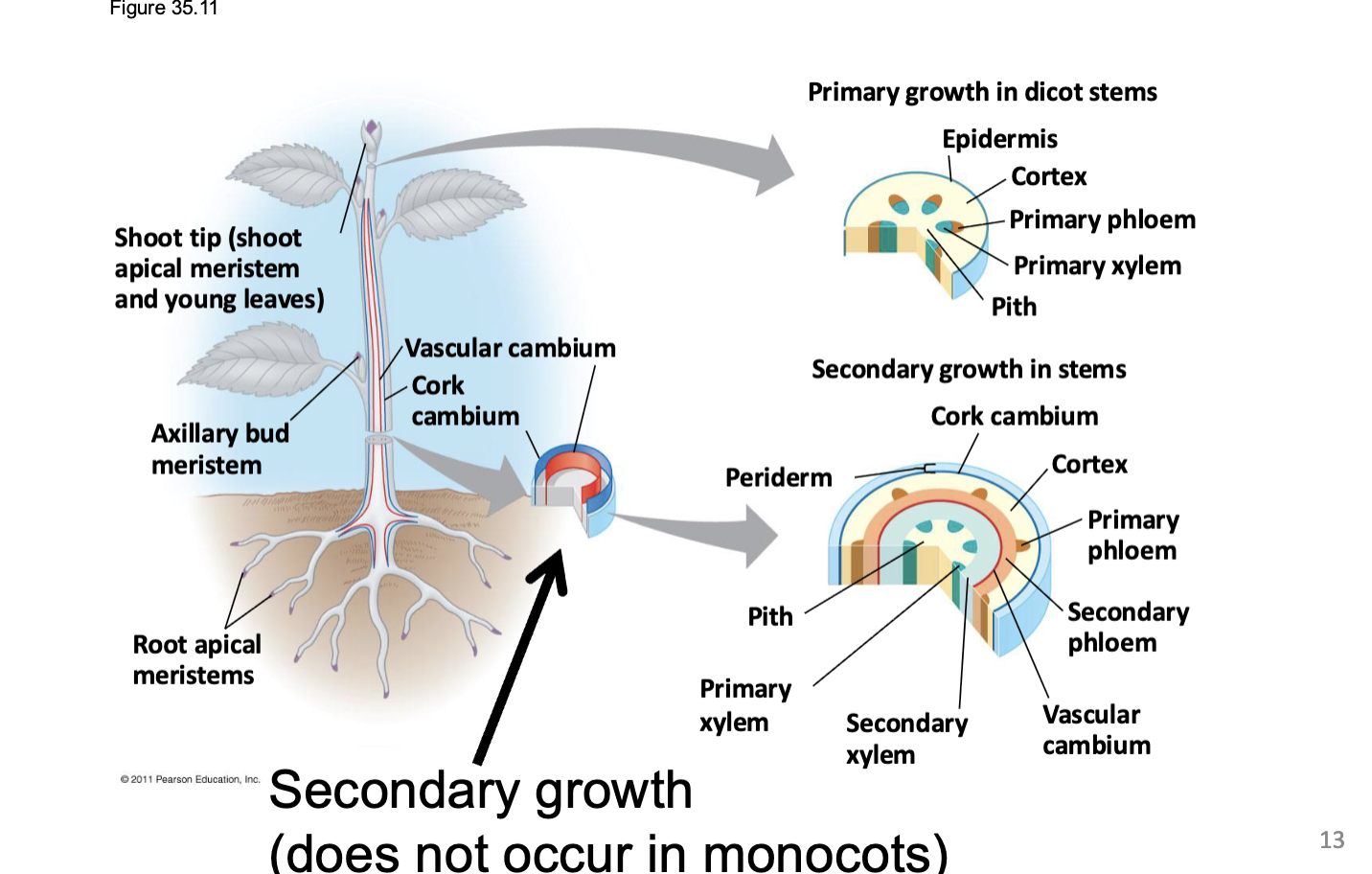
Vascular cambium
Cells divide
If cell differentiates to inside of cambium, it becomes xylem (produced to inside of vascular cambium)
If cell differentiates to outside of cambium, it becomes phloem (produced to outside of vascular cambium)
What cell becomes depends on its location
Produces new tissues in two different locations
Oldest cells of secondary xylem on very inside of the cell, oldest cells of secondary phloem on very outside of the plant.

More about primary and secondary growth
Top of shoot = primary growth only
Cell divides, one cell remains undifferentiated, one becomes either secondary xylem or phloem
What is becomes depends on where it is located
To inside = xylem
To outside = phloem
Farther down branch = gets older
Primary phloem disappeared = it got crushed because it is soft tissue so got pressed against other cells and crushed
Increase in girth of woody plants is primarily due to the increase in the production of xylem (wood)
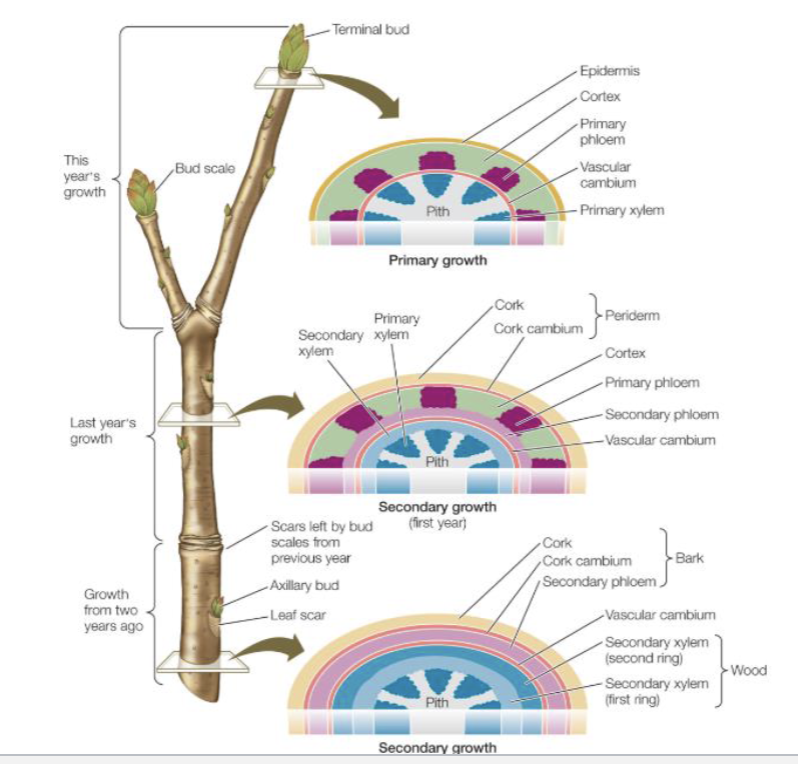
Bark
Cork, cork cambium, and secondary phloem
Inner: pith
Then secondary xylem
Then vascular cambium
Then secondary phloem
Then cork cambium
Ex: you carve your initials 1.5 m above the ground in a 10 meter tall tree. If you return 20 years later and the tree is 25 m tall, your initials will be 1.5 m
Primary and secondary growth do not happen at the same place at the same time
Primary and secondary growth can happen at the same time in a plant, but not at the same place in that plant
Primary growth only happens at tips and roots

Tropisms
Tropisms are a growth response that results in the curvature of whole plant organs (ex: shoots or roots) toward or away from stimuli due to differential rates of cell elongation
Toward = positive tropism
Away = negative tropism
Differences due to elongation on one side vs. other
Positive phototropism: leaning toward light from window
Negative phototropism = roots moving away from light in window
Types of tropisms
Chemotropism = chemical
Ex: production of chemical attractants in gametophyte to attract pollen tube (positive)
Ex: plant grows away from chemicals in soil (negative)
Gravitropism = gravity
Ex: roots growing down (positive)
Ex: cotyledons when they grow up (negative)
Heliotropism = the sun
Ex: leaves of plants growing toward sun (positive)
Ex: sunflowers facing same way because before flower bud tracks sun (positive)
Thigmotropism = touch (something the plant comes into contact with)
Ex: stems wrapping around stick in garden (positive)
Ex: root hits rock and grows away (negative)
How are stimuli translated into action?
Signal transduction pathway
Reception
Hormone or environmental stimulus perceived by receptor
Transduction
Receptor changes in some way (ex: structural change) that induces relay proteins and second messengers
Response
Activation of cellular response
Plants receive information that leads to pathway that leads to physiological shift
Light
Growth toward or away from light is known as phototropism
Growth toward light occurs because cells on dark side elongate more quickly than those on light side
Where is light sensed on phototropism?
Curvature occurs because cells on dark side elongate more than cells on light side
Light sensed at tip of plant (not root/ bottom)
What is sensing the light?
Phototropic = protein that is stimulated by blue light and creates signals for a variety of light-induced processes in plants (including phototropism)
Cells in the growing tip have lots of phototropin proteins
In the shade it becomes inactive, and differential activation – some phototropins activated and others not – across the growing tip creates a signal cascade
Some phototropins in tip on and others off which leads to signal cascade which leads to differential elongation in zone of elongation
Phototropins are activated by…
blue light
How is that signal transmitted?
Signal transmitted from one cell to the next
Cells needed to be able to communicate cell-to-cell
What is the signal transmitted?
Auxin (indoleacetic acid)
Auxin is constantly being made while the tip is actively growing and moves down shoot toward roots
When light is from above, all phototropins are activated and auxin travels down all sides equally
When light is from one side, only lit phototropins are activated and this differential activation alters auxin distribution (only goes down shaded side)
Cell wall
mesh that is made up of many different components, including cellulose microfibrils and cross-linking polysaccharides = help link cellulose microfibrils together, in an aqueous environment
Acid Growth Hypothesis
what auxin is doing to result in elongation in shaded side
Auxin travels down stem and binds to a receptor that stimulates a membrane-bound proton pump
Proton pump takes protons from inside cytoplasm and pushes them into the cell wall matrix
Cell wall becomes more acidic
Low pH activates expansins, which separate polysaccharides from microfibrils (breaks the covalent bond); wall-loosening enzymes cleave polysaccharides, this loosens the cell wall
Expansion and enzymes increase cell wall extensibility. Osmosis draws water into cell (because of solute production./ ion uptake) and cell expands because of turgor pressure
Looseness of cell wall allows cell to expand due to water coming into cell
If auxin isn't present, these steps don't happen and cell doesn’t expand (what the lit cell experiences)
Leaf Abscission (Fall Colors)
Leaves of many temperature woody species change color before falling from the tree or shrub
The process is instigated by relative changes in hormone concentrations (auxin and ethylene)
Leaves are responding to changes in light and temperature
Fall colors are economically important
What happens to get leaves to change colors?
Three things occur +/- simultaneously to start process
Chlorophyll production stops
Nutrients and sugars are moved out of leaf to stem/ roots for storage
Cells in abscission zone divide, but don’t expand/ elongate
Cells get smaller and smaller
Happen at roughly the same time in response to hormonal changes the leaf is experiencing
Cell walls are broken down (pieces get degraded and fall apart)
Cells begin to separate
Cells below breakpoint suberize their cell walls (reduces water loss) on stem side
Wax applied to outside of cells so don’t lose more water
Why do leaves change colors?
Leaves are green because of chlorophyll
During growing season, it is continually being produced
Its production stops in fall
Yellow and orange leaf colors
Carotenes (orange)
Xanthaphylls (yellow)
Carotenoids:
aid in light absorption during photosynthesis
Are present during the summer, but can’t be seen because of chlorophyll
Are always present, so the color of leaves that turn yellow or orange doesn’t vary from year to year
Lots of species drop yellow and orange leaves
Red leaves
Some species’ leaves shift from yellow or orange to red
Anthocyanins (red) are produced in the leaves after abscission layer forms
Not all species make anthocyanins
Conditions that favor photosynthesis increase brilliance of reds
Ex: fall with lots of moisture in soil, lots of sun, cool days → better reds than bad conditions for plant
In species that turn red, leaves will turn yellow or orange and then turn red
Reds are not the same from year to year, it depends on the conditions of the fall
Brown leaves
Brown leaves contain lots of tannins (present all year round)
Produced to keep insects from eating their leaves
Leaf structure and function
Regardless of shape, primary purpose of all of them is absorption of light and CO2 for photosynthesis
Most leaves are thin
Diffusion distance within leaf is shorter for CO2
More light absorbed per investment in leaf tissue
Want more surface area per volume (thinner = more light can be absorbed)
Simplified eudicot leaf cross-section
Top = upper epidermis
Two layers of mesophyll (palisade first, then spongy)
Then bottom = lower epidermis (opening is lower epidermis called stoma)
Mesophyll = parentchyma

Characteristics of mesophyll cells in typical eudicot leaf
Palisade mesophyll
~60% of total mesophyll
10-40% air volume in layer
Lots of chloroplasts per cell
Has more contribution to total photosynthesis (way more than half)
Spongy mesophyll
~40% of total mesophyll
50-80% air volume in layer
Fewer chloroplasts
Why do plants have spongy mesophyll?
All of air spaces in spongy provide pathways for CO2 to diffuse into the leaf
Ways for CO2 to get into leaf
Air pathways because CO2 diffuses 10,000x more slowly in liquid than in air
Air pathways better for diffusion
Air pathways so important that leaf arrangement with both palisade and spongy results in 8x higher photosynthesis rate than arrangement with two palisade layers (would have too little airspace and CO2 would have to diffuse through water for a longer period of time)
The structure of leaves has evolved to…
maximize absorption of light in the wavelengths that drive photosynthesis
Absorption and reflectance
White light (composed of all wavelengths) hits a red box
The red box absorbs all wavelengths of light, except red
Red light is reflected and that why the box appears red
Based on the color of leaves, what colors of light will drive photosynthesis by green plants ost efficiently?
Red and blue light
Graphs
Top graph:
Shows absorption spectrum
How much are the pigments in leaf in chloroplasts absorbing at each of those wavelengths
Bottom graph:
Shows action spectrum
Rate of photosynthesis when leaf is exposed to certain wavelengths of light

How does leaf structure maximize absorption of wavelengths that drive photosynthesis?
When light traveling through air hits water (and vice versa), a small proportion of that light (all colors) is reflected
Same is true for plant cells
Some light will reflect off plant
Light reflecting back is called “backscatter”
The greater number of air-water interfaces in the spongy mesophyll result in more backscatter towards palisade layer
Light will be absorbed by chlorophyll as it passes through the leaf from above, but most light not absorbed on the first pass, will be reflected back up into leaf
Why is more light reflected when a leaf is illuminated from the bottom vs. the top of a leaf?
The spongy mesophyll has more air-water interfaces that cause more backscatter away from the palisade mesophyll
- ~2.5 times as much light reflects from bottom
Simplification
light is bouncing all over within the leaf, not just at one specific spot
Even if structure is different, still lots of air-water interfaces
Alternatives to “normal” photosynthesis
Light = photosynthesis occurring, results in gain in mass
Dry = no photosynthesis = does not lose mass
Dark = loses mass = because it is eating the endosperm because it is starving (as it grows, it consumes endosperm and does not replace it)