Chapter 11- Joints of the Skull BOOK
 Call Kai
 Learn
Learn Practice Test
 Spaced Repetition
 Match
Match Flashcards
 Knowt Play
1/42

There's no tags or description
Looks like no tags are added yet.
Name | Mastery | Learn | Test | Matching | Spaced | Call with Kai | Chat |
|---|
No analytics yet
Send a link to your students to track their progress
43 Terms
how are sutures classified?
as fibrous joints, suture in type
what are the bony surfaces of sutures?
1. sagittal suture
2. frontal (coronal) suture
3. lambdoid suture
4. squamous suture

what is the sagittal suture?
the articulation of the two parietal bones in the median plan of the skull

frontal suture is aka
coronal suture
what is the frontal (coronal) suture?
the articulation of the parietal bones with the frontal bone

what is the lambdoid suture?
the articulation of the parietal bones with the occipital bone
what is the squamous suture?
the articulation of the parietal and temporal bones

there (are, are not) ligaments and movements at these suture joints
ARE NOT
how is the temporomandibular joint (TMJ) classified?
as a synovial joint, combined hinge and plane in type

what are the bony surfaces of the temporomandibular joint?
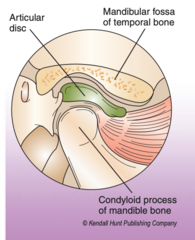
1. mandibular fossa of the temporal bone
2. head (condyloid process) of the mandible

there (are, are not) ligaments at the TMJ
ARE
what is the ligament of the TMJ?
one prominent intraarticular ligament called the articular disc

what is the articular disc composed of?
an oval plate of fibrous tissue that sometimes contains patches of fibrocartilage

what does the circumference of the articular disc attach to?
articular capsule
what does the articular disc do?
divides the joint cavity into two separate compartments
what are the two compartments of the joint cavity?
-superior compartment
-inferior compartment
where is the superior compartment located?
between the articular disc and the mandibular fossa
where is the inferior compartment located?
between the articular disc and the mandible

what are the movements of the mandible at the temporomandibular joint (TMJ)?
HINGE movements and PLANAR movements
what are the hinge movements?
depression and elevation
what is the depression movement?
inferior movement of the mandible (OPEN the mouth)
what is the elevation movement?
superior movement of the mandible (CLOSE the mouth)
what are the planar movements?
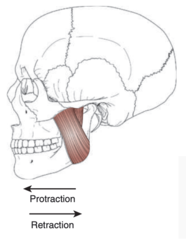
protraction, retraction, and lateral movement

what is the protraction movement?
anterior movement of the mandible in a horizontal plane
what is the retraction movement?
posterior movement of the mandible in a horizontal plane

what is the lateral movement?
side-to-side movement (grinding)

the bones of the fetal skull (are, are not) completely ossified at birth
ARE NOT
what are the unossified areas between the cranial bones called?
fontanelles
what are fontanelles?
six major UNOSSIFIED, MEMBRANOUS areas between the cranial bones

from French, fontanelle means what?
a little fountain
what are the 4 fontanelles (that we need to know)?
-anterior fontanelle
-posterior fontanelle
-anterolateral fontanelle
-posterolateral fontanelle

what is the LARGEST of the fontanelles?
anterior fontanelle

where is the anterior fontanelle located?
at the junction of the coronal and sagittal sutures

where is the anterior fontanelle located in ADULTS?
the BREGMA
where is the triangular posterior fontanelle located?
at the junction of the lambdoid and sagittal sutures

where is the posterior fontanelle located in ADULTS?
the LAMBDA
anterolateral and posterolateral fontanelles are what?
small, irregular fontanelles
anterolateral fontanelles are aka
sphenoid fontanelles
where is the anterolateral fontanelles located?
at the junction of the frontal, parietal, sphenoid, and temporal bones

where is the posterolateral fontanelles located?
at the junction of the occipital, parietal, and temporal bones

which fontanelle is useful to physicians?
anterior fontanelle
how is the anterior fontanelle useful to physicians?
FOUNTAINS are (put in drains)
in determining...
1. the position of the fetal head in utero
2. the development of the skull
3. the extent of pathological intracranial pressure
how does the anterior fontanelle help in determining the development of the skull?
unlike other fontanelles, which ossify within a few months, the anterior fontanelle becomes bony at 2 years of age--> so in babies, this is called the SOFT SPOT