Chapter 9.3: DNA Mutations Alter DNA Sequence
 Call Kai
 Learn
 Practice Test
 Spaced Repetition
 Match
 Flashcards
 Knowt Play
1/18

19 Terms
Incorporation error rate
The probability that an incorrect base will be inserted into a new strand of DNA, creating a mismatch
These are mitigated by proofreading (immediate removal and replacement) and mismatch repair (scanning by a complex for removal and replacement by cellular processes)

Proofreading
A function of DNA polymerases where mismatched nucleotides are removed immediately after being placed down

Mismatch repair
A function of a specialized complex where newly replicated molecules are scanned for helix irregularities, removing and replacing incorrect fragments when found
Point mutation
A mutation that substitutes, deletes, or inserts a single base pair in a DNA molecule

Base-pair substitution
A type of point mutation that leads to a change of a single base pair (A-T to G-C), created through:
Erroneous replacing of the original instead of the new strand
Lack of repair before the next round of DNA replication

Tautomers
The two structural isomeric forms of a base; having a rarer form present can result in the incorrect pairing of another base

Deamination
The removal of an amino group in a base, resulting in a different base form; this can result in mispairing that is passed down after replication
Spontaneous mutations
Mutations caused by polymerase errors or spontaneous chemical change in bases
Mutagens
Substances that chemically alter DNA and lead to induced mutations (unlike spontaneous mutations)
Commonly related to cigarette smoking, certain dietary components, and radiation; these can often be mitigated

Excision repair
The repair of damaged nucleotides with their replacement by normal ones
Involves proteins that remove the fragment for repair by DNA polymerase and ligase
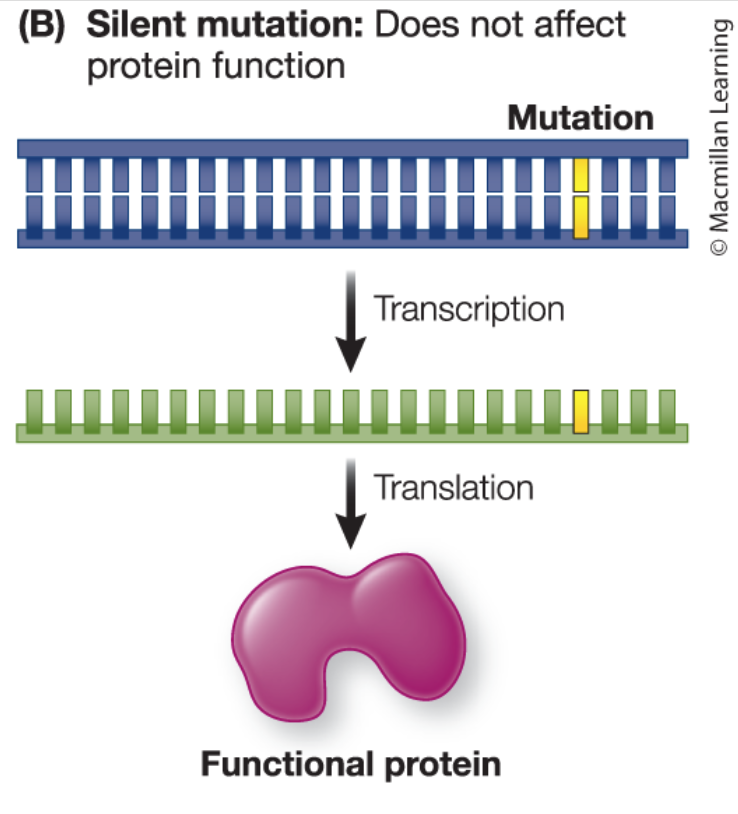
Silent mutations
Mutations that do not change the amino acid sequence or function of the protein

Loss-of-function mutations
Mutations that occur due to low expression or nonfunctional protein production
Often recessively inherited, as a wild-type allele usually results in sufficient functional protein

Gain-of-function mutations
Mutations that lead to proteins with altered function
Often dominantly inherited, as the mutant allele results in a still functioning protein
Conditional mutations
Mutations that affect the phenotype only under certain environmental conditions
Often seen with temperature-sensitive traits, such as coat color in rabbits
Nonhomologous end joining
The joining of two broken ends without regard for homology, potentially joining separate pieces of DNA to cause chromosomal mutations
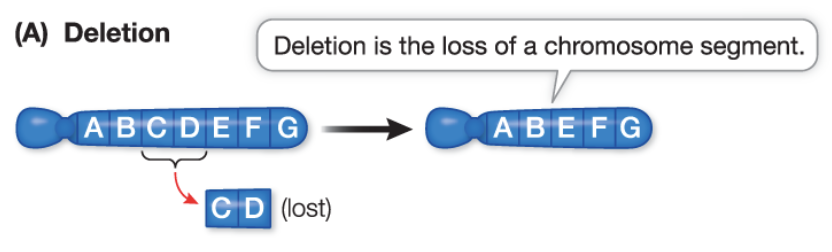
Deletion
The loss of a chromosome segment, typically with severe consequences due to gene absences

Duplication
The repetition of a chromosome segment, resulting in multiple copies of that segment
Occur due to crossing-over errors between homologous chromosomes, producing a deletion in the other chromosome
Typically have mild effects on phenotype due to over-expression of genes

Inversions
Mutations where a chromosome segment is reversed in sequence
Occur due to cutting out and rotation, resulting in a reversed sequence in the chromosome

Translocations
Mutations where non-homologous chromosomes exchange segments
Can potentially be harmless if break points do not interrupt genes, but otherwise can cause erroneous expression