Further Processing
 Call Kai
 Learn
 Practice Test
 Spaced Repetition
 Match
 Flashcards
 Knowt Play
1/85

There's no tags or description
Looks like no tags are added yet.
86 Terms
What is the purpose of further processing?
Preservation (inhibit microbial growth) and add value (flavor, convenience, variety)
Who were the first to salt meat?
Sumerians over 5,000 years ago
How did Ancient Hebrews salt their meat?
Via the Dead Sea 4,000 years ago
How did Native Americans “accidentally” discover meat smoking?
Meat was hung from the tops of teepees to discourage scavengers, allowing smoke from fire to rise and combine with the hung meat
Curing
The addition of salt, sugar, and nitrite/nitrate to meats for purpose of preservation, flavor enhancement, or color development
What are the modern-day functions of curing?
Primarily done for flavor development, though has other functions:
Shelf-life extension
Development of unique properties
Resistance to rapid deterioration
Controlling microbial growth
Salt as a Curing Ingredient
Purpose: Preservative, flavor, bacteriostatic, osmosis
Forms: granular or rock
Quantity of NaCl in each salt type differs—some have more impurities
Sugar as a Curing Ingredient
Purpose: flavor (balances salt), source of bacterial energy, lowers acidity of cure solution
Forms: Sucrose (brown sugar), dextrose (refined corn sugar), Corn syrup solids
Why do commercial cures use corn syrup solids for sugar curing?
It is less expensive
Nitrites and Nitrates as a Curing Ingredient
Purpose: Flavor (prevents warm-over), prevents rancidity, bacteriostatic, contributes to the cured pink color
Forms: Potassium, sodium nitrites (NO2), or nitrates (NO3)
Prague Powder / Cure Salt
Commercial name for nitrites and nitrates
Can be lethal in high doses
Nitrite (NO2) is the (reduced/oxidated) form
Reduced
Nitrate (NO3) is the (reduced/oxidated) form
Oxidated
Why does the industry use nitrates more than nitrites?
It reacts slower
(T/F) — Nitrites and Nitrates are never carcinogenic
False—they can be
FSIS allows the use of nitrate (NaNO3 or KNO3) ONLY in what product(s)?
Dry cured meats or dry sausage
FSIS permits the use of nitrites (NaNO2 or KNO2) in what product?
Bacon
Ingoing nitrite level of bacon
Before cooking; cannot exceed 120 ppm
Outgoing nitrite level of bacon
After cooking; must not exceed 40 ppm
Basic Cure Reaction
Myoglobin (purplish red) + Nitric Oxide = Nitric Oxide Myoglobin (red)
How is Nitric Oxide generated?
During a curing sequence, where bacteria transform nitrate → nitrite
NaNO3 → NaNO2 → HONO → NO
Nitric Oxide in myoglobin is (stable/unstable)
Unstable
How can Nitric Oxide’s color be “fixed” into meat?
By heating to 140 degrees
Fixation Reaction
Nitric Oxide Myoglobin (red) + Heat (stabilizer) = Nitrosylhemochromagen (cured pink)
What is Nitrosylhemochromagen responsible for?
Stable cured-pink color caused by heating
Overall Curing Reaction
Myoglobin + NO → Nitric Oxide Myoglobin + Heat → Nitrosylhemochromagen
Ascorbates
Adjunct curing ingredient responsible for aiding and speeding up proper color development
Alkaline Phosphates
Adjunct curing ingredient responsible for increasing water holding capacity (WHC) of muscle proteins
Alkaline Phosphates may not exceed __ in meat
0.5%
Water
Adjunct curing ingredient that disperses cure throughout meat, reducing the cost of products
Remaining water in retail product is termed?
Added Water
How is added water calculated?
PFF Value = (% of meat protein) / (100%-of fat) x 100
What does FSIS use PFF for?
Regulating the amount of moisture in the final product and communicating such information via labelling for consumers
Ham PFF
Minimum 20.5%
Ham with Natural Juices PFF
Minimum 18.5%
Ham, Water Added PFF
Minimum 17% PFF
Ham and Water Product PFF
Less than 17%
Dry Curing
Slow process
Salt or salt + nitrite/nitrate
Involves rubbing cure mixture of surface
Penetration of NaCl occurs through osmosis
Bone sour (souring around bones) can occur in hams
High levels of product weight shrink/loss
Liquid Curing
“Pickling” or submerging meat in brine
“Sweet pickle” when brine contains sugar
More uniform cure distribution
Bone sour possible
Yeast growth possible
Injection Curing
Most common curing method
3 Types: Stitch/spray, artery, machine
Rapid penetration of cure into meat
Less spoilage and shrinkage
Not conducive to development of typical flavor, aroma, texture
Stitch or Spray Pumping
Cure is directly injected into meat with needles
Artery Pumping
Accomplishes best possible distribution of cure; cure is disperesed via capillaries
Machine injection
Used by most commercial facilities
Materials used to smoke meat come from?
Hardwood sawdust or chips
Phenols — Smoke Component
Adds aroma and flavor; acts as an antioxidant
Alcohols — Smoke Component
Carrier of other components
Organic Acids — Smoke Component
Skin formation, preservation
Carbonyls — Smoke Component
Color and flavor
Hydrocarbons — Smoke Component
Undesirable, carcinogens
Gases — Smoke Component
CO2, CO, O2, N2, H2O, etc
Dispersed phase of Smoking
Consists of parts that are 2-3 micrometers in size
Tars, soot, charcoal, and resins
Gaseous phase of Smoking
Not visible
Phenols, acids, carbonyl compounds
Benefits of smoking
Flavor and odor enhancement
Color development on outside of product
Preservation of the product
Liquid smoke
Widely used in the industry
Removes carcinogens
Cheaper and quicker
Wood combustion products dissolved in water
(T/F) — Any meat species can be used to produce sausages
True
What is the most utilized raw meat source for sausages? Why?
Pork; its cheaper
What are sausages and canned meats most often produced from?
Trimmings resulting from fabrication of carcasses into primals/subprimals
Salt-soluble, heat-coagulable proteins (SSHCP)
Actin, myosin, and actomyosin
Relative SSHCP content influences the ability of meat to bind
Binding Index
Ranges from 0-100
Bull meat—binding index
100—contain a high concentration of SSHCPs
Binders
Animal tissues with a binding index of 50 or greater
Fillers
Animal tissues with a binding index lower than 50
SSHCPs help to emulsify what two things?
Fat and water
Emulsion
A mixture of two immiscible liquids (water : oil/fat)
Dispersed phase of emulsion
Fat
Continuous phase of emulsion
Water
(T/F) — Sausage is normally made of only one meat source
False
Sausage Maker’s Square
Determines fat % in product of each two lean meat sources
Which type of sausage has the most fat %?
Breakfast sausage
Steps of Sausage Processing
Grinding
Mixing
Chopping / Fine Grinding
Stuffing
Thermal Processing
Sausage Processing — Grinding
Whole muscle pieces or trim chunks ground to form uniform cylinders of fat and lean

Grinder Parts — What is A?
Grinder knife

Grinder Parts — What is B?
Auger
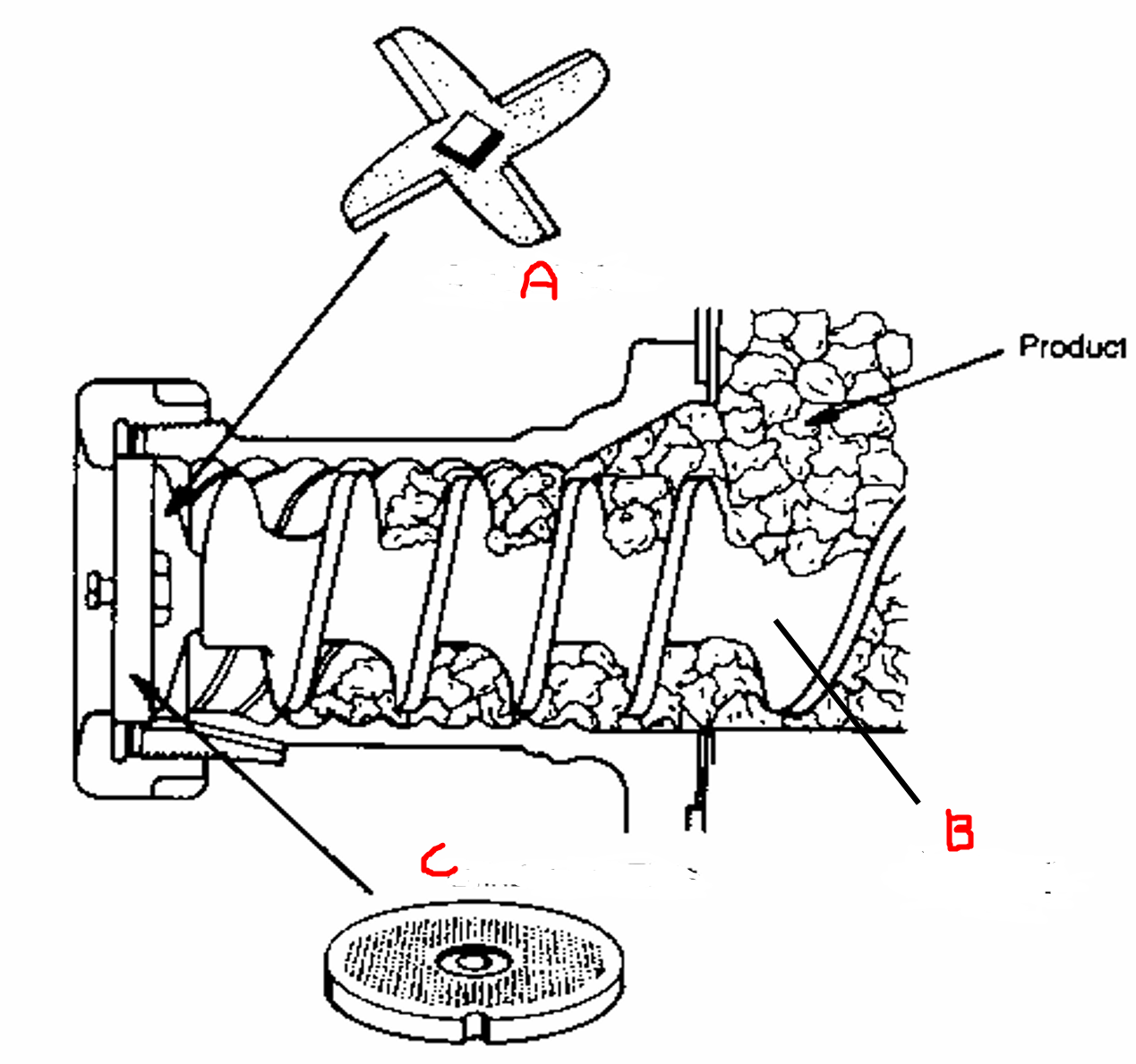
Grinder Parts — What is C?
Grinder end plate
Sausage Processing — Mixing
Fat and lean components are tumbled to give uniform distribution of fat and lean
Also aids in extraction and coating of fat particles with salt-soluble proteins
Sausage Processing — Chopping/Fine Grinding
Chopping — used for greater particle size reduction and greater degree of emulsification
Fine Grinding — fine grinding plate
Sausage Processing — Stuffing
Stuffers extrude sausage emulsion into casings
Sausage Processing — Casing
Determines shape of sausage
Can be made from natural sources (stomachs, intestines) or artificial (cotton linters, beef hides)
Sausage Processing — Cooking
Optional process—sausages are cooked to achieve final properties
Helps coagulate the protein matrix formed by emulsification
Cured sausages heated to stabilize nitrosylhemochromagen
Spices
Made from plants; not distinguished from one another; come from tropical aromatics
Herbs
Derived from species that grow in temperature zones
USA Classifications — Fresh Sausage
Raw/unsafe for consumption — fresh pork sausage, bratwurst
USA Classifications — Uncooked Smoked
Raw/unsafe for consumption — Keilbasa
USA Classifications — Cooked and Smoked
Cooked/safe for consumption — Frankfurter (hotdog), German-style
USA Classifications — Fermented
Somewhat safe for consumption (depends on length of fermentation) — Pepperoni, Salami
USA Classifications — Luncheon Meats
Bologna