BIO120 UOFT TEST 1
 Call Kai
 Learn
 Practice Test
 Spaced Repetition
 Match
 Flashcards
 Knowt Play
 Podcast
1/99

There's no tags or description
Looks like no tags are added yet.
100 Terms
Biology
The study of life
Charles Darwin
English natural scientist who formulated a theory of evolution by natural selection (1809-1882)
Wallace
English naturalist who formulated a concept of evolution that resembled Charles Darwin's (1823-1913)
William Paley
Argued that design in nature is evidence of God's existence
Argument of Design
The universe works so perfectly that it must have a designer.
Lamarck
French naturalist who proposed that evolution resulted from the inheritance of acquired characteristics (1744-1829)
Weissman
Disproves Lamarck with germ plasm theory
germ-plasm theory
cells in the reproductive organs carry a complete set of genetic information that is passed to the egg and sperm
adaptive radiation
An evolutionary pattern in which many species evolve from a single ancestral species
Genotype
An organism's genetic makeup, or allele combinations.
Mendelian Genetics
The pattern of inheriting characteristics that follows the laws formulated by Gregor Mendel
Uniformitarianism
A principle that geologic processes that occurred in the past can be explained by current geologic processes
antibiotic resistance
Resistance evolving rapidly in many species of prokaryotes due to overuse of antibiotics, especially in agriculture.
Microevolution
Evolutionary change below the species level; change in the allele frequencies in a population over generations. (eg. natural selection)
Macroevolution
Evolutionary change above the species level, taking lots of time.
Mutation
A random error in gene replication that leads to a change
Adaptation (noun)
A feature or behavior that helps animals survive.
Adapt (verb)
Evolutionary process that leads to the origin of adaptations
The Theory of Evolution (2 points)
1) Living things change gradually over time
2) Adaptations have risen through natural selection
common ancestry
A group of organisms share common descent if they have a common ancestor
Homozygosity
An organism that has two identical alleles for a trait
Heterozygosity
having different alleles at a gene locus
gene locus
Location of a gene on a chromosome
Phylogeny
Evolutionary history of a species
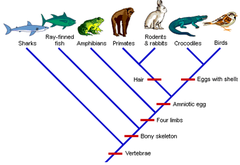
phylogenic tree/cladogram
a diagram that depicts the lines of evolutionary descent of different species, organisms, or genes from a common ancestor.
4 approaches to studying evolutionary biology
1) Observational
2) Theoretical
3) Comparative
4) Experimental
selfing or self fertilization
the fertilization of plants and some invertebrate animals by their own pollen or sperm rather than that of another individual.
scientific theories...
have testable and falsifiable hypotheses
Gradualism
The theory that evolution occurs slowly but steadily
Species
A group of similar organisms that can breed and produce fertile offspring.
Variation
Any difference between individuals of a population
Heredity
Passing of traits from parents to offspring. Progeny resemble their parents more than unrelated individuals.
Fitness
Ability of an organism to survive and reproduce in its environment. Some forms are more successful than others in a given environment.
4 Main Evidences for Evolution
1) geology
2) homology (eg. vestigial limbs, similar genes, embryonic similarities showing vestigial organs)
3) biogeography (geographically close organisms resemble each other)
4) domestication (artificial selection performing the same thing as natural selection)
adaptive radiation
An evolutionary pattern in which many species evolve from a single ancestral species
mutation-selection balance
reintroduces less fit genes to maintain variation
Speciation
Formation of new species
Genetic drift
A change in the allele frequency of a population as a result of chance events rather than natural selection.
Genetic Drift: Bottleneck Effect
The mechanism of microevolution that involves a loss of variety (alleles) after an event that greatly reduces the size of the population. (can lead to extinction)
Genetic Drift: Founder Effect
Occurs when a few individuals become isolated from a larger population; can affect allele frequencies in a population
Endemism
A state in which species are restricted to a single region; they are ONLY found there
descent with modification
principle that each living species has descended, with changes, from other species over time
neutral mutation
a mutation that has no effect on survival or reproduction
Beneficial Mutation
any change to the genetic code that results in noticeable physiological changes that are of benefit to the organism
Deleterious mutation
Genetic changes that are harmful to an organism; weakly up to lethal
Environment can affect the number of mutations, but not the...
chance of mutation.
point mutation
Gene mutation involving changes in one or a few nucleotides.
insertion mutation
a mutation in which one or more nucleotides are added to a gene
Changes in repeat number
ATGATGATGATG -> ATGATGATGATGATG
chromosomal rearrangements
deletion, duplication, inversion, translocation. Large mutations
Diploid
(genetics) an organism or cell having two sets of chromosomes or twice the haploid number
G6PD deficiency
2 amino acid replacements, causes anemia but gives malaria resistance; higher in populations around the tropics
Phenotype
An organism's physical appearance, or visible traits.
Preformationism
spermist and ovists believed only one parent contributed to inheritance.
theory of blending inheritance
each parent contributed factors that were blended in their offspring (blue + yellow = green)
Mendel's Law of Segregation
the two copies of a gene segregate from each other during transmission from parent to offspring
Alleles
Different forms of a gene
Gamete
a mature haploid male or female germ cell that is able to unite with another of the opposite sex in sexual reproduction to form a zygote.
Zygote
the fertilized egg; it enters a 2-week period of rapid cell division and develops into an embryo
Genome
All the genetic information in an organism; all of an organism's chromosomes.
Polyphenism
a trait for which multiple, discrete phenotypes can arise from a single genotype depending on environmental circumstances
Polymorphism
(biology) the existence of two or more forms of individuals within the same animal species (independent of sex differences). Proportion of gene loci that have 2 or more alleles in the population.
discrete traits
Characteristics that are qualitatively different from each other
continuous traits
Continuous traits are those that can exist in a range (height, age, skin color, etc.)
particulate inheritance
the concept of heredity based on the transmission of genes (alleles) according to Mendelian principles
population genetics
Study of allele frequency distribution and change under the influence of evolutionary processes.
Recombination
the genetic process by which one chromosome breaks off and attaches to another chromosome during reproductive cell division. creates new combinations of mutations. The mixing of genes through sex
random genetic drift
acts to decrease genetic variation, affects small populations most
purifying selection (negative selection)
Selection that lowers the frequency of or even eliminates deleterious alleles.
directional selection
Natural selection in which individuals at one end of the phenotypic range survive or reproduce more successfully than do other individuals. Mutations that increase fitness can become fixed.
selection favouring diversity
increases/retains genetic variation in populations, maintains diversity
Migration (gene flow)
movement of genes between populations, can make two unlike populations more genetically similar
Selection maintaining variation (balancing selection)
suite of adaptive forces that maintain genetic variation for longer than expected by random chance. Heterozygote advantage, frequency dependent selection, fitness varies in space and time
artificial selection
Breeding organisms with specific traits in order to produce offspring with identical traits.
monomorphic gene
a gene having a single form
Allozymes
different allelic forms of the same protein
Neutral Theory
The hypothesis that much evolutionary change in genes and proteins has no effect on fitness and therefore is not influenced by Darwinian natural selection.
schools of evolutionary thought
Classical school vs. Balance school, two schools that differed in their predictions on how much genetic variation occurs in natural populations
Electrophoresis
A process where DNA fragments are separated according to size using electrical charges: helped to answer how much of genes were variable
reproductive modes

sexual reproduction
A reproductive process that involves two parents that combine their genetic material to produce a new organism, which differs from both parents
asexual reproduction
Process by which a single parent reproduces by itself; product is clones; maintains favorable combinations of alleles
Clones
Genetically identical cells or individuals.
Paradox of sex
asexual reproduction is much more efficient than sexual reproduction, and yet sexual reproduction brings genetic diversity
Transmission Bias
A situation in which the alleles of the parent organisms are not equally represented in their offsprings.
lottery models
emphasize the role of chance in maintaining species diversity
Tangled Bank Hypothesis
Variety of offspring also helps to eliminate competition for resources; genetically diverse off spring are able to extract more food from their environment than genetically identical clones.
Red Queen Hypothesis
Sexual selection allows hosts to evolve at a rate that counters the rapid evolution of parasites. Species must constantly adapt, evolve, and proliferate in order to survive while pitted against ever-evolving opposing species.
asexual species often appears...
at the end of the phylogenetic tree; they have a low chance of long term evolutionary persistence due to accumulation of deleterious mutations
spatial heterogeneity
the variation in space in distribution of a point pattern, or variation of a qualitative or quantitative value of a surface pattern
parthenogenesis
Asexual reproduction in which females produce offspring from unfertilized eggs; more common in invertabrates
clonal propagation
Cuttings from plant are used to regenerate plants; few species are exclusively asexual
Outbreeding
the process of mating less closely related individuals when compared to the average of the population
inbreeding
A selective breeding method in which two individuals with identical or similar sets of alleles are crossed.
outcrossing
mating with someone else, fusion of gametes between 2 parents
selfing
most extreme form of inbreeding but not asexual reproduction, fusion of gametes from one parent
extra-pair copulations
when an individual that has a social bond with a mate also breeds with other individuals (no monogamy)
inbreeding depression
when individuals with similar genotypes - typically relatives - breed with each other and produce offspring that have an impaired ability to survive and reproduce: reduction in fitness, lower viability, lower fertility
hermaprodite
an organism that has both male and female reproductive organs
sexual dimorphism
Differences in physical characteristics between males and females of the same species.