Biology Chapter 17 Review
 Call Kai
 Learn
 Practice Test
 Spaced Repetition
 Match
 Flashcards
 Knowt Play
1/13

There's no tags or description
Looks like no tags are added yet.
14 Terms
Dolly
The first mammal successfully cloned from an adult somatic (body) cell, proving that specialized adult cells still retain the complete genetic blueprint required to generate a brand-new organism
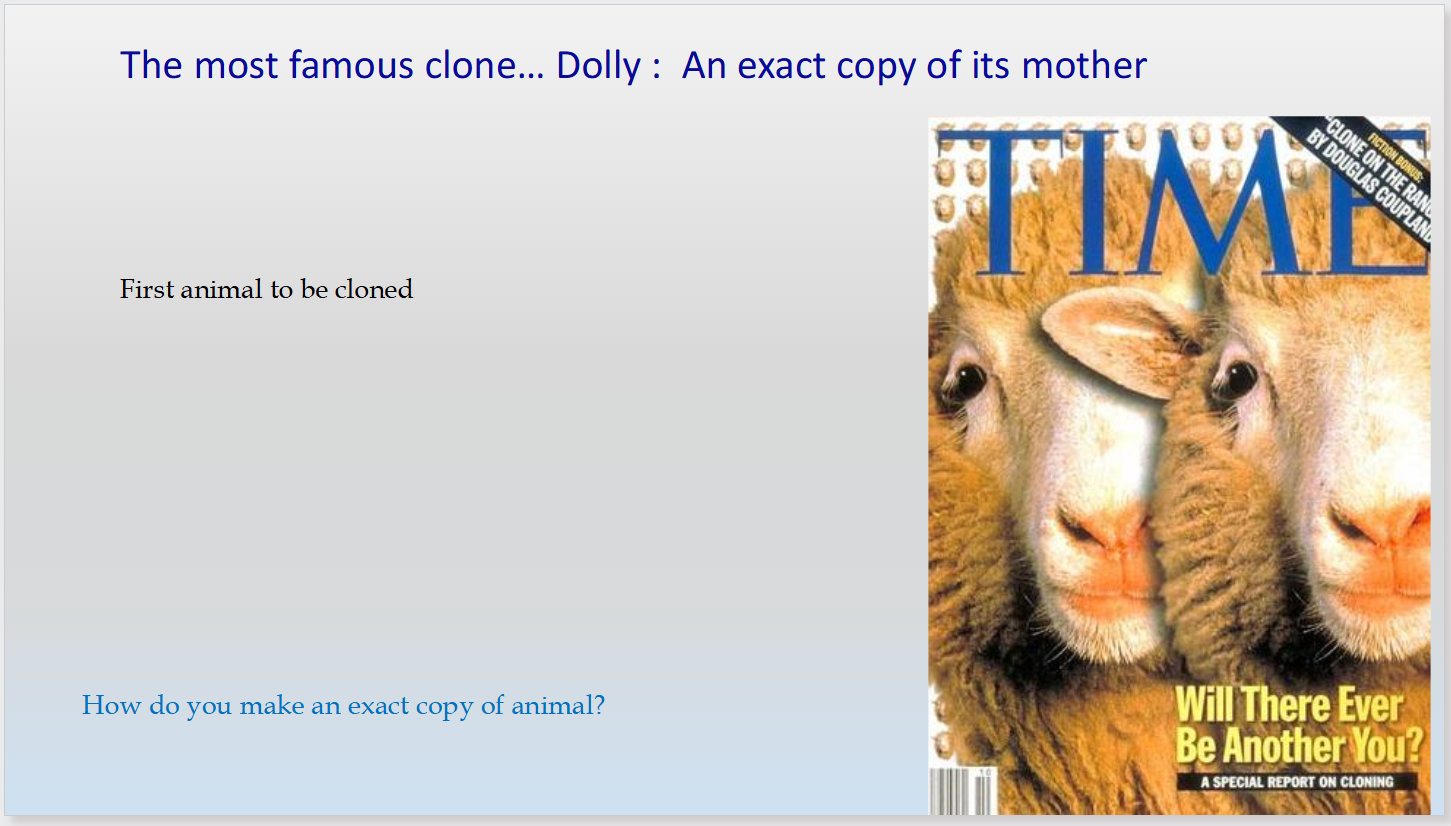
The most famous clone…Dolly: an exact copy of its mother
First animal to be cloned
How Dolly Was Cloned: Somatic Cell Nuclear Transfer (SCNT)
Created by Ian Wilmut, Keith Campbell, and colleagues at the Roslin Institute in Scotland, Dolly was produced without fertilization using somatic cell nuclear transfer (SCNT) across three different ewes
Somatic Cell Isolation: scientists extracted a diploid (2n) nucleus from a differentiated mammary gland cell of a six-year-old white-faced Finn Dorset sheep
Enucleation: they harvested an unfertilized egg cell (oocyte) from a Scottish Blackface ewe and removed its haploid (n) nucleus, leaving an empty cytoplasm
Fusion & Activation: an electrical pulse fused the adult donor nucleus with the enucleated egg and stimulated the hybrid cell to begin dividing via mitosis
Implantation: once the dividing cells reached the blastocyst stage, the embryo was implanted into the uterus of a third sheep (a Scottish Blackface surrogate
Dolly
The most famous clone… Dolly : an exact copy of its mother
First animal to be cloned
Dolly the sheep (1996–2003) was the first mammal successfully cloned from a differentiated, adult somatic cell. Created by researchers at the Roslin Institute in Scotland, she is a foundational case study for demonstrating genomic equivalence—the principle that specialized adult cells retain the entire genetic blueprint required to generate a complete organism
The Process: Somatic Cell Nuclear Transfer (SCNT)
Dolly was produced using Somatic Cell Nuclear Transfer (SCNT), an artificial form of asexual reproduction involving three different sheep:
Somatic Cell Isolation: scientists extracted a diploid (2n) mammary gland cell from an adult white-faced Finn Dorset ewe
Enucleation: an unfertilized egg cell (oocyte) was harvested from a Scottish Blackface ewe, and its haploid (n) nucleus was removed
Fusion and Reprogramming: an electric pulse fused the adult mammary cell with the enucleated egg. Factors in the egg's cytoplasm chemically reprogrammed the adult nucleus back into an undifferentiated, totipotent embryonic state
Implantation: once the dividing cell formed a blastocyst, it was implanted into the uterus of a third Scottish Blackface surrogate mother. Dolly was born with a white face, confirming she was genetically identical to the Finn Dorset nuclear donor rather than her egg donor or surrogate

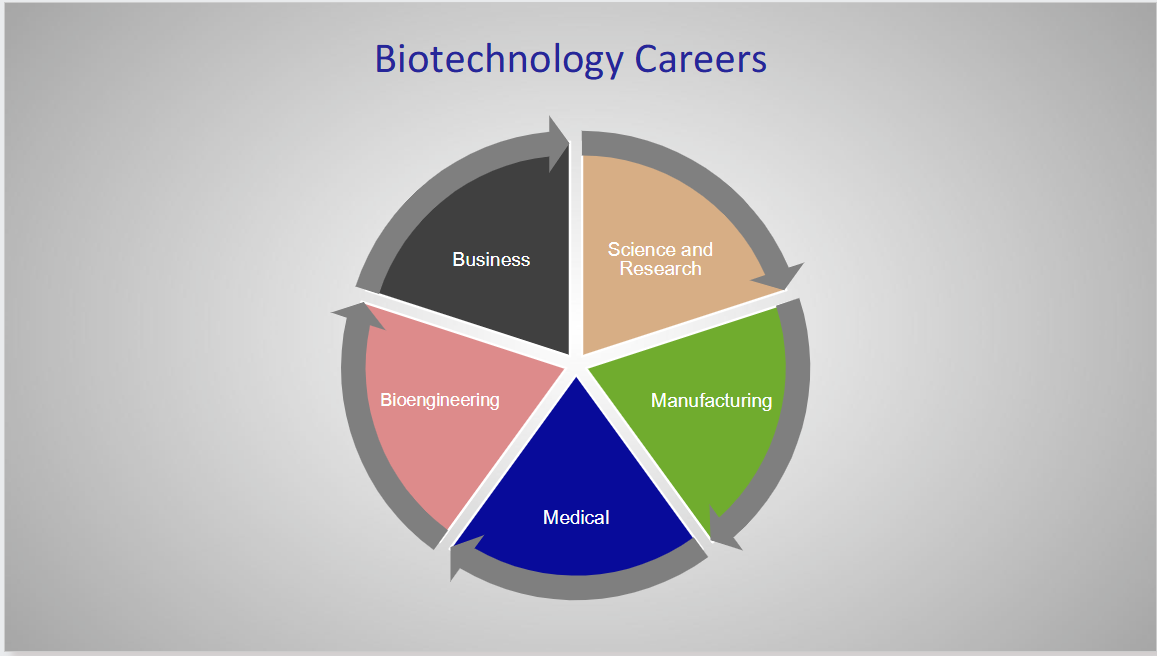
Biotechnology Careers
Business
Science and Research
Manufacturing
Medical
Bioengineering
Biotechnology Careers
Business
Science and Research
Manufacturing
Medical
Bioengineering

Biotechnology Careers
Biochemist
Bioinformatics
Computational biologist
Genetic engineer
Microbiologist
Biological / laboratory technician
Bioprocess engineer
Biochemist
Studies chemical processes for drug development
A biochemist is a scientist who studies the chemical processes and substances that occur within living organisms
Bioinformatics
Analyzes biological data using computational tools
bioinformatics is the use of computer science, mathematics, and statistics to collect, store, analyze, and interpret large sets of biological data—most commonly DNA, RNA, and protein sequences
Computational biologist
Use algorithims and models to understand biological systems, often working on projects involving complex data analysis
a scientist who applies computer science, mathematics, and statistics to analyze large biological datasets, build mathematical models, and run simulations to understand complex living systems
Genetic engineer
Modifies the genes of organisms to develop crops
genetic engineering is the deliberate manipulation, modification, or recombination of an organism's DNA to alter its genotype and achieve desired traits. A genetic engineer is a scientist who uses biotechnology tools to cut, paste, copy, or edit these genetic sequences
Microbiologist
Studies microorganisms to develop vaccines, waste treatment, identify infections
a scientist who studies microscopic organisms—including bacteria, viruses, fungi, algae, and protozoa—and how they interact with humans, other living organisms, and the environment
Biological/laboratory technician
Performs experiments procedures to support research projects
and biomanufacturing
a scientific support professional who assists biological and medical scientists by preparing samples, operating lab equipment, running experiments, and recording data
Bioprocess engineer
Large-scale production of biological products
a specialist who designs, develops, and scales up manufacturing systems that use living cells, bacteria, or biological molecules (like enzymes) to create commercial products
Somatic cell nuclear transfer (SCNT)
A laboratory cloning technique in which the diploid nucleus of a somatic (body) cell is transferred into an enucleated egg cell (an egg cell that has had its own haploid nucleus removed)
a laboratory cloning technique in which the diploid nucleus of a somatic (body) cell is transferred into an enucleated egg cell (an oocyte that has had its own haploid nucleus removed)
How the Process Works
Enucleation: scientists remove and discard the haploid (n) nucleus from an unfertilized donor egg cell
Nuclear Transfer: a diploid (2n) nucleus is extracted from a specialized somatic cell (such as a skin or mammary cell) of the organism to be cloned and inserted into the empty egg
Reprogramming & Activation: cytoplasmic factors inside the egg reprogram the differentiated somatic nucleus back to an embryonic state, and an electric shock or chemical stimulus triggers mitotic cell division to form an early embryo (blastocyst)
Reproductive Cloning: the resulting blastocyst is implanted into the uterus of a surrogate mother to develop into a full organism genetically identical to the nuclear donor (famously demonstrated with Dolly the sheep in 1996)
