Plant tissues
 Call Kai
 Learn
 Practice Test
 Spaced Repetition
 Match
 Flashcards
 Knowt Play
1/22

There's no tags or description
Looks like no tags are added yet.
23 Terms
Two main groups of plant tissues
Meristematic tissue and permanent tissue.
- Meristematic tissue
Actively dividing tissue responsible for plant growth.
- Apical meristem
Meristematic tissue found at the growing tips of roots and stems; increases length.
- Lateral meristem (cambium)
Tissue responsible for increasing the thickness or width of roots and stems.
Permanent tissue
Differentiated plant tissue with specific functions.
Epidermal tissue
A single layer of thin-walled, brick-shaped cells that protects the inner tissues.

- Guard cells
Specialised epidermal cells that control the opening and closing of stomata.
- Root hairs
Specialised epidermal cells that absorb water and mineral salts from the soil.
Parenchyma
Thin-walled, irregularly shaped cells found in roots and stems; acts as packing and storage tissue.

Other functions of parenchyma
Air spaces between cells allow movement of water and gases.
- Chlorenchyma
Parenchyma tissue containing chloroplasts.
Collenchyma
Closely packed cells with thick walls that provide strength and support to aerial parts of the plant.

Sclerenchyma
Thick-walled cells strengthened with lignin that provide strength and support.
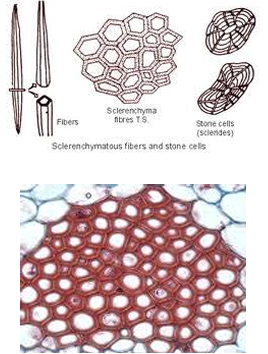
- Two types of sclerenchyma cells
Sclerenchyma fibres and stone cells.
- Characteristics of sclerenchyma
Cells are closely packed, thick-walled, lignified and dead at maturity.
Xylem
Complex vascular tissue that transports water and mineral salts from roots to the rest of the plant.

- Xylem vessels
Dead, hollow cells joined end-to-end to form continuous tubes for water transport.
- Tracheids
Elongated xylem cells with tapered ends and lignified walls.
- Other function of xylem
Provides strength and mechanical support to the plant.
- Phloem
Complex vascular tissue that transports manufactured food from leaves to other parts of the plant.
- Sieve tube elements
Living, elongated phloem cells with perforated cross walls and no nuclei.
- Companion cells
Nucleated cells attached to sieve tubes that control their functioning.
- Vascular tissue
The collective name for xylem and phloem. /