Lecture 3: Synaptic Process
 Call Kai
 Learn
Learn Practice Test
 Spaced Repetition
 Match
Match Flashcards
 Knowt Play
1/18

There's no tags or description
Looks like no tags are added yet.
Name | Mastery | Learn | Test | Matching | Spaced | Call with Kai | Chat |
|---|
No analytics yet
Send a link to your students to track their progress
19 Terms
Where are sodium and potassium more concentrated?
Sodium - outside the Cell
Potassium - inside the Cell

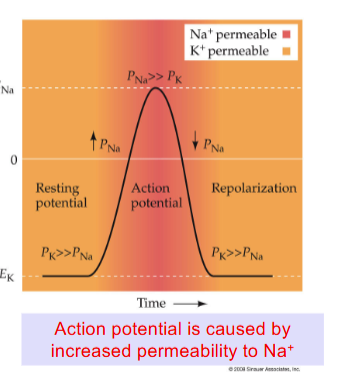
Ionic permeability is ____ dependent.
voltage
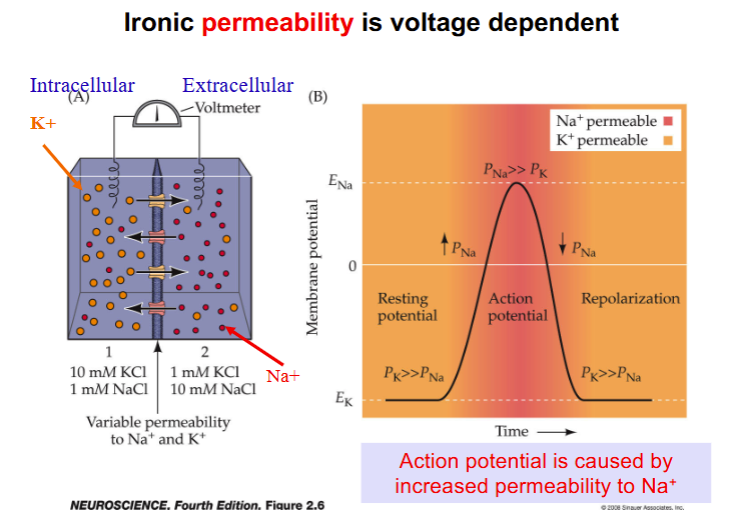

fill in the chart
The ____ axon terminal connects with the _____ dendrite spines to create a synapse.
The presynaptic axon terminal connects with the postsynaptic dendrite spines to create a synapse.
What is the difference between electrical and chemical synapse
Electrical Synapse: The cell bodies are directly connected through connexons, allowing for ions to directly flow from cell to cell, rarer
Chemical Synapse: AP travels to axon terminal and causes the release of chemicals called neurotransmitters which bind with receptors on post synaptic cell which can cause depolarization/repolarization
what is the connection point of electrical synapses called?
gap junctions
What is the function of gap junctions at electrical synapses?
transmission of ions at quick speeds
What are the advantages of electrical synapses?
transmission is extraordinarily fast, transmission can be bidirectional

Transmitter is synthesized and then stored in ____
An Action Potential invades the ____ terminal
____ of presynaptic terminal causes opening of voltage-gated __ channels
___ of ___ through channels
Ca2+ causes vesicles to ____ with presynaptic membrane
____ is released into synaptic cleft via exocytosis
Transmitter binds to receptor molecules in the ____ membrane
Opening or Closing of ____ ____
Postsynaptic current causes ___ or ___ PSPs that changes the ____ of the postsynaptic cell
Removal of Neurotransmitter by ____ ____ or ____ ___
Retrieval of ____ membrane from Plasma Membrane
Transmitter is synthesized and then stored in vesicles
An Action Potential invades the presynaptic terminal
Depolarization of presynaptic terminal causes opening of voltage-gated Ca2+ channels
Influx of Ca2+ through channels
Ca2+ causes vesicles to fuse with postsynaptic membrane
Transmitter is released into synaptic cleft via exocytosis
Transmitter binds to receptor molecules in the presynaptic membrane
Opening or Closing of postsynaptic channels
Postsynaptic current causes Excitatory or Inhibitory PSPs that changes the excitability of the postsynaptic cell
Removal of Neurotransmitter by glial uptake or enzymatic degradation
Retrieval of vesicular membrane from Plasma Membrane
What are MEPPs
Miniatur EPPs
EPPs represent the ____ ____ of many MEPP-like units
EPPs represent the simultaneous release of many MEPP-like units

How do Synaptic Vesicles get recycled?

What is the role of Calcium in Transmitter Secretion?
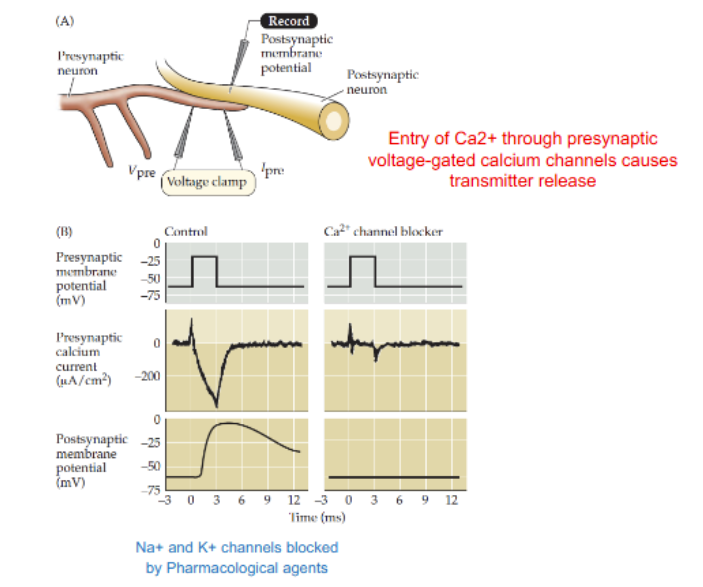
Entry of Ca2+ through presynaptic voltage-gated calcium channels causes transmitter release
What is Reversal Potential?
the voltage at which the direction of the current changes from inward to outward
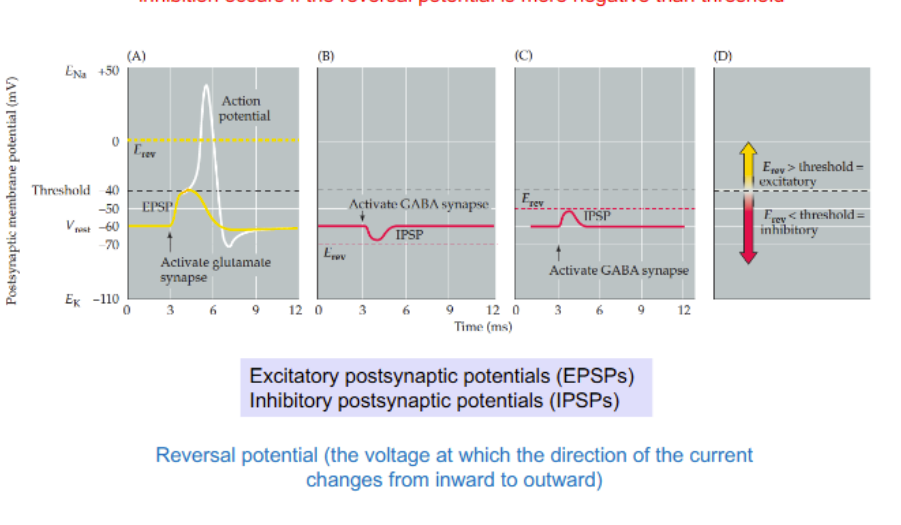
If the reversal potential is more ____ than threshold, excitation results;
inhibition occurs if the reversal potential is more _____ than threshold
If the reversal potential is more positive than threshold, excitation results;
inhibition occurs if the reversal potential is more negative than threshold

What causes action potential in Postsynaptic neuron?
Summation of EPSPs and IPSPs

What are the types of Summation?
Spatial summation (Many PSPs in different locations of dendrites summing up)
Temporal Summation (Many PSPs in the same location at a high frequency, leading to summation)
Electrical Properties of Neurons
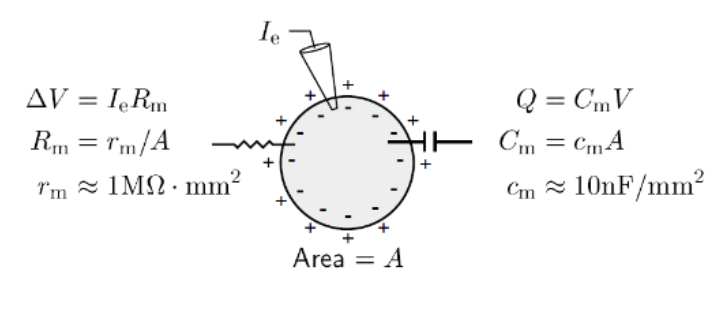
What is the Single-Compartmet Neuron Model?
