6.2 Finishing GWAS and an introduction to selection
 Call Kai
 Learn
Learn Practice Test
 Spaced Repetition
 Match
Match Flashcards
 Knowt Play
1/12

There's no tags or description
Looks like no tags are added yet.
Name | Mastery | Learn | Test | Matching | Spaced | Call with Kai | Chat |
|---|
No analytics yet
Send a link to your students to track their progress
13 Terms
Which of the following is the unit used to study haplogroup relationships?
a) Single nucleotide polymorphisms (SNPs)
b) Haplotypes
c) Insertions
d) Deletions
e) Inversions
b) Haplotypes
Positive selection
The tendency for advantageous alleles (and traits) to increase in frequency over generational time (favoring in advantageous variant)
low genetic diversity and longer haplotypes in the region being selected for
referred to as a ‘selective sweep’

Hard selective sweeps
occur soon after the mutation arises, causing a single haplotype to dominate that locus in the genome, which reduces genetic diversity outside of the selected for SNP
significantly reduces neutral polymorphism

Soft selective sweeps
occur when multiple beneficial haplotypes increase in frequency simultaneously, those
different haplotypes can be from standing variation or convergent evolutionThe differences between starting haplotypes means that the reduction in polymorphism is less
can arise from the same mutation happening in different haplotypes, or a single mutation happening in the ancestor that evolved neutrally before being selected for, allowing for it to be put on different haplotypes
will cause a decrease in nucleotide variation, and an increase in nearby haplotype size, these variables can be used to identify regions of the genome under selection

Neutral polymorphism
is the average number of nucleotide differences per site between two DNA sequences
just think of it as the background mutation rate for the species
The lower genetic diversity is illustrated on the bottom
has a reverse bell curve because recombination drives both shapes
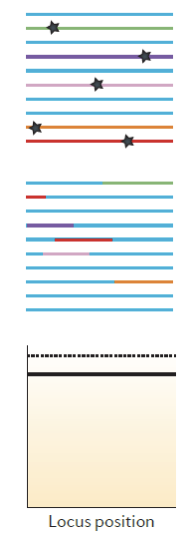
Negative (purifying) selection
is the purging of deleterious variants
will reduce the overall genetic diversity of the surrounding region but will not affect linkage disequilibrium
can be difficult to observe a ‘peak’ or ‘dip’ if nucleotide divergence compared to background

Balancing selection
the selection (favoring) for the heterozygote state
ex: the MHC locus (immune diversity) and the sickle-cell mutation in the beta hemoglobin gene (HBB)

Nucleotide diversity
π is the symbol used to talk about —- in a population
the average number of nucleotide differences per site between two DNA sequences in the sample population
DNA sequences being compared can be a gene, haplotype, chromosome, or entire genome
Genetic drift
the change in allele frequency between generations due to random chance
“Fixation” refers to an allele reaching 100% allele frequency
In small populations, inbreeding is inevitable and will cause some alleles to become fixed while others are lost
will lead to issues over time as already discussed for inbreeding:
Genetic drift is heavily influenced by population size
Larger population sizes will not have this problem and are generally considered healthier over evolutionary time
one of the assumptions of Hardy-Weinberg equilibrium
This also means advantageous alleles may be lost before they can be selected for in small populations
You are studying the emergence of resistance to dichlorodiphenyltrichloroethane (DDT) in wild Drosophila populations. You observe that two subpopulations have become resistant to DDT. Around the Cytochrome P450 gene in these populations compared to others, you observe longer haplotypes and fewer neutral mutations. What type of selection do you appear to be observing?
A) Negative Selection
B) Positive Selection
C) Balancing Selection
D) Genetic Drift
B) Positive Selection
RNA polymerase is an essential gene that cannot tolerate even slightly deleterious mutations. What type of selection maintains the sequence of this gene?
A) Negative Selection
B) Positive Selection
C) Balancing Selection
D) Genetic Drift
A) Negative Selection
You are studying a species of rodent where the ancestral population was split into two subpopulations by an earthquake. The western population has 15 individuals, while the Eastern population has 7,500. Assuming equal starting genetic diversity, which population has a higher likelihood of a deleterious mutation reaching 100% allele frequency?
A) Western
B) Eastern
C) Not enough information
A) Western